Key facts
- Dates
- 2–5 Aug 2027 (4 days)
- Where
- Seoul, South Korea
- Fee per participant
- £2,750 (GBP)
- Payment
- By invoice and bank transfer
- Registration closes
- 23 Jun 2027
- Format
- 4-day short course: a practical capacity-building programme for government, NGO and project teams in Seoul
- Groups
- Teams of 3 or more qualify for a group discount, offered case by case: ask for a group quote.
- In-house option
- Run it for your team, on your dates
On this page 10 sections
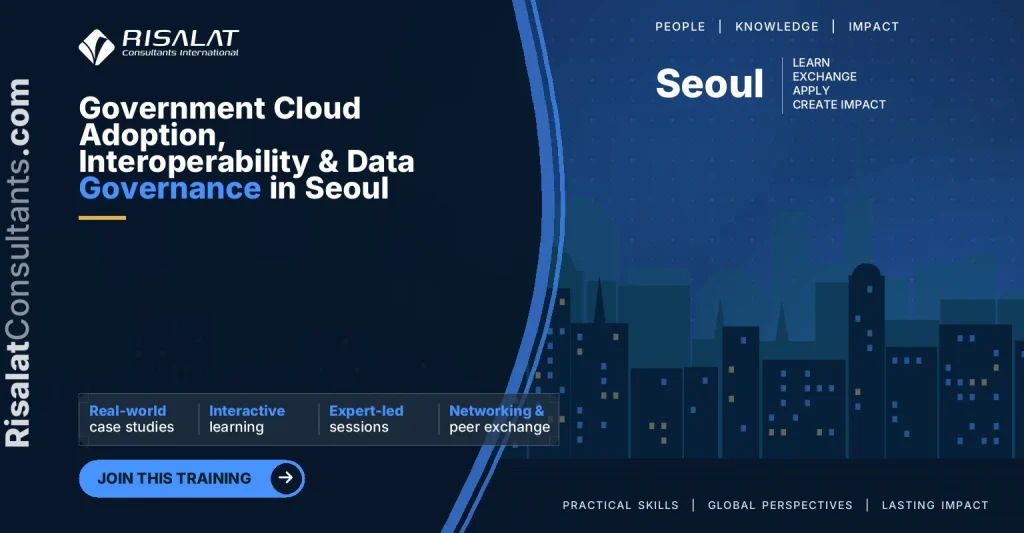
Government Cloud Adoption, Interoperability & Data Governance in Seoul
Programme Overview
Government agencies face mounting pressure to modernise legacy digital infrastructure while ensuring robust public data protection, sovereign control, and system cohesion. This executive training programme in Seoul equips public sector leaders with practical capabilities to navigate government cloud adoption, whole-of-government interoperability, and cross-agency data governance. Participants examine real-world architectures, procurement structures, and institutional policies essential for delivering secure, scalable, and citizen-centric digital public administration systems in alignment with international digital government standards.
Free self-check: the governance self-audit gives a quick check of governance, controls and accountability, in about 10 minutes.
The curriculum systematically explores open data exchange architectures, digital interoperability stacks, and enterprise application programming interface (API) management frameworks. Drawing operational insights from advanced digital public administration implementations, sessions focus on transitioning from fragmented IT silos into unified, shared-services environments. Participants analyse trusted technical reference architectures, government service buses, microservices patterns, and data classification regimes necessary to balance cross-border data security, agency autonomy, and rapid digital service integration.
Tailored to the practical realities of donor-funded public sector modernisation initiatives, such as reforms supported by the Philippines Second Digital Transformation Development Policy Loan, the course provides hands-on methods for policy design, cloud procurement, and technical risk management. Delivered by Risalat Consultants International in Seoul, South Korea, it combines expert-led sessions, real cases, and group work to help public sector architects and directors structure cloud service level agreements, enforce data protection mandates, and coordinate multi-agency digital reforms.
The programme strengthens institutional capability in:
- Sovereign cloud requirements, multi-cloud models, and public agency migration strategies
- Assessing legacy ministerial infrastructure and evaluating cloud readiness using standard maturity models
- Cloud-first policy formulation: balancing central control with line agency autonomy
- Structuring cloud procurement contracts, pricing models, and public sector service level agreements
- Practical design session: drafting agency-level cloud migration roadmaps and exit strategies
- Architectural layers of whole-of-government interoperability: technical, semantic, and legal stacks
- Data exchange backbones: evaluating government service buses, publish-subscribe queues, and secure distributed ledgers
- Secure API gateway management: protocols, rate limiting, and interface documentation using OpenAPI standards
- Digital strategy and transformation planning
- Data governance and data quality
- Data analysis and visualisation
- Cybersecurity basics and risk management
Why this matters now
Organisations increasingly require professionals capable of:
- Plan digital initiatives that solve real problems
- Manage data quality, protection and sharing
- Analyse data and present it clearly
- Manage cyber and technology risks
- Lead people through digital change
Strong digital government, data and technology systems help organisations:
- Deliver faster and more accessible services
- Make better use of data in decisions
- Protect systems and personal data
- Get value from technology investments
Who Should Attend
This programme is designed for:
- Department of Information and Communications Technology (DICT) enterprise architects
- Public digital reform and modernization team leads
- Central government agency MIS and IT directors
- National digital identification and registry technical specialists
- Government data protection officers and chief information security officers
- Project implementation unit (PIU) managers for World Bank and ADB projects
- E-government service delivery and digital portal technical coordinators
- Public procurement specialists handling IT and cloud service contracts
- State auditing and public sector digital compliance officers
- ICT managers and officers
- Digital transformation leads
- Data analysts and statisticians
Tick what your team needs to be able to do.
Programme Objectives
By the end of this programme participants will be able to:
- Evaluate whole-of-government cloud adoption frameworks, deployment models, and migration approaches for core public administration registries
- Design open data exchange architectures and secure API gateway frameworks using international interoperability standards such as e-GIF and TOGAF
- Establish public agency data governance protocols, metadata registries, and national data classification frameworks that align with data privacy legislation
- Structure public procurement processes, tender specifications, and service level agreements for commercial and sovereign cloud infrastructure
- Implement technical controls for zero trust architectures, identity federation, and cryptographic protection across inter-agency public networks
- Formulate institutional change management strategies and cross-ministerial coordination mechanisms required to enforce shared digital infrastructure mandates
- Draft an integrated technical and policy roadmap for agency-level modernization in compliance with international development financing requirements
- Explain the main trends in digital government and data use
- Plan a digital initiative linked to service goals
- Apply data governance and quality principles
Training Structure & Contents
- Sovereign cloud requirements, multi-cloud models, and public agency migration strategies
- Assessing legacy ministerial infrastructure and evaluating cloud readiness using standard maturity models
- Cloud-first policy formulation: balancing central control with line agency autonomy
- Structuring cloud procurement contracts, pricing models, and public sector service level agreements
- Practical design session: drafting agency-level cloud migration roadmaps and exit strategies
- Workshop: Applying cloud adoption strategies and architectural blueprints to your institution
- Architectural layers of whole-of-government interoperability: technical, semantic, and legal stacks
- Data exchange backbones: evaluating government service buses, publish-subscribe queues, and secure distributed ledgers
- Secure API gateway management: protocols, rate limiting, and interface documentation using OpenAPI standards
- Cross-agency identity federation, OAuth2, and integration with national digital ID platforms
- Architecture lab: mapping cross-agency data pipelines and service integration endpoints
- Workshop: Applying interoperability and open data exchange models to your institution
- Establishing national data governance: roles of chief data officers, data stewards, and custodial mandates
- Data classification frameworks: handling open, confidential, restricted, and top-secret public records
- Zero trust architecture principles and ISO/IEC 27001 controls applied to government shared services
- Data residency, national privacy compliance, and handling auditability for sovereign registries
- Risk mitigation clinic: structuring incident response and continuity plans for national digital assets
- Case Study: Data governance, security architecture, and compliance frameworks in practice
- Aligning digital modernization projects with donor-financed operations and development policy loans
- Defining institutional key performance indicators for digital service uptake and platform uptime
- Overcoming bureaucratic resistance, procurement friction, and inter-agency coordination barriers
- Developing total cost of ownership models for shared public administration digital infrastructure
- Participant presentations: defensible cloud adoption and interoperability roadmaps
- Capstone Exercise: Formulating an institutional action plan with priorities, owners, and initial steps
- Consolidation of whole-of-government cloud architecture and interoperability roadmaps
- Review of cross-border data security, agency autonomy, and digital service integration standards
- Refinement of institutional cloud procurement specifications and service level agreements
- Finalisation of public sector data governance frameworks and metadata registries
- Peer review and facilitator feedback on institutional modernization roadmaps
Full day-by-day contents
First Day | Government Cloud Adoption Strategy and Architectural Blueprints
- Sovereign cloud requirements, multi-cloud models, and public agency migration strategies
- Assessing legacy ministerial infrastructure and evaluating cloud readiness using standard maturity models
- Cloud-first policy formulation: balancing central control with line agency autonomy
- Structuring cloud procurement contracts, pricing models, and public sector service level agreements
- Practical design session: drafting agency-level cloud migration roadmaps and exit strategies
- Workshop: Applying cloud adoption strategies and architectural blueprints to your institution
Second Day | Whole-of-Government Interoperability and Open Data Exchange
- Architectural layers of whole-of-government interoperability: technical, semantic, and legal stacks
- Data exchange backbones: evaluating government service buses, publish-subscribe queues, and secure distributed ledgers
- Secure API gateway management: protocols, rate limiting, and interface documentation using OpenAPI standards
- Cross-agency identity federation, OAuth2, and integration with national digital ID platforms
- Architecture lab: mapping cross-agency data pipelines and service integration endpoints
- Workshop: Applying interoperability and open data exchange models to your institution
Third Day | Data Governance, Security Architecture, and Compliance Frameworks
- Establishing national data governance: roles of chief data officers, data stewards, and custodial mandates
- Data classification frameworks: handling open, confidential, restricted, and top-secret public records
- Zero trust architecture principles and ISO/IEC 27001 controls applied to government shared services
- Data residency, national privacy compliance, and handling auditability for sovereign registries
- Risk mitigation clinic: structuring incident response and continuity plans for national digital assets
- Case Study: Data governance, security architecture, and compliance frameworks in practice
Fourth Day | Roadmap Formulation, Implementation Monitoring, and Donor Alignment
- Aligning digital modernization projects with donor-financed operations and development policy loans
- Defining institutional key performance indicators for digital service uptake and platform uptime
- Overcoming bureaucratic resistance, procurement friction, and inter-agency coordination barriers
- Developing total cost of ownership models for shared public administration digital infrastructure
- Participant presentations: defensible cloud adoption and interoperability roadmaps
- Capstone Exercise: Formulating an institutional action plan with priorities, owners, and initial steps
Fifth Day | Synthesis, Policy Integration, and Institutional Action Planning
- Consolidation of whole-of-government cloud architecture and interoperability roadmaps
- Review of cross-border data security, agency autonomy, and digital service integration standards
- Refinement of institutional cloud procurement specifications and service level agreements
- Finalisation of public sector data governance frameworks and metadata registries
- Peer review and facilitator feedback on institutional modernization roadmaps
Training Methodology
The training is delivered through intensive, practitioner-led modules combining comparative international case studies, architectural breakdown exercises, and hands-on planning sessions to enable direct institutional application.
- Expert-led instructional briefings and interactive presentations
- Architectural breakdown labs and technical mapping exercises
- Comparative review of international public administration case studies
- Small-group collaborative workshops addressing institutional scenarios
- Development of actionable roadmaps and institutional action plans
- Collect
- Clean
- Store
- Analyse
- Decide
Expected Outcomes
- Capabilities to establish whole-of-government cloud adoption frameworks and sovereign deployment strategies
- Practical competence in designing open data exchange architectures and secure API gateway systems
- Ability to institute national data governance protocols, metadata registries, and robust classification schemes
- Skills to negotiate and manage public procurement tenders, pricing structures, and cloud service level agreements
- Working knowledge of zero trust architectures, identity federation, and cross-agency data security controls
- Completed institutional modernization action plans aligned with international donor governance requirements
£2,750 per participant · invoice and bank transfer · groups of 5 or more receive a discount
Five or more from one organisation: ask for the group rate on the invoice request.
Ten or more: an in-house version for your institution may cost less per person. Ask for an in-house quote.
Registration closes in 206 days (23 Jun 2027)
Who Will Deliver This Programme
Each date is delivered by a team assigned from Risalat's expert network for this subject. For this programme we assign:
How we choose them: Experience in the region of the participants or comparable settings; Command of the financier rules that apply (World Bank, ADB, AfDB, EU, UN) where relevant; Delivery in English; other languages on request for in-house groups; No conflict of interest with participants' institutions.
Training courses in SeoulTechnology training courses
Why Seoul for this programme
Seoul is a leader in e-government and e-procurement, ideal for digital transformation study visits.
The Government Cloud Adoption, Interoperability & Data Governance in Seoul programme in August 2027 brings together officials and professionals from across the Asia region and beyond. Sessions combine short inputs, case studies and group work on participants' own files, and the city's institutions can be added as a study visit on request.
Getting there: Incheon (ICN).
Check whether you need a visa with the free Visa Checker, and ask for an invitation letter once you are registered.
The same topic in other cities
- AI and Data Governance for the Public Sector in Gozo (Gozo)
- AI for Smart Cities and Urban Services Training in Barcelona (Barcelona)
- Digital Government and Citizen e-Services Training for North African Officials in Sliema (Sliema)
- Integrating AI into Public Services: From Pilot to Scale Training in Tallinn (Tallinn)
- Digital Health Insurance Platform Architecture and PMO Operations in Tallinn (Tallinn)
- Digital Financial Infrastructure & Capital Market Modernisation in Singapore (Singapore)
Other programmes in Seoul
- Data Governance and AI-Ready Data for Institutions Training in Seoul
- Hospital Infection Prevention and Clinical Facility Readiness in Seoul
- Digital Land Administration and Cadastral Parcel Mapping in Seoul
- Modern Cadastral Surveying & Integrated Land Information Systems in Seoul
- Inter-Urban Freight Corridor Logistics and Rural Road Asset Maintenance in Seoul
Questions before you nominate your team? Book a 30-minute call with us, or ask for this programme in-house.
- Open Contracting Partnership Open Contracting Partnership
- OECD (Organisation for Economic Co-operation and Development) OECD
Is there data, ai and analytics training for government officials in Seoul in August 2027?
Can "Government Cloud Adoption, Interoperability & Data Governance in Seoul" be delivered in-house for one organisation?
Which other data, ai and analytics programmes does Risalat run?
How do organisations register and pay?
For teams and institutions
Bring your team
Teams that learn together apply more at work. Tell us how many people and how you would like to take part: we reply with a group quote within two working days.
Watch: this programme in short


Other dates and cities for this subject: Digital Government and Data Governance training courses (123 upcoming dates).
More training courses in South Korea · All programmes in Asia · Full training calendar
Plan this programme in a roadmap: why it matters, why to approve it, the dates to plan and the career it builds.