Key facts
- Dates
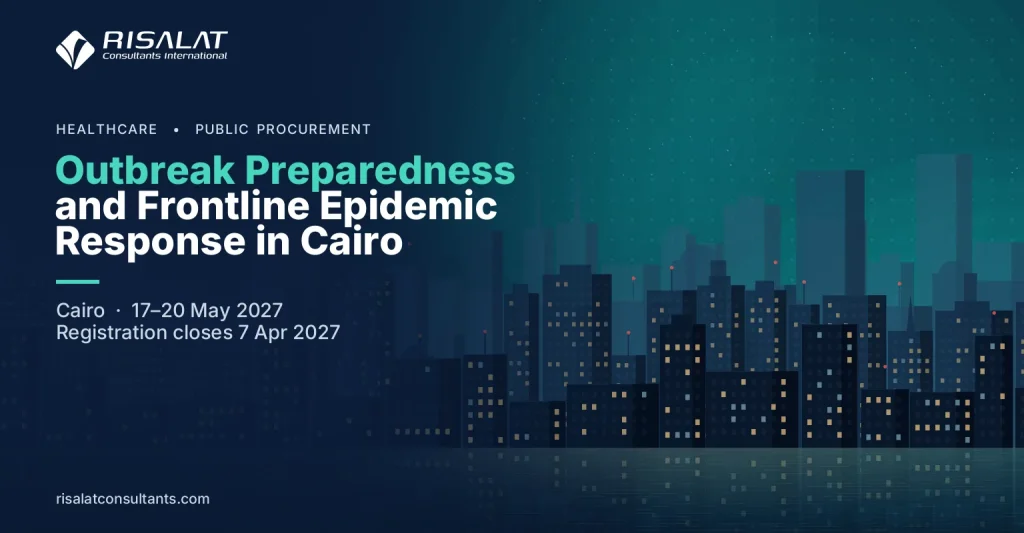
- 17–20 May 2027 (4 days)
- Where
- Cairo, Egypt
- Fee per participant
- £2,350 (GBP)
- Payment
- By invoice and bank transfer
- Registration closes
- 7 Apr 2027
- Format
- 4-day short course: a practical capacity-building programme for government, NGO and project teams in Cairo
- In-house option
- Run it for your team, on your dates
On this page 10 sections
Outbreak Preparedness and Frontline Epidemic Response in Cairo
Programme Overview
Health systems facing acute humanitarian disruptions require robust capacities to identify, isolate, and contain infectious disease threats before they overwhelm communities. This four-day intensive programme equips technical leaders with essential tools to maintain disease surveillance, deploy mobile emergency teams, and manage frontline triage systems. By focusing on practical interventions suited to high-risk environments, participants master standard operational workflows required to secure health delivery amidst compromised civic infrastructure.
Free self-check: the governance self-audit gives a quick check of governance, controls and accountability, in about 10 minutes.
The curriculum addresses the operational realities of establishing resilient alert networks and coordinating immediate containment interventions. Participants examine established World Health Organisation standards for Early Warning, Alert and Response Systems alongside international outbreak guidelines. Practical exercises emphasise the management of frontline field facilities, the safeguarding of medical supply lines, and the rapid establishment of reliable triage mechanisms when physical hospital installations are inoperative or inaccessible.
Delivered by Risalat Consultants International in Cairo, Egypt, this programme offers an immersive learning environment for technical personnel directly involved in emergency health planning. Professionals analyse empirical field scenarios, design standard operating procedures for rapid deployment, and adapt infection prevention measures to complex frontline conditions. The training strengthens institutional capacity to implement donor-financed emergency health priorities, ensuring frontline teams can mount coherent, technically sound responses to sudden epidemic escalations.
The programme strengthens institutional capability in:
- Assessment of Early Warning, Alert and Response System protocols during system displacement
- Community-based disease surveillance models and informal notification pathways
- Case definitions and syndromic surveillance under severe diagnostic laboratory constraints
- Data verification, threshold calculation, and outbreak signal validation procedures
- Risk mapping for waterborne and vector-borne pathogens across displaced populations
- Composition, mandate, and rapid mobilisation SOPs for multidisciplinary investigation teams
- Field investigation logistics: safety, essential supplies, and immediate specimen management
- Conducting rapid contact tracing and active case finding in volatile urban settings
- Procurement planning and market analysis
- Choosing procurement methods and approaches
- Writing specifications and terms of reference
- Bidding documents and evaluation criteria
Why this matters now
Organisations increasingly require professionals capable of:
- Plan procurement that matches project needs and timelines
- Prepare clear specifications and evaluation criteria
- Evaluate bids consistently and defend the decision
- Manage contracts, variations and performance
- Keep complete records for audit and review
Strong procurement and contract management systems help organisations:
- Reduce procurement delays and failed tenders
- Achieve value for money
- Lower the risk of complaints and audit findings
- Deliver contracts on time and to quality
Who Should Attend
This programme is designed for:
- Epidemiologists monitoring communicable disease surveillance systems
- Clinical team leaders operating in emergency and field clinics
- Ministry of Health directors managing disease control programmes
- Public health emergency operations centre technical personnel
- Surveillance officers managing early warning and response networks
- Medical coordinators for international and local humanitarian operations
- Infection prevention and control leads in crisis-affected facilities
- Health cluster technical focal points and emergency project managers
- Procurement officers and managers
- Contract managers and administrators
- Project and programme managers
- PIU procurement specialists
Tick what your team needs to be able to do.
Programme Objectives
By the end of this programme participants will be able to:
- Evaluate early detection alert systems and syndromic reporting mechanisms under conditions of limited connectivity
- Structure rapid response health teams to conduct timely field verifications and community-level containment
- Design field clinic triage procedures to manage mass casualty and infectious disease influxes safely
- Formulate rapid deployment protocols to control epidemic surges amidst severely damaged hospital infrastructure
- Apply international infection prevention and control standards within temporary healthcare and isolation units
- Establish resilient cold chain and medical supply contingency plans for frontline treatment centres
- Coordinate frontline epidemic operational data reporting in alignment with humanitarian health cluster mechanisms
- Explain the procurement cycle and the rules that apply to it
- Prepare a procurement plan linked to project timelines
- Choose a suitable method and approach to the market
Training Structure & Contents
- Assessment of Early Warning, Alert and Response System protocols during system displacement
- Community-based disease surveillance models and informal notification pathways
- Case definitions and syndromic surveillance under severe diagnostic laboratory constraints
- Data verification, threshold calculation, and outbreak signal validation procedures
- Risk mapping for waterborne and vector-borne pathogens across displaced populations
- Surveillance Architecture and Early Warning Systems in Insecure Contexts practical workshop
- Composition, mandate, and rapid mobilisation SOPs for multidisciplinary investigation teams
- Field investigation logistics: safety, essential supplies, and immediate specimen management
- Conducting rapid contact tracing and active case finding in volatile urban settings
- Micro-planning for localised reactive vaccination campaigns and targeted chemoprophylaxis
- Risk communication, community engagement, and rumour management during active crises
- Rapid Response Teams and Immediate Field Containment institutional application workshop
- Emergency clinical triage pathways: separation of suspect, probable, and confirmed cases
- Rapid conversion of non-clinical structures into functional isolation and treatment units
- Infection prevention and control barriers, water sanitation, and medical waste disposal
- Clinical management protocols for acute watery diarrhoea and viral haemorrhagic fevers
- Maintaining healthcare worker protection and occupational safety in improvised facilities
- Field Triage Systems and Clinical Care amidst Infrastructure Damage case study analysis
- Last-mile medical logistics: securing essential treatment kits and maintaining cold chain continuity
- Standard operating procedures for mobile clinic deployment in high-density informal camps
- Inter-agency coordination, Health Cluster reporting, and information management sharing
- Monitoring and evaluating frontline clinical quality indicators under emergency conditions
- Simulation exercise: formulating an integrated rapid response deployment plan
- Capstone Exercise: Outbreak Preparedness and Frontline Epidemic Response action planning
- Cross-border epidemic tracking and multi-jurisdictional notification workflows
- Resource mobilisation and emergency procurement under humanitarian cluster financing
- Health emergency operations centre integration with local primary care networks
- Standard operating procedures for emergency triage during concurrent armed conflict
- Community engagement strategies to combat vaccine hesitancy in displaced settings
- Institutional handover, operational evaluation, and post-epidemic review processes
Full day-by-day contents
First Day | Surveillance Architecture and Early Warning Systems in Insecure Contexts
- Assessment of Early Warning, Alert and Response System protocols during system displacement
- Community-based disease surveillance models and informal notification pathways
- Case definitions and syndromic surveillance under severe diagnostic laboratory constraints
- Data verification, threshold calculation, and outbreak signal validation procedures
- Risk mapping for waterborne and vector-borne pathogens across displaced populations
- Surveillance Architecture and Early Warning Systems in Insecure Contexts practical workshop
Second Day | Rapid Response Teams and Immediate Field Containment
- Composition, mandate, and rapid mobilisation SOPs for multidisciplinary investigation teams
- Field investigation logistics: safety, essential supplies, and immediate specimen management
- Conducting rapid contact tracing and active case finding in volatile urban settings
- Micro-planning for localised reactive vaccination campaigns and targeted chemoprophylaxis
- Risk communication, community engagement, and rumour management during active crises
- Rapid Response Teams and Immediate Field Containment institutional application workshop
Third Day | Field Triage Systems and Clinical Care amidst Infrastructure Damage
- Emergency clinical triage pathways: separation of suspect, probable, and confirmed cases
- Rapid conversion of non-clinical structures into functional isolation and treatment units
- Infection prevention and control barriers, water sanitation, and medical waste disposal
- Clinical management protocols for acute watery diarrhoea and viral haemorrhagic fevers
- Maintaining healthcare worker protection and occupational safety in improvised facilities
- Field Triage Systems and Clinical Care amidst Infrastructure Damage case study analysis
Fourth Day | Deployment Protocols, Supply Chains, and Coordinated Response
- Last-mile medical logistics: securing essential treatment kits and maintaining cold chain continuity
- Standard operating procedures for mobile clinic deployment in high-density informal camps
- Inter-agency coordination, Health Cluster reporting, and information management sharing
- Monitoring and evaluating frontline clinical quality indicators under emergency conditions
- Simulation exercise: formulating an integrated rapid response deployment plan
- Capstone Exercise: Outbreak Preparedness and Frontline Epidemic Response action planning
Fifth Day | Coordinated Epidemic Governance and Operational Consolidation
- Cross-border epidemic tracking and multi-jurisdictional notification workflows
- Resource mobilisation and emergency procurement under humanitarian cluster financing
- Health emergency operations centre integration with local primary care networks
- Standard operating procedures for emergency triage during concurrent armed conflict
- Community engagement strategies to combat vaccine hesitancy in displaced settings
- Institutional handover, operational evaluation, and post-epidemic review processes
Training Methodology
The training employs an operational and participatory adult-learning methodology grounded in real-world humanitarian scenarios. Participants work through table-top simulation exercises, technical case studies, and standard operating procedure development workshops. Facilitation combines expert presentations on international clinical standards with peer-to-peer technical reviews, enabling practitioners to adapt global best practice directly to the constraints of fragile, conflict-affected, and resource-depleted healthcare environments.
- Expert-led sessions on current practice
- Regional and international case studies
- Group work and practical exercises
- Simulations and role plays where relevant
- Discussion of participants’ own challenges
- Peer learning across institutions and countries
- Practical tools and templates to take back to work
- Daily reflection and action planning
- Pre-assessment to review roles and priorities
Expected Outcomes
- Strengthened technical competence in early outbreak detection and verification
- Operational ability to structure and mobilise multidisciplinary rapid response teams
- Proficiency in establishing emergency clinical triage and isolation pathways in damaged infrastructure
- Enhanced capacity to secure last-mile supply lines and cold chains in crisis environments
- Improved alignment with Health Cluster mechanisms and emergency reporting standards
- Practical procurement and contract management capabilities aligned with project timelines and audits
- Completed institutional action plan ready for immediate implementation
£2,350 per participant · invoice and bank transfer · groups of 5 or more receive a discount
Five or more from one organisation: ask for the group rate on the invoice request.
Ten or more: an in-house version for your institution may cost less per person. Ask for an in-house quote.
Registration closes in 130 days (7 Apr 2027)
Who Will Deliver This Programme
Each date is delivered by a team assigned from Risalat's expert network for this subject. For this programme we assign:
How we choose them: Experience in the region of the participants or comparable settings; Command of the financier rules that apply (World Bank, ADB, AfDB, EU, UN) where relevant; Delivery in English; other languages on request for in-house groups; No conflict of interest with participants' institutions.
Training courses in CairoHealthcare training courses
Why Cairo for this programme
Cairo is central for Arabic-speaking delegations from Africa and the Middle East.
The Outbreak Preparedness and Frontline Epidemic Response in Cairo programme in May 2027 brings together officials and professionals from across the Africa region and beyond. Sessions combine short inputs, case studies and group work on participants' own files, and the city's institutions can be added as a study visit on request.
Getting there: Cairo International (CAI).
Check whether you need a visa with the free Visa Checker, and ask for an invitation letter once you are registered.
The same topic in other cities
- Hospital Emergency Triage and Clinical Infection Containment in Bangkok (Bangkok)
- Public Health Surveillance and Epidemic Preparedness in Nairobi (Nairobi)
- Community-Based Infectious Disease Surveillance and Grassroots Outbreak Control in Hanoi (Hanoi)
- Pandemic Preparedness, Laboratory Systems and Emergency Health Logistics in Bangkok (Bangkok)
Other programmes in Cairo
- Emergency Nutrition Surveillance and Malnutrition Treatment Auditing in Cairo
- Social Registry Field Data Collection and Household Profiling in Cairo
- Smallholder Terracing, Spate Irrigation and Soil Conservation in Cairo
- Emergency Nutrition & Essential Health Package Delivery in Conflict in Cairo
- Dryland Water Harvesting and Pastoral Community Water Infrastructure in Cairo
Questions before you nominate your team? Book a 30-minute call with us, or ask for this programme in-house.
Teams often travel here from Jordan, Lebanon, Palestine, Yemen, Egypt, Libya, Sudan. Funding, visa letters and group rates are explained on each country page.
- Procurement Framework and Regulations for Projects World Bank
- MAPS: Methodology for Assessing Procurement Systems MAPS Initiative
Is there public procurement training for government officials in Cairo in May 2027?
Can "Outbreak Preparedness and Frontline Epidemic Response in Cairo" be delivered in-house for one organisation?
Which other public procurement programmes does Risalat run?
How do organisations register and pay?
For teams and institutions
Bring your team
Teams that learn together apply more at work. Tell us how many people and how you would like to take part: we reply with a group quote within two working days.
Watch: this programme in short


Other dates and cities for this subject: Health Systems and Health Project Management training courses (112 upcoming dates).
More training courses in Egypt · All programmes in Africa · Full training calendar
Plan this programme in a roadmap: why it matters, why to approve it, the dates to plan and the career it builds.