Key facts
- Dates
- 5–7 Jul 2027 (3 days)
- Where
- Hanoi, Vietnam
- Fee per participant
- £2,350 (GBP)
- Payment
- By invoice and bank transfer
- Registration closes
- 26 May 2027
- Format
- 3-day short course: a practical capacity-building programme for government, NGO and project teams in Hanoi
- In-house option
- Run it for your team, on your dates
On this page 9 sections
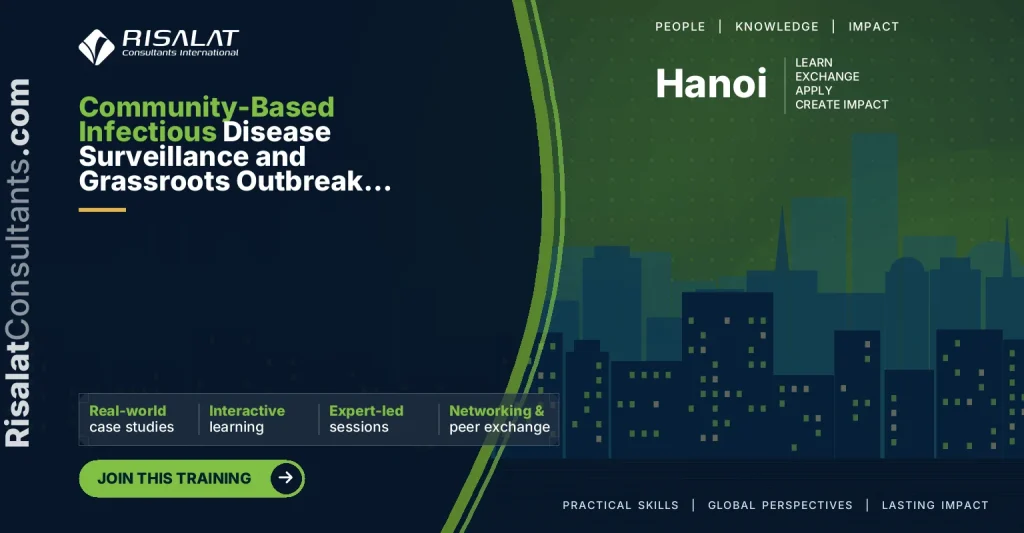
Community-Based Infectious Disease Surveillance and Grassroots Outbreak Control in Hanoi
Programme Overview
Community-based disease surveillance forms the frontline of national health security, ensuring that abnormal health events are detected before escalating into widespread epidemics. This intensive programme in Hanoi provides participants with practical approaches to operationalising disease surveillance at the grassroots level. Attendees review established syndromic reporting pathways, examine standard case definitions, and align local health notifications with core national epidemiological requirements, emphasising routine data transmission from remote and peri-urban settlements to higher administrative tiers.
Effective grassroots outbreak containment depends directly on structured coordination between professional medical officers and non-professional village health networks. Participants investigate robust community contact tracing protocols, early risk isolation strategies, and culturally grounded public health communication methods. Delivered by Risalat Consultants International in Hanoi, Vietnam, the course combines expert-led sessions, real cases, and group work, drawing on World Health Organisation field guidelines and regional disease detection models to maintain operational safety, clear command structures, and community engagement during public health emergencies.
Watch: a short video on this subject
Grassroots disease detection remains vital as public health systems confront recurrent endemic infections and emergent pathogens, highlighted by targeted initiatives such as the 3 million USD Japan Social Development Fund project for Strengthening Preparedness and Response to COVID-19 at the Grassroots Level in Vietnam. Designed for professionals supporting public health systems and donor-financed interventions, this training equips attendees to translate technical epidemiological frameworks into practical field operations through dynamic simulation modules and response workflows.
The programme strengthens institutional capability in:
- Principles of community-based surveillance and syndromic case definitions
- Mechanisms for community health volunteer disease detection and initial reporting
- Overcoming field reporting barriers in remote and vulnerable localities
- Data verification and initial screening at commune health centres
- Case study analysis of early warning signals in regional communicable disease control
- Standard operating procedures for community-level contact identification and listing
- Operational workflows for voluntary quarantine and home-based monitoring
- Coordination of village health teams during active field investigations
- Environmental and social risk screening
- Assessment instruments and management plans
- Stakeholder engagement planning
- Grievance mechanisms that work
Why this matters now
Organisations increasingly require professionals capable of:
- Screen and classify environmental and social risks
- Prepare and implement management plans
- Engage stakeholders meaningfully throughout the project
- Run grievance mechanisms that resolve issues
- Monitor and report on commitments to financiers
Strong environmental, social and stakeholder management systems help organisations:
- Avoid delays and suspended disbursements
- Protect communities and workers
- Meet financier standards and commitments
- Build trust with affected people and the public
- Collect
- Clean
- Store
- Analyse
- Decide
Who Should Attend
This programme is designed for:
- Preventive medicine coordinators
- District disease surveillance officers
- Public health trainers and community facilitators
- Commune health centre directors
- Provincial epidemiology programme officers
- Ministry of Health technical staff
- Project officers from donor-financed health operations
- Village health volunteer network supervisors
- Monitoring and evaluation officers in public health projects
- Environmental and social specialists
- Safeguards officers in PIUs
- Project and programme managers
Tick what your team needs to be able to do.
Programme Objectives
By the end of this programme participants will be able to:
- Apply standard syndromic disease reporting protocols to capture early epidemiological alerts within village settings
- Implement community contact tracing procedures aligned with international infectious disease standards
- Design grassroots risk communication strategies that address public hesitation and counter health misinformation
- Coordinate village health volunteer networks to support standardised field screening and reporting
- Execute rapid containment workflows for suspected infectious disease clusters prior to laboratory confirmation
- Establish reliable data transmission links connecting commune health stations to district surveillance centres
- Evaluate local outbreak response mechanisms using standard public health performance indicators
- Explain the environmental and social standards that apply to their projects
- Screen and classify risks and impacts
- Prepare the key instruments and management plans
Training Structure & Contents
- Principles of community-based surveillance and syndromic case definitions
- Mechanisms for community health volunteer disease detection and initial reporting
- Overcoming field reporting barriers in remote and vulnerable localities
- Data verification and initial screening at commune health centres
- Case study analysis of early warning signals in regional communicable disease control
- Workshop on applying grassroots syndromic surveillance methods to home institutions
- Standard operating procedures for community-level contact identification and listing
- Operational workflows for voluntary quarantine and home-based monitoring
- Coordination of village health teams during active field investigations
- Infection prevention and control measures for grassroots health workers
- Simulation exercise on district and commune response to an unverified cluster
- Workshop on field contact tracing and containment application
- Designing actionable public health messaging for diverse community audiences
- Addressing vaccine hesitancy and health misinformation through village leaders
- Integrating community reporting channels into national surveillance databases
- Supervision, refresher training, and retention of village health volunteers
- Action planning for district-level surveillance and grassroots response improvement
- Capstone exercise on institutional action planning with peer feedback
- Screening and classifying environmental and social risks in field interventions
- Assessment instruments and management plan development
- Operational standards for community and worker safety during health events
- Addressing vulnerability, inclusion, and resettlement safeguards
- Practical group analysis of project safeguard compliance
- Meaningful stakeholder engagement planning throughout public health operations
- Establishing effective grievance mechanisms that resolve local issues
- Monitoring and reporting commitments to financiers and health authorities
- Cross-institutional learning and final peer review of safeguard mechanisms
- Finalisation of personal and institutional action plans
Full day-by-day contents
First Day | Grassroots Syndromic Surveillance and Community Event Detection
- Principles of community-based surveillance and syndromic case definitions
- Mechanisms for community health volunteer disease detection and initial reporting
- Overcoming field reporting barriers in remote and vulnerable localities
- Data verification and initial screening at commune health centres
- Case study analysis of early warning signals in regional communicable disease control
- Workshop on applying grassroots syndromic surveillance methods to home institutions
Second Day | Field Contact Tracing and Grassroots Outbreak Containment
- Standard operating procedures for community-level contact identification and listing
- Operational workflows for voluntary quarantine and home-based monitoring
- Coordination of village health teams during active field investigations
- Infection prevention and control measures for grassroots health workers
- Simulation exercise on district and commune response to an unverified cluster
- Workshop on field contact tracing and containment application
Third Day | Community Engagement, Communication, and Surveillance System Integration
- Designing actionable public health messaging for diverse community audiences
- Addressing vaccine hesitancy and health misinformation through village leaders
- Integrating community reporting channels into national surveillance databases
- Supervision, refresher training, and retention of village health volunteers
- Action planning for district-level surveillance and grassroots response improvement
- Capstone exercise on institutional action planning with peer feedback
Fourth Day | Environmental and Social Safeguards Integration
- Screening and classifying environmental and social risks in field interventions
- Assessment instruments and management plan development
- Operational standards for community and worker safety during health events
- Addressing vulnerability, inclusion, and resettlement safeguards
- Practical group analysis of project safeguard compliance
Fifth Day | Stakeholder Engagement and Field Grievance Systems
- Meaningful stakeholder engagement planning throughout public health operations
- Establishing effective grievance mechanisms that resolve local issues
- Monitoring and reporting commitments to financiers and health authorities
- Cross-institutional learning and final peer review of safeguard mechanisms
- Finalisation of personal and institutional action plans
Training Methodology
The training applies adult-learning methodologies suited to public health practitioners, combining interactive lectures with practical scenario simulations. Participants work through real-world outbreak scenarios, review standard reporting tools, and engage in peer-led problem solving. Daily exercises require attendees to draft district action plans, critique surveillance data workflows, and simulate field-level volunteer briefings, ensuring the immediate applicability of all course concepts to local preventive health systems. A short pre-assessment helps facilitators understand each participant’s role and priorities, and each day concludes with a reflection to review practical workplace application.
- Expert-led sessions on current practice
- Regional and international case studies
- Group work and practical exercises
- Simulations and role plays where relevant
- Discussion of participants’ own challenges
- Peer learning across institutions and countries
- Practical tools and templates to take back to work
- Daily reflection and action planning
Expected Outcomes
- Proficiency in operationalising syndromic surveillance protocols within grassroots communities
- Capability to lead field-level contact tracing initiatives during suspected disease outbreaks
- Enhanced competency in structuring village health volunteer deployment and daily supervision
- Strengthened communication workflows between village settlements and district health centres
- Ability to design context-appropriate grassroots health messages during emergency responses
- Practical action plans to upgrade routine surveillance quality within local health districts
- Competency to screen and classify environmental and social risks
£2,350 per participant · invoice and bank transfer · groups of 5 or more receive a discount
Five or more from one organisation: ask for the group rate on the invoice request.
Ten or more: an in-house version for your institution may cost less per person. Ask for an in-house quote.
Registration closes in 178 days (26 May 2027)
Who Will Deliver This Programme
Each date is delivered by a team assigned from Risalat's expert network for this subject. For this programme we assign:
How we choose them: Experience in the region of the participants or comparable settings; Command of the financier rules that apply (World Bank, ADB, AfDB, EU, UN) where relevant; Delivery in English; other languages on request for in-house groups; No conflict of interest with participants' institutions.
Training courses in HanoiHealthcare training courses
Why Hanoi for this programme
Hanoi is the administrative centre of Vietnam, home to key government ministries, national agencies, and multilateral development offices. Visiting officials can examine practical public sector administration, urban planning projects, and infrastructure initiatives across the metropolitan area. The city is straightforward to reach internationally via Noi Bai International Airport.
The Community-Based Infectious Disease Surveillance and Grassroots Outbreak Control in Hanoi programme in July 2027 brings together officials and professionals from across the Asia region and beyond. Sessions combine short inputs, case studies and group work on participants' own files, and the city's institutions can be added as a study visit on request.
Getting there: Noi Bai International (HAN).
Check whether you need a visa with the free Visa Checker, and ask for an invitation letter once you are registered.
Other programmes in Hanoi
- Fundamentals of Road Construction & Maintenance Training
- Non-Performing Loans Management & Debt-Recovery Strategies Training
- Mastering Bank Financial Statement Analysis in Hanoi
- Strategic Procurement Planning and Tender Evaluation Training in Hanoi
- Integrated River Basin Management and Restoration Training
Questions before you nominate your team? Book a 30-minute call with us, or ask for this programme in-house.
Teams often travel here from Cambodia, Lao PDR. Funding, visa letters and group rates are explained on each country page.
Is there environmental and social safeguards training for government officials in Hanoi in July 2027?
Can "Community-Based Infectious Disease Surveillance and Grassroots Outbreak Control in Hanoi" be delivered in-house for one organisation?
Which other environmental and social safeguards programmes does Risalat run?
How do organisations register and pay?
For teams and institutions
Bring your team
Teams that learn together apply more at work. Tell us how many people and how you would like to take part: we reply with a group quote within two working days.
Watch: this programme in short


More training courses in Vietnam · All programmes in Asia · Full training calendar
Plan this programme in a roadmap: why it matters, why to approve it, the dates to plan and the career it builds.