Key facts
- Dates
- 19–23 Apr 2027 (5 days)
- Where
- Dubai, United Arab Emirates
- Fee per participant
- £3,850 (GBP)
- Payment
- By invoice and bank transfer
- Registration closes
- 10 Mar 2027
- Format
- 5-day short course: a practical capacity-building programme for government, NGO and project teams in Dubai
- In-house option
- Run it for your team, on your dates
On this page 10 sections
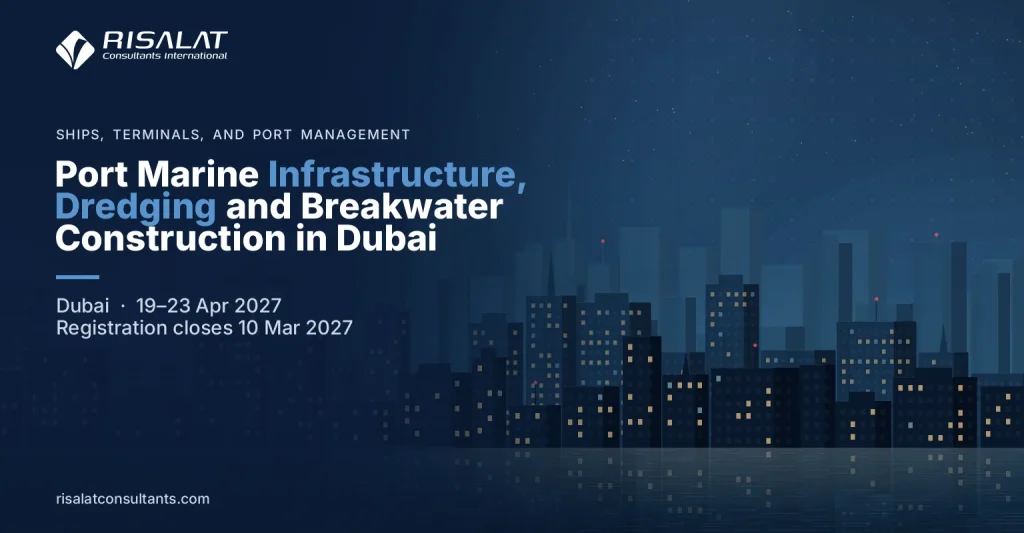
Port Marine Infrastructure, Dredging and Breakwater Construction in Dubai
Programme Overview
Marine transport hubs require robust civil engineering frameworks to accommodate modern container vessels and regional cargo demands. This 5-day professional course in Dubai provides engineering professionals and public sector managers with technical knowledge in coastal infrastructure design, capital dredging execution, and breakwater construction. Participants examine geotechnical foundations, hydrodynamic modelling parameters, and structural typologies suitable for high-capacity maritime terminals, using real-world operational examples from major regional deep-water facilities.
Navigating international civil engineering contracts demands strict compliance with recognised standards, including FIDIC Conditions of Contract for Construction (Red Book) and the British Standard BS 6349 for maritime works. Attendees analyse the practical mechanics of capital dredging works, reclamation methodologies, sediment plume management, and rubble-mound or caisson breakwater engineering. The curriculum emphasises contractor supervision, structural health monitoring, bathymetric survey analysis, and quality verification during offshore and nearshore construction phases.
Delivered by Risalat Consultants International in Dubai, United Arab Emirates, the programme combines expert-led sessions, real cases, and group work, allowing participants to apply what they learn in their own institution. Designed for teams tasked with delivering large-scale marine civil works, this course bridges design theory and site supervision, aligning projects with multilateral development bank standards throughout the infrastructure lifecycle.
The programme strengthens institutional capability in:
- Analysis of tides, wave regimes, storm surges, and current dynamics for port siting
- Geotechnical site investigations in marine environments: boreholes, CPT, and geophysical surveys
- Application of BS 6349 (Maritime Works) and PIANC design principles for terminal layouts
- Numerical modelling review: hydrodynamic, spectral wave, and coastal morphological models
- Metocean data verification and structural design risk identification for nearshore structures
- Technical appraisal of dredging plant: CSD, TSHD, backhoe dredgers, and split hopper barges
- Geotechnical classification of marine sediments and dredgeability assessment methodologies
- Hydraulic fill placement techniques, ground improvement, and containment bund construction
- Climate and environmental risk assessment
- Adaptation and mitigation planning
- Sector strategies for energy, water and land
- Project design for climate and environmental goals
- Collect
- Clean
- Store
- Analyse
- Decide
Why this matters now
Organisations increasingly require professionals capable of:
- Assess climate and environmental risks to their services and assets
- Design projects that meet climate and environmental goals
- Prepare proposals that financiers can approve
- Measure and report results credibly
- Work with communities and partners across sectors
Strong climate, environment and natural resources systems help organisations:
- Protect services and infrastructure from climate risks
- Access climate and environmental finance
- Meet national and international commitments
- Use natural resources sustainably
Who Should Attend
This programme is designed for:
- Port authority civil and marine engineers
- Maritime infrastructure project directors
- Project Implementation Unit (PIU) technical specialists
- Coastal and geotechnical design engineers
- Consulting engineers supervising marine civil contracts
- Procurement and contract managers for maritime works
- Environmental compliance officers overseeing dredging operations
- Hydrographic survey coordinators and quality assurance leads
- Government transport ministry technical advisors
- Climate change and environment officers
- Energy, water and agriculture sector staff
- Planning and policy officers
Tick what your team needs to be able to do.
Programme Objectives
By the end of this programme participants will be able to:
- Evaluate structural designs for breakwaters, revetments, and quay walls in accordance with BS 6349 and PIANC guidelines
- Manage capital dredging and land reclamation operations using appropriate plant selection and productivity calculation methods
- Formulate supervisory oversight plans and quality assurance protocols for complex deep-water port civil works contracts
- Assess geotechnical data, hydrodynamic assessments, and metocean parameters to verify contractor construction designs
- Implement marine environmental management controls to mitigate turbidity, sediment plumes, and coastal habitat disruption
- Apply FIDIC contractual provisions to handle marine site conditions, measurement variations, and progress claims
- Review bathymetric surveys and non-destructive testing results to verify compliance with dredging and structural tolerances
- Explain the main climate and environmental challenges for their sector
- Assess climate and environmental risks to services and assets
- Plan adaptation and mitigation measures
Training Structure & Contents
- Analysis of tides, wave regimes, storm surges, and current dynamics for port siting
- Geotechnical site investigations in marine environments: boreholes, CPT, and geophysical surveys
- Application of BS 6349 (Maritime Works) and PIANC design principles for terminal layouts
- Numerical modelling review: hydrodynamic, spectral wave, and coastal morphological models
- Metocean data verification and structural design risk identification for nearshore structures
- Workshop: Coastal Engineering Fundamentals, Metocean Data, and Site Characterisation: Applying It to Your Institution
- Technical appraisal of dredging plant: CSD, TSHD, backhoe dredgers, and split hopper barges
- Geotechnical classification of marine sediments and dredgeability assessment methodologies
- Hydraulic fill placement techniques, ground improvement, and containment bund construction
- Dredge production calculations, fuel consumption metrics, and cycle time optimisation
- Bathymetric survey methodologies: multi-beam echo sounders (MBES) and volume computation standards
- Workshop: Capital Dredging, Reclamation, and Dredging Plant Selection: Applying It to Your Institution
- Comparative assessment of breakwater typologies: rubble-mound, caisson, and composite structures
- Armour layer stability formulas: Hudson and Van der Meer empirical design equations
- Concrete armour units (Accropode, Core-loc, Xbloc): placement rules and packing density controls
- Geotextile filters, underlayers, and core material specifications for deep-water breakwaters
- Caisson fabrication, slipforming, towing, sinking, and ballasting quality control steps
- Case Study: Breakwater Design, Armouring Systems, and Marine Structural Works in Practice
- World Bank Environmental and Social Framework (ESF) applied to marine and coastal works
- Managing water quality: total suspended solids (TSS), turbidity monitoring, and silt curtains
- Dredged material management: beneficent reuse, offshore disposal protocols, and London Convention rules
- Underwater noise and vibration management plan implementation for marine pile driving
- Continuous environmental baseline monitoring, sensor deployment, and reporting mechanisms
- Workshop: Marine Environmental Controls, Monitoring, and Compliance Frameworks: Applying It to Your Institution
- The Engineer role under FIDIC Red Book contracts for maritime civil engineering packages
- Contractual management of unforeseen ground conditions, weather downtime, and variation orders
- Drafting supervisory oversight plans (SOP) for off-site fabrication and on-site marine works
- Non-destructive testing (NDT), concrete durability checks, and cathodic protection verification
- Developing quality assurance inspection and test plans (ITP) for deep-water port projects
- Capstone Exercise: Port Marine Infrastructure, Dredging and Breakwater Construction in Dubai Action Plan for Your Institution
Full day-by-day contents
First Day | Coastal Engineering Fundamentals, Metocean Data, and Site Characterisation
- Analysis of tides, wave regimes, storm surges, and current dynamics for port siting
- Geotechnical site investigations in marine environments: boreholes, CPT, and geophysical surveys
- Application of BS 6349 (Maritime Works) and PIANC design principles for terminal layouts
- Numerical modelling review: hydrodynamic, spectral wave, and coastal morphological models
- Metocean data verification and structural design risk identification for nearshore structures
- Workshop: Coastal Engineering Fundamentals, Metocean Data, and Site Characterisation: Applying It to Your Institution
Second Day | Capital Dredging, Reclamation, and Dredging Plant Selection
- Technical appraisal of dredging plant: CSD, TSHD, backhoe dredgers, and split hopper barges
- Geotechnical classification of marine sediments and dredgeability assessment methodologies
- Hydraulic fill placement techniques, ground improvement, and containment bund construction
- Dredge production calculations, fuel consumption metrics, and cycle time optimisation
- Bathymetric survey methodologies: multi-beam echo sounders (MBES) and volume computation standards
- Workshop: Capital Dredging, Reclamation, and Dredging Plant Selection: Applying It to Your Institution
Third Day | Breakwater Design, Armouring Systems, and Marine Structural Works
- Comparative assessment of breakwater typologies: rubble-mound, caisson, and composite structures
- Armour layer stability formulas: Hudson and Van der Meer empirical design equations
- Concrete armour units (Accropode, Core-loc, Xbloc): placement rules and packing density controls
- Geotextile filters, underlayers, and core material specifications for deep-water breakwaters
- Caisson fabrication, slipforming, towing, sinking, and ballasting quality control steps
- Case Study: Breakwater Design, Armouring Systems, and Marine Structural Works in Practice
Fourth Day | Marine Environmental Controls, Monitoring, and Compliance Frameworks
- World Bank Environmental and Social Framework (ESF) applied to marine and coastal works
- Managing water quality: total suspended solids (TSS), turbidity monitoring, and silt curtains
- Dredged material management: beneficent reuse, offshore disposal protocols, and London Convention rules
- Underwater noise and vibration management plan implementation for marine pile driving
- Continuous environmental baseline monitoring, sensor deployment, and reporting mechanisms
- Workshop: Marine Environmental Controls, Monitoring, and Compliance Frameworks: Applying It to Your Institution
Fifth Day | Site Supervision, FIDIC Contracts, and Quality Assurance Protocols
- The Engineer role under FIDIC Red Book contracts for maritime civil engineering packages
- Contractual management of unforeseen ground conditions, weather downtime, and variation orders
- Drafting supervisory oversight plans (SOP) for off-site fabrication and on-site marine works
- Non-destructive testing (NDT), concrete durability checks, and cathodic protection verification
- Developing quality assurance inspection and test plans (ITP) for deep-water port projects
- Capstone Exercise: Port Marine Infrastructure, Dredging and Breakwater Construction in Dubai Action Plan for Your Institution
Training Methodology
Delivered through a practical format combining expert-led inputs, realistic case analyses, and small-group working sessions, this programme enables participants to translate technical guidance into operational practice. Attendees analyse maritime civil engineering challenges, evaluate project choices against international standards, and collaborate on immediate applications for their home organisations.
- Interactive technical presentations covering engineering standards and contract administration
- Analysis of real operational deep-water facility cases and design choices
- Small-group workshops dedicated to applying daily methodologies to institutional projects
- Action planning sessions to define institutional priorities, owners, and initial implementation steps
- Peer reviews and facilitator-led feedback discussions
Expected Outcomes
- Ability to evaluate marine structural designs using BS 6349 and PIANC engineering principles
- Competence in selecting dredging equipment and calculating reclamation productivity parameters
- Proficiency in formulating quality assurance inspection plans and supervisory frameworks
- Capacity to verify contractor submittals against metocean, geotechnical, and bathymetric data
- Skill in executing environmental monitoring to manage turbidity, sediment plumes, and coastal habitats
- Sound application of FIDIC Red Book conditions to manage variations, downtime, and unforeseen site conditions
- Delivery of an actionable institutional implementation plan addressing marine infrastructure priorities
£3,850 per participant · invoice and bank transfer · groups of 5 or more receive a discount
Five or more from one organisation: ask for the group rate on the invoice request.
Ten or more: an in-house version for your institution may cost less per person. Ask for an in-house quote.
Registration closes in 102 days (10 Mar 2027)
Who Will Deliver This Programme
Each date is delivered by a team assigned from Risalat's expert network for this subject. For this programme we assign:
How we choose them: Experience in the region of the participants or comparable settings; Command of the financier rules that apply (World Bank, ADB, AfDB, EU, UN) where relevant; Delivery in English; other languages on request for in-house groups; No conflict of interest with participants' institutions.
Training courses in DubaiShips, Terminals, and Port Management training courses
Why Dubai for this programme
Dubai is a one-flight hub for Africa, Asia and Europe, with simple visas for many nationalities and modern training venues.
The Port Marine Infrastructure, Dredging and Breakwater Construction in Dubai programme in April 2027 brings together officials and professionals from across the Middle East region and beyond. Sessions combine short inputs, case studies and group work on participants' own files, and the city's institutions can be added as a study visit on request.
Getting there: Dubai International (DXB).
Check whether you need a visa with the free Visa Checker, and ask for an invitation letter once you are registered.
The same topic in other cities
Other programmes in Dubai
- Mini Degree in Internal Audit and Risk Management in Dubai
- Refugee and Host Community Programme Management in Dubai
- Performance Audit for Supreme Audit Institutions in Dubai
- Artificial Intelligence for Public Sector Leaders Training in Dubai
- Records and Archives Management for Public Institutions in Dubai
Questions before you nominate your team? Book a 30-minute call with us, or ask for this programme in-house.
Teams often travel here from Maldives, Sri Lanka, Bangladesh, Nepal, Pakistan, Afghanistan, Kazakhstan, Uzbekistan. Funding, visa letters and group rates are explained on each country page.
Free roadmap: Sustainable Infrastructure: a 12-month plan for your team
Is there infrastructure and urban development training for government officials in Dubai in April 2027?
Can "Port Marine Infrastructure, Dredging and Breakwater Construction in Dubai" be delivered in-house for one organisation?
Which other infrastructure and urban development programmes does Risalat run?
How do organisations register and pay?
For teams and institutions
Bring your team
Teams that learn together apply more at work. Tell us how many people and how you would like to take part: we reply with a group quote within two working days.
Watch: this programme in short


Other dates and cities for this subject: Infrastructure, Roads and Transport Projects training courses (162 upcoming dates).
More training courses in the United Arab Emirates · All programmes in Middle East · Full training calendar
Plan this programme in a roadmap: why it matters, why to approve it, the dates to plan and the career it builds.