Key facts
- Dates
- 11–15 Oct 2027 (5 days)
- Where
- Bangkok, Thailand
- Fee per participant
- £2,450 (GBP)
- Payment
- By invoice and bank transfer
- Registration closes
- 1 Sep 2027
- Format
- 5-day short course: a practical capacity-building programme for government, NGO and project teams in Bangkok
- Groups
- Teams of 3 or more qualify for a group discount, offered case by case: ask for a group quote.
- In-house option
- Run it for your team, on your dates
On this page 11 sections
Programme Overview
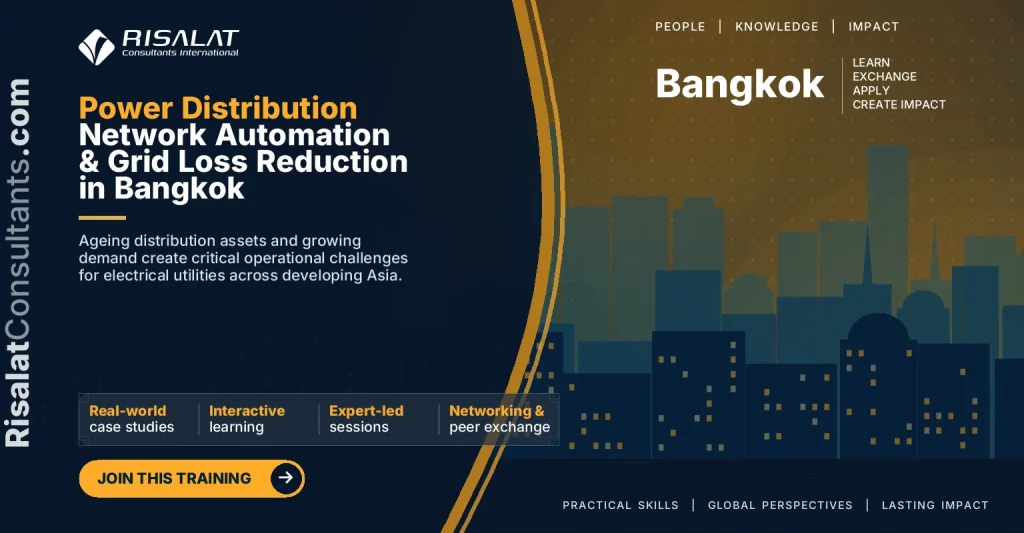
Ageing distribution assets and growing demand create critical operational challenges for electrical utilities across developing Asia. This five-day training programme in Bangkok focuses on modernising medium-voltage and low-voltage distribution networks through digital controls and engineering methodologies. Participants examine feeder automation architectures, distribution management system integration, and supervisory control upgrades designed to lower technical losses, streamline outage handling, and improve electricity service reliability.
The curriculum addresses the engineering and operational disciplines required to transition from manual switching to automated network operations. Distribution professionals analyse automated reclosers, sectionalisers, remote terminal units, and digital protection relays in line with international engineering standards. Through structured modules, attendees learn to assess line loading, model feeder power flows, and implement voltage and reactive power optimisation schemes to control technical and commercial losses systematically.
Delivered through a public sector and utility lens, the course provides practical tools to modernise utility operating workflows. Participants develop technical specifications, evaluate asset health parameters, and draft capital investment plans suited to donor-financed infrastructure projects. By assessing real-world network operational scenarios, attendees leave prepared to formulate actionable grid modernisation initiatives that align engineering interventions with regulatory performance targets and long-term utility financial sustainability.
The programme strengthens institutional capability in:
- Medium-voltage and low-voltage feeder topologies: Radial, ring, and interconnected configurations
- Technical loss fundamentals: Resistance, transformer core losses, and reactive power imbalances
- Non-technical loss detection: Metering discrepancies, bypass identification, and data integrity audits
- Methodologies for conducting comprehensive distribution feeder asset audits and line assessments
- Baseline calculation of System Average Interruption Frequency and Duration indices (SAIFI and SAIDI)
- Overhead and underground automated switchgear: Reclosers, load break switches, and sectionalisers
- Fault Detection, Isolation, and Service Restoration (FDIR) operational logic and sequence design
- Integration of Remote Terminal Units (RTUs) and modern master control station interfaces
- Fraud risk assessment and fraud risk registers
- Design and testing of internal controls
- The Three Lines model and the role of oversight
- Audit planning, evidence and documentation
Why this matters now
Organisations increasingly require professionals capable of:
- Identify and rate fraud and control risks in their own processes
- Design controls that are proportionate and testable
- Gather and document reliable audit evidence
- Recognise red flags early and escalate them correctly
- Turn findings into practical, agreed actions
Strong fraud, audit and internal control systems help organisations:
- Reduce losses and ineligible expenditure
- Pass external audits with fewer findings
- Strengthen trust with financiers and citizens
- Respond to allegations in a fair and documented way
Who Should Attend
This programme is designed for:
- Distribution network planning engineers
- Power utility operations and maintenance managers
- Substation automation and protection engineers
- Distribution management system and SCADA technicians
- Grid modernisation and loss reduction project directors
- Power sector technical specialists from Lao PDR
- Engineers managing donor-funded energy infrastructure components
- Energy ministry officials overseeing electricity distribution policy
- Utility asset management specialists
- Public works electrical distribution coordinators
- Internal auditors and audit managers
- Finance managers and accountants
Tick what your team needs to be able to do.
Programme Objectives
By the end of this programme participants will be able to:
- Evaluate medium-voltage distribution network architectures to identify technical loss drivers and asset constraints
- Specify requirements for automated switching devices including reclosers, sectionalisers, and remote terminal units
- Design voltage and reactive power control schemes to improve feeder voltage profiles and lower line losses
- Apply international communication standards including IEC 61850 and IEC 60870-5-104 to distribution automation systems
- Analyse supervisory control and data acquisition architectures for real-time distribution management and fault isolation
- Formulate operational loss reduction programmes distinguishing between technical dissipation and non-technical loss mechanisms
- Develop practical project implementation schedules and technical criteria for donor-funded distribution modernisation tenders
- Explain how and why fraud happens, using recognised fraud risk models
- Carry out a fraud and control risk assessment for a real process
- Map controls to risks using the Three Lines model
Training Structure & Contents
- Medium-voltage and low-voltage feeder topologies: Radial, ring, and interconnected configurations
- Technical loss fundamentals: Resistance, transformer core losses, and reactive power imbalances
- Non-technical loss detection: Metering discrepancies, bypass identification, and data integrity audits
- Methodologies for conducting comprehensive distribution feeder asset audits and line assessments
- Baseline calculation of System Average Interruption Frequency and Duration indices (SAIFI and SAIDI)
- Workshop: Distribution Network Topologies, Asset Audits, and Loss Characterisation: Applying It to Your Institution
- Overhead and underground automated switchgear: Reclosers, load break switches, and sectionalisers
- Fault Detection, Isolation, and Service Restoration (FDIR) operational logic and sequence design
- Integration of Remote Terminal Units (RTUs) and modern master control station interfaces
- Protection coordination principles: Time-overcurrent grading and auto-reclosing schemes
- Reliability modelling to assess the economic placement of automated switching devices
- Workshop: Feeder Automation and Switchgear Engineering: Applying It to Your Institution
- Substation digital control systems: Architecture, bay controllers, and intelligent electronic devices
- Application of the IEC 61850 standard for distribution substation automation and communications
- Telecommunications infrastructure for distribution grids: Fibre optics, cellular networks, and radio links
- IEC 60870-5-104 and DNP3 communication protocol configuration and cyber-physical security basics
- Condition monitoring and life-extension diagnostics for distribution power transformers
- Case Study: Substation Digital Controls and Communication Frameworks in Practice
- Capacitor bank placement and sizing strategies for feeder reactive power compensation
- Volt-VAR Control (VVC) and Volt-VAR Optimisation (VVO) implementation methodologies
- Distribution transformer load management and phase balancing techniques to reduce neutral currents
- Conductor reconductoring, line voltage upgrades, and network reconfiguration assessments
- Integration considerations for distributed renewable generation and their impact on feeder loss profiles
- Workshop: Technical Loss Minimisation and Volt-VAR Optimisation: Applying It to Your Institution
- Supervisory Control and Data Acquisition (SCADA) and Advanced Distribution Management Systems (ADMS)
- Outage Management System (OMS) and Geographical Information System (GIS) enterprise integration
- Drafting technical employer requirements and specifications for international procurement tenders
- Monitoring, evaluation, and verification frameworks for grid modernisation capital investments
- Participant presentations: Practical feeder modernisation and loss reduction project plans
- Capstone Exercise: Power Distribution Network Automation & Grid Loss Reduction in Bangkok Action Plan for Your Institution
Full day-by-day contents
First Day | Distribution Network Topologies, Asset Audits, and Loss Characterisation
- Medium-voltage and low-voltage feeder topologies: Radial, ring, and interconnected configurations
- Technical loss fundamentals: Resistance, transformer core losses, and reactive power imbalances
- Non-technical loss detection: Metering discrepancies, bypass identification, and data integrity audits
- Methodologies for conducting comprehensive distribution feeder asset audits and line assessments
- Baseline calculation of System Average Interruption Frequency and Duration indices (SAIFI and SAIDI)
- Workshop: Distribution Network Topologies, Asset Audits, and Loss Characterisation: Applying It to Your Institution
Second Day | Feeder Automation and Switchgear Engineering
- Overhead and underground automated switchgear: Reclosers, load break switches, and sectionalisers
- Fault Detection, Isolation, and Service Restoration (FDIR) operational logic and sequence design
- Integration of Remote Terminal Units (RTUs) and modern master control station interfaces
- Protection coordination principles: Time-overcurrent grading and auto-reclosing schemes
- Reliability modelling to assess the economic placement of automated switching devices
- Workshop: Feeder Automation and Switchgear Engineering: Applying It to Your Institution
Third Day | Substation Digital Controls and Communication Frameworks
- Substation digital control systems: Architecture, bay controllers, and intelligent electronic devices
- Application of the IEC 61850 standard for distribution substation automation and communications
- Telecommunications infrastructure for distribution grids: Fibre optics, cellular networks, and radio links
- IEC 60870-5-104 and DNP3 communication protocol configuration and cyber-physical security basics
- Condition monitoring and life-extension diagnostics for distribution power transformers
- Case Study: Substation Digital Controls and Communication Frameworks in Practice
Fourth Day | Technical Loss Minimisation and Volt-VAR Optimisation
- Capacitor bank placement and sizing strategies for feeder reactive power compensation
- Volt-VAR Control (VVC) and Volt-VAR Optimisation (VVO) implementation methodologies
- Distribution transformer load management and phase balancing techniques to reduce neutral currents
- Conductor reconductoring, line voltage upgrades, and network reconfiguration assessments
- Integration considerations for distributed renewable generation and their impact on feeder loss profiles
- Workshop: Technical Loss Minimisation and Volt-VAR Optimisation: Applying It to Your Institution
Fifth Day | SCADA/ADMS Integration and Project Modernisation Planning
- Supervisory Control and Data Acquisition (SCADA) and Advanced Distribution Management Systems (ADMS)
- Outage Management System (OMS) and Geographical Information System (GIS) enterprise integration
- Drafting technical employer requirements and specifications for international procurement tenders
- Monitoring, evaluation, and verification frameworks for grid modernisation capital investments
- Participant presentations: Practical feeder modernisation and loss reduction project plans
- Capstone Exercise: Power Distribution Network Automation & Grid Loss Reduction in Bangkok Action Plan for Your Institution
Training Methodology
Delivered by Risalat Consultants International in Bangkok, Thailand, the programme combines expert input, practical work and closing workshops or case studies. Each objective is practised during the course through structured activities so that attendees can apply what they learn in their own settings:
- Expert-led instructional sessions
- Real-world operational scenarios and case studies
- Small group work and practical exercises
- Interactive workshops applying methods to participants’ institutions
- Action planning capstone exercise
- Collect
- Clean
- Store
- Analyse
- Decide
Expected Outcomes
- Ability to assess and reconfigure medium-voltage and low-voltage distribution topologies
- Proficiency in specifying automated switchgear and designing FDIR operational logic
- Capability to implement substation digital control systems and communication protocols
- Practical methods for conducting Volt-VAR optimisation and balancing distribution loads
- Preparedness to draft technical procurement specifications and loss reduction investment plans
- Competence in carrying out fraud and internal control risk assessments within institutional processes
£2,450 per participant · invoice and bank transfer · groups of 5 or more receive a discount
Five or more from one organisation: ask for the group rate on the invoice request.
Ten or more: an in-house version for your institution may cost less per person. Ask for an in-house quote.
Registration closes in 276 days (1 Sep 2027)
Regional Relevance & Application
Electric utilities across Southeast Asia, particularly in Lao PDR, face urgent requirements to rehabilitate medium-voltage lines, reinforce overloaded substations, and reduce severe distribution losses. Aligned with the priorities of major capital interventions such as the US$51m Power Distribution Improvement Project, distribution companies must modernise their infrastructure to accommodate industrial demand and rural electrification. Implementing automated feeder systems, supervisory control, and data acquisition architectures enables public utilities to mitigate chronic supply interruptions and deliver reliable power essential for sustained economic growth.
Who Will Deliver This Programme
Each date is delivered by a team assigned from Risalat's expert network for this subject. For this programme we assign:
How we choose them: Experience in the region of the participants or comparable settings; Command of the financier rules that apply (World Bank, ADB, AfDB, EU, UN) where relevant; Delivery in English; other languages on request for in-house groups; No conflict of interest with participants' institutions.
Training courses in BangkokEnergy and Water training courses
Why Bangkok for this programme
Bangkok hosts UN regional offices and is a central, good-value hub for South and South-East Asia.
The Power Distribution Network Automation & Grid Loss Reduction in Bangkok programme in October 2027 brings together officials and professionals from across the Asia region and beyond. Sessions combine short inputs, case studies and group work on participants' own files, and the city's institutions can be added as a study visit on request.
Getting there: Suvarnabhumi (BKK).
Check whether you need a visa with the free Visa Checker, and ask for an invitation letter once you are registered.
The same topic in other cities
- Medium and Low Voltage Grid Electrification and Substation Works in Dakar (Dakar)
- Grid Modernisation and Clean Energy Transition Planning in Johannesburg (Johannesburg)
- Grid Expansion and Power Distribution Operations in Accra (Accra)
- Grid-Connected Solar and Distribution Network Modernisation in Dubai (Dubai)
- Grid Electrification Expansion & Transmission Quality Management in Cape Town (Cape Town)
- Electricity Distribution Network Expansion & SCADA Automation in Dubai (Dubai)
Other programmes in Bangkok
- Mini Degree in Monitoring, Evaluation and Learning in Bangkok
- Instructional Design and E-Learning for Institutions in Bangkok
- Public Service Delivery and Citizen Charters in Bangkok
- Prompt Engineering and AI Tools for Professionals Training in Bangkok
- Artificial Intelligence for Public Sector Managers in Bangkok
Related: AI governance for public institutions · free AI Governance Readiness · all programmes
Questions before you nominate your team? Book a 30-minute call with us, or ask for this programme in-house.
Teams often travel here from Timor-Leste, Maldives, Sri Lanka, Bangladesh, Nepal, Bhutan, Myanmar, Cambodia. Funding, visa letters and group rates are explained on each country page.
Is there energy and utilities training for government officials in Bangkok in October 2027?
Can "Power Distribution Network Automation & Grid Loss Reduction in Bangkok" be delivered in-house for one organisation?
Which other energy and utilities programmes does Risalat run?
How do organisations register and pay?
For teams and institutions
Bring your team
Teams that learn together apply more at work. Tell us how many people and how you would like to take part: we reply with a group quote within two working days.
Watch: this programme in short
Other dates and cities for this subject: Energy, Power and Utility Management training courses (118 upcoming dates).
More training courses in Thailand · All programmes in Asia · Full training calendar
Plan this programme in a roadmap: why it matters, why to approve it, the dates to plan and the career it builds.