Key facts
- Dates
- 1–5 Feb 2027 (5 days)
- Where
- INNTEL HOTELS ROTTERDAM CENTRE, Rotterdam, Netherlands
- Fee per participant
- £4,440 (GBP)
- Payment
- By invoice and bank transfer
- Registration closes
- 23 Dec 2026
- Format
- 5-day short course: a practical capacity-building programme for government, NGO and project teams in Rotterdam
- Who it is for
- The programme suits experienced professionals as well as those moving into new responsibilities. Groups that mix institutions and countries are enc…
- In-house option
- Run it for your team, on your dates
On this page 12 sections
Precision Agriculture and Smart Technologies Training in Rotterdam
Programme Overview
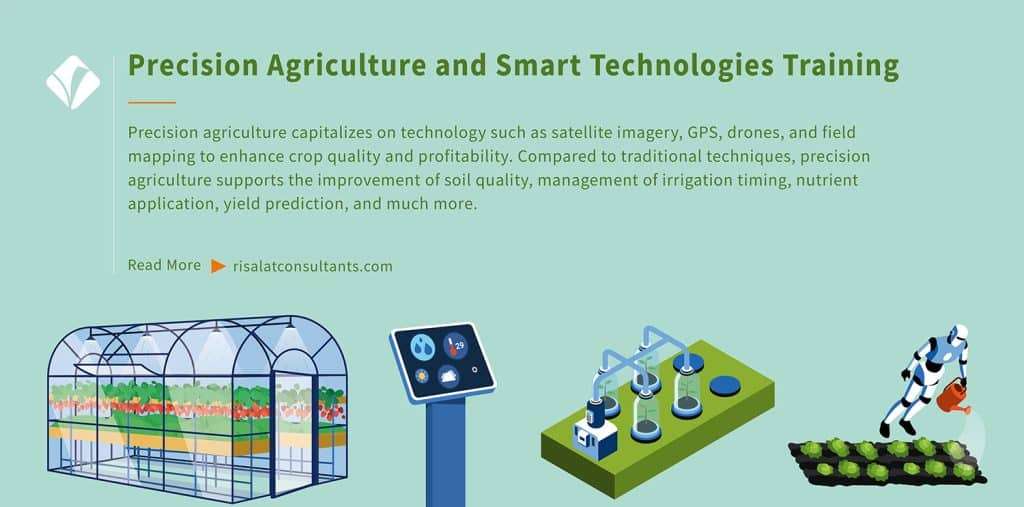
Precision agriculture capitalises on technology such as satellite imagery, GPS, drones, and field mapping to enhance crop quality and profitability. Compared to traditional techniques, precision agriculture supports the improvement of soil quality, management of irrigation timing, nutrient application, yield prediction, and much more. Overall, it reduces the sector’s vulnerability to climate change, enabling farmers to control processes remotely, make financial savings, and increase production.
Exclusively designed by Risalat, this training programme helps farmers and agribusinesses optimise resource management, increase productivity, lower costs, and reduce their environmental footprint. Delivered by Risalat Consultants International in Rotterdam, Netherlands, it combines expert-led sessions, real cases, and group work so that participants can apply what they learn in their own institution.
Upon successful completion of the programme, participants will possess a thorough grasp of fundamental concepts in precision agriculture and understand how to leverage technology to optimise farm operations. It is designed for farmers, agribusiness professionals, agricultural extension agents, and others seeking practical, current skills in climate, environment, and natural resources.
The programme strengthens institutional capability in:
- The evolution of precision agriculture
- Benefits and challenges associated with the adoption of precision agriculture practices
- Smart technologies in agriculture
- GPS/GNSS
- Remote sensing for crop monitoring
- IoT sensors
- Networks for data collection
- Drones
- Climate and environmental risk assessment
- Adaptation and mitigation planning
- Sector strategies for energy, water, and land
- Project design for climate and environmental goals
- Collect
- Clean
- Store
- Analyse
- Decide
Why this matters now
Climate change, environmental pressure, and resource management now shape national plans, budgets, and investment decisions. Financiers increasingly expect climate and environmental considerations to be built into projects from the start. Institutions that plan for climate risks, manage natural resources effectively, and prepare sound proposals are better placed to protect services and access available funding.
Organisations increasingly require professionals capable of:
- Assess climate and environmental risks to their services and assets
- Design projects that meet climate and environmental goals
- Prepare proposals that financiers can approve
- Measure and report results credibly
- Work with communities and partners across sectors
Strong climate, environment and natural resources systems help organisations:
- Protect services and infrastructure from climate risks
- Access climate and environmental finance
- Meet national and international commitments
- Use natural resources sustainably
Who Should Attend
The programme suits experienced professionals as well as those moving into new responsibilities. Groups that mix institutions and countries are encouraged, as participants learn from each other’s experience.
This programme is designed for:
- Farmers
- Agribusiness professionals
- Agricultural extension agents
- Members of government and regulatory agencies
- NGOs and International Development Organizations
- Agricultural consultants
- Climate change and environment officers
- Energy, water, and agriculture sector staff
- Planning and policy officers
- Project and programme managers
- Disaster risk management staff
- Local government officials
Tick what your team needs to be able to do.
Programme Objectives
Each objective is practised during the programme through exercises, cases, or group work, ensuring participants leave equipped to execute these tasks in practical settings.
By the end of this programme participants will be able to:
- Comprehend the fundamental principles of precision agriculture including its benefits, key technologies, and applications in modern farming practices
- Grasp a wide range of smart technologies used in precision agriculture, such as GPS/GNSS, remote sensing, drones, IoT sensors, automated machinery, and data analytics platforms
- Collect, manage, process, and analyze agricultural data effectively
- Understand various applications of precision farming techniques such as variable rate application of inputs, precision irrigation, crop monitoring, yield mapping, and more
- Assess the economic viability of adopting smart technologies in agriculture
- Support the promotion of environmental sustainability and resource efficiency by minimizing chemical usage, reducing soil erosion, conserving water resources, and enhancing biodiversity
- Explain the main climate and environmental challenges for their sector
- Assess climate and environmental risks to services and assets
- Plan adaptation and mitigation measures
- Design projects with clear climate and environmental results
Training Structure & Contents
- The evolution of precision agriculture
- IoT sensors and networks for data collection
- Data analysis, interpretation, and decision making
- Spatial variability analysis
- Strategies for the reduction of chemical usage and soil erosion
- Risk management, regulatory compliance, and sector climate trends
- Workshop: Applying Context and Risks to Your Institution
- Benefits and challenges associated with the adoption of precision agriculture practices
- Networks for data collection and soil management smart technologies
- Variable rate application of pesticides and fertilizers
- Water conservation via precision irrigation
- Adaptation and mitigation options, including nature-based and engineering solutions
- Visit to a farm with precision agriculture technology in place
- Workshop: Applying Planning Solutions to Your Institution
- Smart technologies in agriculture and drone applications
- Precision irrigation systems and management
- Pest and disease monitoring using sensor networks
- Biodiversity conservation and habitat management
- Demonstration of selected smart technologies used in precision farming
- Developing results frameworks for climate and environment project concepts
- Case Study: Project Design in Practice
- GPS/GNSS data collection methods and techniques
- Crop monitoring using sensors and drones
- Livestock management using IoT
- Economic analysis of precision agriculture and ROI
- Observation of variable rate application of inputs
- Sources of climate and environmental finance and requirements of financiers
- Workshop: Applying Finance and Proposals to Your Institution
- Remote sensing for crop monitoring and yield mapping
- Data management systems, platforms, and environmental implications
- Business plan development for smart agriculture initiatives
- Hands-on experience with precision irrigation systems
- Measurement, reporting, and verification basics
- Monitoring results and learning
- Capstone Exercise: Precision Agriculture and Smart Technologies Action Plan for Your Institution
Full day-by-day contents
First Day | Context and risks
- The evolution of precision agriculture
- IoT sensors and networks for data collection
- Data analysis, interpretation, and decision making
- Spatial variability analysis
- Strategies for the reduction of chemical usage and soil erosion
- Risk management, regulatory compliance, and sector climate trends
- Workshop: Applying Context and Risks to Your Institution
Second Day | Planning solutions
- Benefits and challenges associated with the adoption of precision agriculture practices
- Networks for data collection and soil management smart technologies
- Variable rate application of pesticides and fertilizers
- Water conservation via precision irrigation
- Adaptation and mitigation options, including nature-based and engineering solutions
- Visit to a farm with precision agriculture technology in place
- Workshop: Applying Planning Solutions to Your Institution
Third Day | Project design
- Smart technologies in agriculture and drone applications
- Precision irrigation systems and management
- Pest and disease monitoring using sensor networks
- Biodiversity conservation and habitat management
- Demonstration of selected smart technologies used in precision farming
- Developing results frameworks for climate and environment project concepts
- Case Study: Project Design in Practice
Fourth Day | Finance and proposals
- GPS/GNSS data collection methods and techniques
- Crop monitoring using sensors and drones
- Livestock management using IoT
- Economic analysis of precision agriculture and ROI
- Observation of variable rate application of inputs
- Sources of climate and environmental finance and requirements of financiers
- Workshop: Applying Finance and Proposals to Your Institution
Fifth Day | Measurement, reporting and action planning
- Remote sensing for crop monitoring and yield mapping
- Data management systems, platforms, and environmental implications
- Business plan development for smart agriculture initiatives
- Hands-on experience with precision irrigation systems
- Measurement, reporting, and verification basics
- Monitoring results and learning
- Capstone Exercise: Precision Agriculture and Smart Technologies Action Plan for Your Institution
Training Methodology
The training methodology is designed to encourage maximum participation of all delegates. Consultants lead sessions through open presentations supported by interactive exercises, flipped learning, case studies, video demonstrations, group assignments, practical exposure, and panel discussions. Proven adult-learning principles guide the entire delivery. Before the programme, a short pre-assessment helps facilitators understand each participant’s role and priorities, and each day concludes with a structured reflection.
- Expert-led sessions on current practice
- Regional and international case studies
- Group work and practical exercises
- Simulations and role plays where relevant
- Discussion of participants’ own challenges
- Peer learning across institutions and countries
- Practical tools and templates to take back to work
- Daily reflection and action planning
Expected Outcomes
- Assess climate and environmental risks
- Plan adaptation and mitigation measures
- Design projects with clear results
- Prepare stronger funding proposals
- Measure and report results credibly
- Work effectively with communities and partners
£4,440 per participant · invoice and bank transfer · groups of 5 or more receive a discount
Five or more from one organisation: ask for the group rate on the invoice request.
Ten or more: an in-house version for your institution may cost less per person. Ask for an in-house quote.
Registration closes in 26 days (23 Dec 2026)
Host Country Profile
Precision agriculture in the Netherlands is highly advanced and widely adopted, driven by the country’s small land area, high population density, and intensive agricultural practices. Dutch farmers leverage sensors, data analytics, and AI for optimized cultivation, enhancing efficiency and yields through data-driven precision beyond GPS. They produce 20 times the yield per unit area compared to the global average, thanks to advanced greenhouse technology and optimized growing conditions. More than 50% of Dutch arable farmers currently use GPS with more and more willing to invest in precision agriculture technology.
Regional Relevance & Application
European institutions apply climate, environment, and natural resources within detailed regulatory frameworks and reform agendas. Participants from Europe can compare their practice with colleagues from other regions and test how established methods work under varying operational settings.
Who Will Deliver This Programme
Each date is delivered by a team assigned from Risalat's expert network for this subject. For this programme we assign:
How we choose them: Experience in the region of the participants or comparable settings; Command of the financier rules that apply (World Bank, ADB, AfDB, EU, UN) where relevant; Delivery in English; other languages on request for in-house groups; No conflict of interest with participants' institutions.
Training courses in RotterdamAgriculture & Forestry training courses
Why Rotterdam for this programme
Rotterdam is home to Europe's largest seaport, offering direct insight into international trade, modern logistics, and maritime management. Visiting officials can examine flood protection infrastructure such as the Maeslantkering and observe urban regeneration projects across the city. The location is easily accessible through Rotterdam The Hague Airport and frequent rail connections from Amsterdam Airport Schiphol.
The Precision Agriculture and Smart Technologies Training in Rotterdam programme in February 2027 brings together officials and professionals from across Europe, Africa, the Middle East and Asia. Sessions combine short inputs, case studies and group work on participants' own files, and the city's institutions can be added as a study visit on request.
Getting there: Rotterdam The Hague Airport (RTM).
Check whether you need a visa with the free Visa Checker, and ask for an invitation letter once you are registered.
The same topic in other cities
- Smart Irrigation Modernisation and On-Farm Water Management in Cairo (Cairo)
- Agricultural Extension Systems and Technology Adoption in Almaty (Almaty)
- Training on Climate-smart Agriculture in Rotterdam (Rotterdam)
Other programmes in Rotterdam
- Urban Flood Resilience & Nature-Based Stormwater Drainage Engineering in Rotterdam
- Urban Flood Risk Reduction and Drainage Master Planning in Rotterdam
- Inland Waterway Navigation Systems & Multimodal Corridor Modernisation in Rotterdam
- Transport Corridor Management & Road Financing Training in Rotterdam
- Training on Humanitarian Negotiations and Decision-Making
Questions before you nominate your team? Book a 30-minute call with us, or ask for this programme in-house.
Is there agriculture and food security training for government officials in Rotterdam in February 2027?
Can "Precision Agriculture and Smart Technologies Training in Rotterdam" be delivered in-house for one organisation?
Which other agriculture and food security programmes does Risalat run?
How do organisations register and pay?
For teams and institutions
Bring your team
Teams that learn together apply more at work. Tell us how many people and how you would like to take part: we reply with a group quote within two working days.
Watch: this programme in short


Other dates and cities for this subject: Agriculture, Value Chains and Food Security training courses (97 upcoming dates).
More training courses in the Netherlands · All programmes in Europe · Full training calendar
Plan this programme in a roadmap: why it matters, why to approve it, the dates to plan and the career it builds.