Key facts
- Dates
- 20–24 Sep 2027 (5 days)
- Where
- Rotterdam, Netherlands
- Fee per participant
- £2,750 (GBP)
- Payment
- By invoice and bank transfer
- Registration closes
- 11 Aug 2027
- Format
- 5-day short course: a practical capacity-building programme for government, NGO and project teams in Rotterdam
- In-house option
- Run it for your team, on your dates
On this page 9 sections
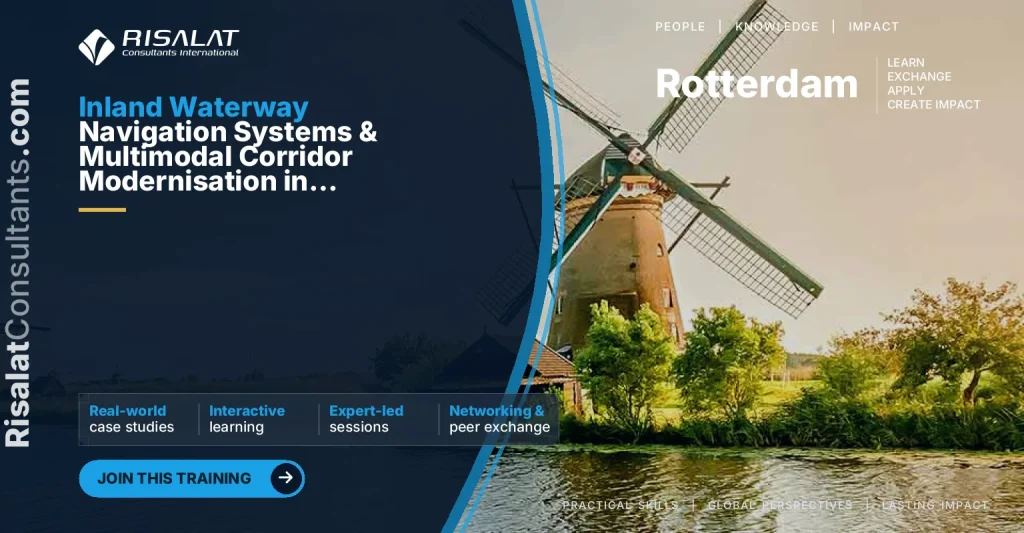
Inland Waterway Navigation Systems & Multimodal Corridor Modernisation in Rotterdam
Programme Overview
Inland waterway transport offers an energy-efficient, high-capacity alternative to congested road networks, particularly for rapidly industrialising economies managing substantial bulk and containerised cargo volumes. Modernising river corridors requires integrated technical approaches combining channel design, hydraulic management, digital navigation aids, and modernised terminal transfer infrastructure. Held in Rotterdam, Europe’s foremost multimodal shipping hub, this programme exposes transport professionals to advanced fairway management methodologies, operational planning frameworks, and sustainable dredging regimes essential for converting natural river corridors into reliable commercial transport routes.
Participants explore the operational systems that sustain heavy barge navigation, including River Information Services, hydrographic surveying, lock automation, and intermodal freight connectivity. The curriculum addresses technical fairway maintenance along with the institutional planning required to integrate river services into regional supply chains. Through technical case assessments and field exposures in the Rhine-Meuse-Scheldt delta, delegates examine how modern channel maintenance programmes, environmental protocols, and intelligent logistics interfaces operate under high-density commercial traffic conditions.
Delivered by Risalat Consultants International in Rotterdam, Netherlands, it combines expert-led sessions, real cases and group work, so that participants can apply what they learn in their own institution. Large-scale infrastructure initiatives, such as the Southern Waterway Corridors and Logistics Development Project investing 107m USD into upgrading key river corridors, reflect a strategic pivot towards inland water transport for sustainable trade growth. Delivering these extensive investments demands updated institutional capacity in capital dredging oversight, fairway maintenance, bank protection, and intermodal integration to ensure navigational reliability, climate resilience, and full economic return across national transport networks.
The programme strengthens institutional capability in:
- Classification of inland waterways: UNECE AGN standards and regional fairway dimensioning
- Channel hydrodynamics: vessel squat, bank suction, cross-currents, and navigation safety margins
- River morphology and sediment transport dynamics affecting commercial shipping channels
- Geotechnical design of bank protection works and climate-resilient revetments
- PIANC guidelines for inland navigation channel dimensions and layout design
- Hydrographic surveying technologies: multibeam echo sounding and channel depth validation
- Dredging methodologies: cutter suction, trailing suction hopper, and mechanical dredging suitability
- Procurement and oversight of capital versus maintenance dredging contracts
- Climate and environmental risk assessment
- Adaptation and mitigation planning
- Sector strategies for energy, water and land
- Project design for climate and environmental goals
- Funds
- Entity
- Project
- Results
- MRV
Why this matters now
Organisations increasingly require professionals capable of:
- Assess climate and environmental risks to their services and assets
- Design projects that meet climate and environmental goals
- Prepare proposals that financiers can approve
- Measure and report results credibly
- Work with communities and partners across sectors
Strong climate, environment and natural resources systems help organisations:
- Protect services and infrastructure from climate risks
- Access climate and environmental finance
- Meet national and international commitments
- Use natural resources sustainably
Who Should Attend
This programme is designed for:
- Vietnam Inland Waterways Administration technical and planning officers
- Transport ministry civil and hydraulic engineers
- Inland waterway infrastructure project implementation unit personnel
- Port and terminal logistics operations planners
- River basin navigation authority managers
- Dredging programme supervisors and hydrographic survey specialists
- Multimodal freight logistics corridor coordinators
- Transport sector public-private partnership procurement officers
- Donor-funded transport project engineering consultants
- Climate change and environment officers
- Energy, water and agriculture sector staff
- Planning and policy officers
Tick what your team needs to be able to do.
Programme Objectives
By the end of this programme participants will be able to:
- Evaluate fairway channel maintenance strategies using PIANC technical guidance and international navigation norms
- Formulate capital and maintenance dredging oversight programmes incorporating hydrographic monitoring and environmental safeguards
- Analyse modern lock, weir, and bank protection designs to improve waterway resilience and operational throughput
- Apply River Information Services standards to enhance commercial vessel tracking, traffic management, and navigational safety
- Assess intermodal barge-to-road and barge-to-rail transfer terminal connectivity for bulk and containerised freight
- Develop performance-based maintenance contracts for long-term fairway preservation and operational depth reliability
- Construct multimodal corridor modernisation plans that align national transport policy with donor-funded infrastructure requirements
- Explain the main climate and environmental challenges for their sector
- Assess climate and environmental risks to services and assets
- Plan adaptation and mitigation measures
Training Structure & Contents
- Classification of inland waterways: UNECE AGN standards and regional fairway dimensioning
- Channel hydrodynamics: vessel squat, bank suction, cross-currents, and navigation safety margins
- River morphology and sediment transport dynamics affecting commercial shipping channels
- Geotechnical design of bank protection works and climate-resilient revetments
- PIANC guidelines for inland navigation channel dimensions and layout design
- Workshop: Fairway Geometry, Hydrodynamics, and Channel Design: Applying It to Your Institution
- Hydrographic surveying technologies: multibeam echo sounding and channel depth validation
- Dredging methodologies: cutter suction, trailing suction hopper, and mechanical dredging suitability
- Procurement and oversight of capital versus maintenance dredging contracts
- Dredged material management: sediment characterisation, beneficial reuse, and disposal protocols
- Environmental mitigation standards and turbidity management during channel deepening operations
- Workshop: Dredging Oversight, Surveying, and Environmental Controls: Applying It to Your Institution
- Civil design principles for navigation locks, approach basins, and water-saving basins
- Lock automation, hydraulic gate mechanics, and throughput capacity optimisation
- River Information Services architecture: inland AIS, electronic navigational charts, and notices to skippers
- Vessel traffic services integration for high-density river networks and narrow fairway bottlenecks
- Rotterdam waterway traffic management study: coordinating seagoing and inland barge flows
- Case Study: Locks, Weirs, and Vessel Traffic Management Systems in Practice
- Inland terminal site selection, layout design, and waterfront cargo handling equipment
- Containerised and bulk barge terminal operations: berth productivity and quay crane cycle efficiency
- Barge-to-road and barge-to-rail intermodal transfer operational interfaces and bottleneck analysis
- Digital customs clearance, logistics tracking, and terminal operating system coordination
- Site inspection of modern inland barge transfer and trimodal terminal logistics facilities
- Workshop: Multimodal Logistics Hubs and Barge-to-Road Integration: Applying It to Your Institution
- Corridor-level infrastructure investment planning and multimodal demand forecasting
- Structuring performance-based fairway maintenance contracts and key performance indicators
- Waterway asset management systems: life-cycle costing from dredging to lock infrastructure
- Financing mechanisms and donor-funded project compliance for river corridor upgrades
- Participant presentations: formulating a river corridor modernisation action plan
- Capstone Exercise: Inland Waterway Navigation Systems & Multimodal Corridor Modernisation in Rotterdam Action Plan for Your Institution
Full day-by-day contents
First Day | Fairway Geometry, Hydrodynamics, and Channel Design
- Classification of inland waterways: UNECE AGN standards and regional fairway dimensioning
- Channel hydrodynamics: vessel squat, bank suction, cross-currents, and navigation safety margins
- River morphology and sediment transport dynamics affecting commercial shipping channels
- Geotechnical design of bank protection works and climate-resilient revetments
- PIANC guidelines for inland navigation channel dimensions and layout design
- Workshop: Fairway Geometry, Hydrodynamics, and Channel Design: Applying It to Your Institution
Second Day | Dredging Oversight, Surveying, and Environmental Controls
- Hydrographic surveying technologies: multibeam echo sounding and channel depth validation
- Dredging methodologies: cutter suction, trailing suction hopper, and mechanical dredging suitability
- Procurement and oversight of capital versus maintenance dredging contracts
- Dredged material management: sediment characterisation, beneficial reuse, and disposal protocols
- Environmental mitigation standards and turbidity management during channel deepening operations
- Workshop: Dredging Oversight, Surveying, and Environmental Controls: Applying It to Your Institution
Third Day | Locks, Weirs, and Vessel Traffic Management Systems & Multimodal Corridor Modernisation
- Civil design principles for navigation locks, approach basins, and water-saving basins
- Lock automation, hydraulic gate mechanics, and throughput capacity optimisation
- River Information Services architecture: inland AIS, electronic navigational charts, and notices to skippers
- Vessel traffic services integration for high-density river networks and narrow fairway bottlenecks
- Rotterdam waterway traffic management study: coordinating seagoing and inland barge flows
- Case Study: Locks, Weirs, and Vessel Traffic Management Systems in Practice
Fourth Day | Multimodal Logistics Hubs and Barge-to-Road Integration
- Inland terminal site selection, layout design, and waterfront cargo handling equipment
- Containerised and bulk barge terminal operations: berth productivity and quay crane cycle efficiency
- Barge-to-road and barge-to-rail intermodal transfer operational interfaces and bottleneck analysis
- Digital customs clearance, logistics tracking, and terminal operating system coordination
- Site inspection of modern inland barge transfer and trimodal terminal logistics facilities
- Workshop: Multimodal Logistics Hubs and Barge-to-Road Integration: Applying It to Your Institution
Fifth Day | Corridor Modernisation Planning and Infrastructure Asset Management
- Corridor-level infrastructure investment planning and multimodal demand forecasting
- Structuring performance-based fairway maintenance contracts and key performance indicators
- Waterway asset management systems: life-cycle costing from dredging to lock infrastructure
- Financing mechanisms and donor-funded project compliance for river corridor upgrades
- Participant presentations: formulating a river corridor modernisation action plan
- Capstone Exercise: Inland Waterway Navigation Systems & Multimodal Corridor Modernisation in Rotterdam Action Plan for Your Institution
Training Methodology
The programme runs over 5 days, combining expert-led sessions, real cases, small-group work, site inspection, and closing workshops or case studies. Each objective is practised during the course through exercises, cases or group work, so that participants leave able to apply what they learn in their own setting.
- Expert input and presentations
- Practical exercises and small-group work
- Technical case assessments and case studies
- Field exposures and site inspection of terminal logistics facilities
- Interactive workshops applying methods to participants’ own institutions
- Action planning capstone exercise
Expected Outcomes
- Ability to evaluate fairway maintenance using PIANC guidance and international norms
- Capability to establish capital and maintenance dredging oversight programmes with hydrographic monitoring
- Skills to assess lock, weir, and bank protection designs for waterway resilience and throughput
- Competence in applying River Information Services standards to vessel tracking and traffic safety
- Proficiency in analysing intermodal barge-to-road and barge-to-rail freight terminal interfaces
- Preparation of performance-based fairway maintenance specifications and contracts
- Formulation of multimodal corridor modernization plans aligned with transport policy and donor funding
- Delivery of an actionable corridor modernisation plan tailored to the participant’s home institution
£2,750 per participant · invoice and bank transfer · groups of 5 or more receive a discount
Five or more from one organisation: ask for the group rate on the invoice request.
Ten or more: an in-house version for your institution may cost less per person. Ask for an in-house quote.
Registration closes in 255 days (11 Aug 2027)
Who Will Deliver This Programme
Each date is delivered by a team assigned from Risalat's expert network for this subject. For this programme we assign:
How we choose them: Experience in the region of the participants or comparable settings; Command of the financier rules that apply (World Bank, ADB, AfDB, EU, UN) where relevant; Delivery in English; other languages on request for in-house groups; No conflict of interest with participants' institutions.
Training courses in RotterdamInfrastructure, Planning, and Development training courses
Why Rotterdam for this programme
Rotterdam is home to Europe's largest seaport, offering direct insight into international trade, modern logistics, and maritime management. Visiting officials can examine flood protection infrastructure such as the Maeslantkering and observe urban regeneration projects across the city. The location is easily accessible through Rotterdam The Hague Airport and frequent rail connections from Amsterdam Airport Schiphol.
The Inland Waterway Navigation Systems & Multimodal Corridor Modernisation in Rotterdam programme in September 2027 brings together officials and professionals from across Europe, Africa, the Middle East and Asia. Sessions combine short inputs, case studies and group work on participants' own files, and the city's institutions can be added as a study visit on request.
Getting there: Rotterdam The Hague Airport (RTM).
Check whether you need a visa with the free Visa Checker, and ask for an invitation letter once you are registered.
Other programmes in Rotterdam
- Urban Flood Resilience & Nature-Based Stormwater Drainage Engineering in Rotterdam
- Urban Flood Risk Reduction and Drainage Master Planning in Rotterdam
- Transport Corridor Management & Road Financing Training in Rotterdam
- Training on Humanitarian Negotiations and Decision-Making
- Training on Environmental, Social, and Governance (ESG) Fundamentals
Questions before you nominate your team? Book a 30-minute call with us, or ask for this programme in-house.
Is there water and sanitation training for government officials in Rotterdam in September 2027?
Can "Inland Waterway Navigation Systems & Multimodal Corridor Modernisation in Rotterdam" be delivered in-house for one organisation?
Which other water and sanitation programmes does Risalat run?
How do organisations register and pay?
For teams and institutions
Bring your team
Teams that learn together apply more at work. Tell us how many people and how you would like to take part: we reply with a group quote within two working days.
Watch: this programme in short


Other dates and cities for this subject: Water Supply and Sanitation Management training courses (96 upcoming dates).
More training courses in the Netherlands · All programmes in Europe · Full training calendar
Plan this programme in a roadmap: why it matters, why to approve it, the dates to plan and the career it builds.