关键信息
- 日期
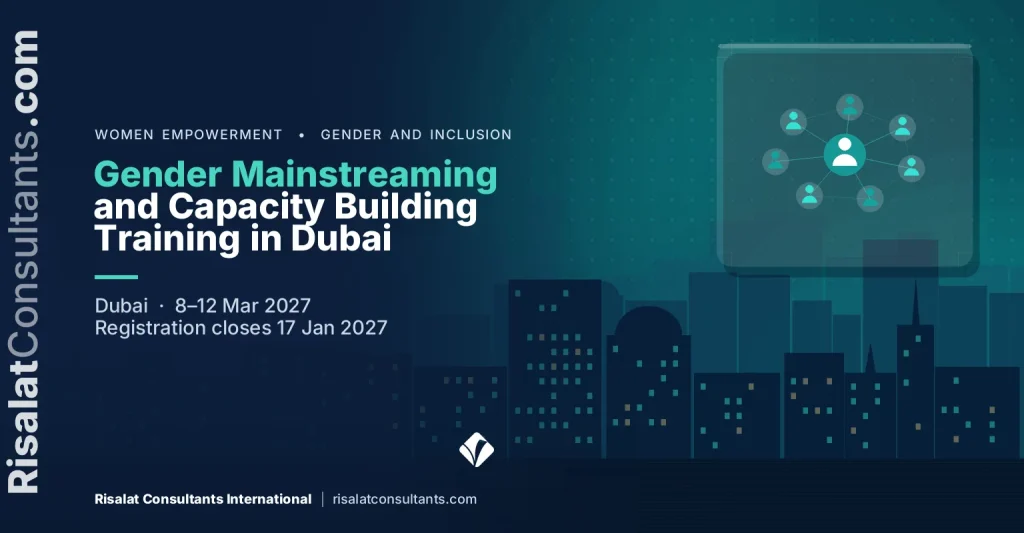
- 2027年3月8–12日(5天)
- 地点
- Studio M Arabian Plaza, Dubai, United Arab Emirates
- 每位学员费用
- £2,850(英镑)
- 付款
- 通过发票和银行转账付款
- 报名截止
- 2027年1月17日
- 形式
- 5-day short course: a practical capacity-building programme for government, NGO and project teams in Dubai
- 证书
- 结业证书
- 内训选项
- 按您的日期,为您的团队专场举办
本页内容16个部分
培训项目概述
This practical gender mainstreaming programme in Dubai is designed for professionals who must turn established technical guidance into reliable institutional practice. Participants examine the decisions, evidence, controls and working relationships that determine whether improvements endure beyond an individual course.
The learning journey covers gender concepts and structural barriers, institutional gender policy and mandates and gender analysis of services and budgets. Each topic is treated as an operational responsibility, not simply a theoretical concept.
Current primary guidance informs the programme, including World Bank Group Gender Strategy 2024-2030. Participants learn to identify which requirements apply to their organisation and how to document the reasoning behind their decisions.
The programme is hosted in Dubai, UAE. Case studies are adapted to the participant group; no external institutional visit, accreditation, funding allocation or regulatory endorsement is implied unless separately agreed and verified.
The Programme Strengthens Institutional Capability
- Gender concepts and structural barriers
- Institutional gender policy and mandates
- Gender analysis of services and budgets
- Sex-disaggregated and intersectional data
- Gender-responsive stakeholder engagement
- Inclusive consultation and participation
- 性别预算编制
- Gender action plans and responsibilities
- Preventing discrimination and exclusion
- Gender-sensitive indicators and results
- Safeguarding and grievance mechanisms
- Institutional gender audit and learning
- Apply a documented decision rule to gender mainstreaming
- Review evidence and data limitations for gender mainstreaming
- Define accountable owners and approval points for gender mainstreaming
- Record practical risks and corrective actions for gender mainstreaming
The emphasis is on practical templates, defensible decisions and an implementation plan that can be reviewed by a line manager.
性别主流化的日益重要性
Institutions are expected to show how their gender mainstreaming arrangements work in practice. Written policies alone cannot demonstrate sound decisions, quality assurance or follow-up when responsibilities are fragmented.
官方指导提供了有用的参考点:世界银行集团2024至2030年性别战略。该项目将该指导转化为团队在其自身运营环境中可使用的提问、检查和证据。
A structured approach makes it easier to distinguish a genuine control weakness from a documentation gap, set priorities and communicate progress without relying on unsupported performance claims.
各机构日益需要具备以下能力的专业人员:
- Gender concepts and structural barriers
- Institutional gender policy and mandates
- Gender analysis of services and budgets
- Sex-disaggregated and intersectional data
- Gender-responsive stakeholder engagement
- Inclusive consultation and participation
- 性别预算编制
- Gender action plans and responsibilities
- Preventing discrimination and exclusion
- Gender-sensitive indicators and results
- Apply a documented decision rule to institutional performance
Strong gender mainstreaming systems help organisations:
- Clarify decision rights and accountability
- 减少可避免的错误和返工
- Use evidence consistently across teams
- Identify implementation risks earlier
- Make records easier to review
- Improve coordination between functions
- Prioritise limited staff time
- Support defensible reporting to leadership
- Track corrective actions to completion
The course focuses on improvements that can be implemented with realistic resources and assigned owners.
谁应该参加本性别主流化培训?
本培训项目适合:
- 性别联络员
- Ministry policy advisers
- 项目经理
- Safeguards specialists
- Community engagement officers
- HR directors
- Budget analysts
- Monitoring officers
- 民间社会伙伴
- 社会发展专家
- Procurement officers
- Programme evaluators
Mixed teams are welcome where technical, operational and management perspectives need to be aligned. Participants should be able to discuss a current institutional process or case.
勾选您的团队需要具备的能力。
Gender Mainstreaming Training Objectives
Upon successful completion of this Gender Mainstreaming Training, participants will be able to:
- Explain the relevant official framework and its scope
- Diagnose a current institutional capability gap
- Select fit-for-purpose methods and controls
- Prepare a traceable evidence and decision record
- Design an achievable improvement plan
- Set indicators and reporting responsibilities
- Present findings clearly to senior management
- Gender concepts and structural barriers
- Institutional gender policy and mandates
- Gender analysis of services and budgets
- Sex-disaggregated and intersectional data
- Gender-responsive stakeholder engagement
Each objective is tested through an exercise, peer review or practical output during the programme.
1. What should an institution do before changing its gender mainstreaming procedures?
The official reference material on gender mainstreaming must be interpreted in its applicable context: https://www.worldbank.org/en/brief/2024/10/10/gender-strategy-update-2024-30-accelerating-equality-and-empowerment-for-all
2. Which output best supports implementation after training?
A documented implementation plan helps translate the principles in World Bank Group Gender Strategy 2024-2030 into operational practice.
3. 培训提供者何时可以声称外部组织认可某门课程?
Publishing an official guideline does not by itself confer endorsement or accreditation.
培训项目内容与结构
- Gender concepts and structural barriers
- Institutional gender policy and mandates
- Gender analysis of services and budgets
- Sex-disaggregated and intersectional data
- Gender-responsive stakeholder engagement
- Inclusive consultation and participation
- Apply a documented decision rule to gender analysis and institutional mandates
- Gender analysis of services and budgets
- Sex-disaggregated and intersectional data
- Gender-responsive stakeholder engagement
- Inclusive consultation and participation
- 性别预算编制
- Gender action plans and responsibilities
- Apply a documented decision rule to gender-responsive programme design
- Gender-responsive stakeholder engagement
- Inclusive consultation and participation
- 性别预算编制
- Gender action plans and responsibilities
- Preventing discrimination and exclusion
- Gender-sensitive indicators and results
- Apply a documented decision rule to participation safeguards and inclusion
- 性别预算编制
- Gender action plans and responsibilities
- Preventing discrimination and exclusion
- Gender-sensitive indicators and results
- Safeguarding and grievance mechanisms
- Institutional gender audit and learning
- 将有据可查的决策规则应用于预算编制指标和问责制
- Preventing discrimination and exclusion
- Gender-sensitive indicators and results
- Safeguarding and grievance mechanisms
- Institutional gender audit and learning
- Gender concepts and structural barriers
- Institutional gender policy and mandates
- 将有记录的决策规则应用于性别行动规划和机构变革
完整的每日课程内容
The five-day learning pathway moves from fundamentals to applied decisions, review and implementation.
- Day 1: Gender analysis and institutional mandates
- Day 2: Gender-responsive programme design
- Day 3: Participation safeguards and inclusion
- Day 4: Budgeting indicators and accountability
- Day 5: Gender action planning and institutional change
完整的每日课程内容
First Day | Gender analysis and institutional mandates
- Gender concepts and structural barriers
- Institutional gender policy and mandates
- Gender analysis of services and budgets
- Sex-disaggregated and intersectional data
- Gender-responsive stakeholder engagement
- Inclusive consultation and participation
- Apply a documented decision rule to gender analysis and institutional mandates
- Review evidence and data limitations for gender analysis and institutional mandates
- Define accountable owners and approval points for gender analysis and institutional mandates
Workshop: Gender analysis and institutional mandates in practice
Working with a realistic gender mainstreaming scenario, participants review the available records, identify the decisions that require justification and produce a practical output. The group tests assumptions, records risks and receives structured peer feedback. The result is a reusable template and a clear next step for the participant’s organisation.
Second Day | Gender-responsive programme design
- Gender analysis of services and budgets
- Sex-disaggregated and intersectional data
- Gender-responsive stakeholder engagement
- Inclusive consultation and participation
- 性别预算编制
- Gender action plans and responsibilities
- Apply a documented decision rule to gender-responsive programme design
- Review evidence and data limitations for gender-responsive programme design
- Define accountable owners and approval points for gender-responsive programme design
Case Study: Gender-responsive programme design in practice
Working with a realistic gender mainstreaming scenario, participants review the available records, identify the decisions that require justification and produce a practical output. The group tests assumptions, records risks and receives structured peer feedback. The result is a reusable template and a clear next step for the participant’s organisation.
Third Day | Participation safeguards and inclusion
- Gender-responsive stakeholder engagement
- Inclusive consultation and participation
- 性别预算编制
- Gender action plans and responsibilities
- Preventing discrimination and exclusion
- Gender-sensitive indicators and results
- Apply a documented decision rule to participation safeguards and inclusion
- Review evidence and data limitations for participation safeguards and inclusion
- Define accountable owners and approval points for participation safeguards and inclusion
Workshop: Participation safeguards and inclusion in practice
Working with a realistic gender mainstreaming scenario, participants review the available records, identify the decisions that require justification and produce a practical output. The group tests assumptions, records risks and receives structured peer feedback. The result is a reusable template and a clear next step for the participant’s organisation.
Fourth Day | Budgeting indicators and accountability
- 性别预算编制
- Gender action plans and responsibilities
- Preventing discrimination and exclusion
- Gender-sensitive indicators and results
- Safeguarding and grievance mechanisms
- Institutional gender audit and learning
- 将有据可查的决策规则应用于预算编制指标和问责制
- 审查预算指标和问责制的证据与数据局限性
- Define accountable owners and approval points for budgeting indicators and accountability
Case Study: Budgeting indicators and accountability in practice
Working with a realistic gender mainstreaming scenario, participants review the available records, identify the decisions that require justification and produce a practical output. The group tests assumptions, records risks and receives structured peer feedback. The result is a reusable template and a clear next step for the participant’s organisation.
Fifth Day | Gender action planning and institutional change
- Preventing discrimination and exclusion
- Gender-sensitive indicators and results
- Safeguarding and grievance mechanisms
- Institutional gender audit and learning
- Gender concepts and structural barriers
- Institutional gender policy and mandates
- 将有记录的决策规则应用于性别行动规划和机构变革
- Review evidence and data limitations for gender action planning and institutional change
- Define accountable owners and approval points for gender action planning and institutional change
Capstone Exercise: Gender action planning and institutional change in practice
Working with a realistic gender mainstreaming scenario, participants review the available records, identify the decisions that require justification and produce a practical output. The group tests assumptions, records risks and receives structured peer feedback. The result is a reusable template and a clear next step for the participant’s organisation.
Gender Mainstreaming Training Methodology
授课与引导式分析、真实的案例文件、小组练习以及简短的个人反思相结合。我们鼓励参与者带入非机密示例,并调整模板以适应他们自己的程序。
本培训项目融合了:
- 简短的专家讲解
- Official framework interpretation
- Guided document review
- Practical worksheets
- 特定角色模拟
- 小组解决问题
- Case comparisons
- Peer feedback
- Facilitator demonstrations
- Decision logs
- Daily learning reflections
- Final action planning
Exercises emphasise evidence quality, transparent assumptions and the limits of what a particular source or case can establish.
预期成果
Upon completion of this Gender Mainstreaming Training, participants will be able to:
- 阐述与其角色相关的治理原则
- 识别最重大的流程弱点
- Use a documented checklist to assess current practice
- Prepare a decision and evidence log
- Select appropriate operational indicators
- Communicate findings to non-specialists
- 识别角色与资源需求
- Draft a phased improvement roadmap
- Plan a review of progress and unresolved risks
Participants leave with a draft improvement plan and practical working materials, rather than an unsupported claim of organisational certification.
每位学员£2,850 · 发票与银行转账 · 5人及以上团体可享折扣
同一机构五人及以上:请在申请发票时索取团体价。
Ten or more: an in-house version for your institution may cost less per person. Ask for an in-house quote.
注册截止于 56天后 (2027年1月17日)
Institutional Application of Gender Mainstreaming Training
本培训项目帮助机构加强:
- Gender concepts and structural barriers
- Institutional gender policy and mandates
- Gender analysis of services and budgets
- Sex-disaggregated and intersectional data
- Gender-responsive stakeholder engagement
- Inclusive consultation and participation
- 性别预算编制
- Gender action plans and responsibilities
- Preventing discrimination and exclusion
- Gender-sensitive indicators and results
- Apply a documented decision rule to institutional accountability
学员将带着实用工具回到工作岗位,以提升:
- Process mapping and responsibility allocation
- Evidence and document review
- 风险与问题登记册
- Quality checklists
- Management briefings
- Action plans with owners
- 绩效指标
- Peer review and escalation
- Post-training learning transfer
Teams can use the outputs in internal planning, supervision and professional development without assuming that a specific donor has allocated funds for this course.
区域相关性与应用
亚洲
For organisations working in Asia, gender mainstreaming capabilities can support cross-border professional learning, service delivery and institutional reporting. The exercises are adaptable to local requirements; participants must verify the standards and laws that govern their own institution.
欧洲
For organisations working in Europe, gender mainstreaming capabilities can support regulatory interpretation, documentation and accountable management. The exercises are adaptable to local requirements; participants must verify the standards and laws that govern their own institution.
非洲
For organisations working in Africa, gender mainstreaming capabilities can support capacity-building, programme implementation and resource prioritisation. The exercises are adaptable to local requirements; participants must verify the standards and laws that govern their own institution.
中东
For organisations working in Middle East, gender mainstreaming capabilities can support institutional modernisation and performance management. The exercises are adaptable to local requirements; participants must verify the standards and laws that govern their own institution.
Regional examples are illustrative learning contexts, not claims that any particular project has commissioned or financed this programme.
东道国概况:阿联酋
Dubai provides an international setting for structured professional learning, peer exchange and reflection away from routine office demands. The programme retains the original advertised destination.
The training content uses official international reference material and participant case studies. No claim is made that an institution in Dubai has endorsed the course or agreed to receive a study visit.
Travel documentation, visa eligibility, local entry rules and accommodation arrangements should be checked individually before booking. The programme team can provide administrative guidance but cannot guarantee admission or a visa.
Gender Mainstreaming Training Deliverables
The following learning and participation services form the standard Risalat programme package, subject to the participant agreement and final logistical confirmation.
培训开始前
- 学员课前评估
- Gender Mainstreaming Readiness Assessment
- Gender Mainstreaming Resource Pack
- 课前阅读资料
- 免费签证支持与咨询
培训期间
- 机场接机与欢迎协助
- Accommodation with breakfast: 6 nights, check-in Sunday 7 March 2027, check-out Saturday 13 March 2027 (one night before and one night after the programme)
- 欢迎交流晚宴
- Risalat培训礼包(背包、水瓶、马克杯、T恤、帽子、护照套、笔、笔记本、冰箱贴及钥匙扣)
- Comprehensive Gender Mainstreaming Training Manual
- Assessment checklist
- Decision log template
- 风险和行动登记册
- Evidence review worksheet
- Management briefing template
- 实践研讨与模拟演练
- 小组讨论与同伴学习
- 每日午餐与茶歇
- 全面使用培训场地设施
- 装有数字学习资料的迷你平板电脑
- 实地考察(如适用,以确认结果为准)
- 城市休闲观光
培训结束后
- 结业证书
- Risalat培训项目参与表彰奖
- 培训后参考资料
- Personal improvement roadmap
- Institutional action tracker
- Post-training reflection checklist
- 培训后支持与跟进指导
- 培训项目报告
Institutions may request a tailored in-house version through the Risalat proposal request form.
Common Challenges in Gender Mainstreaming, And How This Training Helps
我们的团队如何识别最紧急的能力差距?
Day 1 addresses this challenge through a guided exercise on gender analysis and institutional mandates. Participants use a checklist, discuss competing choices and document an action that can be tested in their own institution.
How can we interpret official guidance consistently?
Day 2 addresses this challenge through a guided exercise on gender-responsive programme design. Participants use a checklist, discuss competing choices and document an action that can be tested in their own institution.
How can we improve decisions without adding unnecessary bureaucracy?
Day 3 addresses this challenge through a guided exercise on participation safeguards and inclusion. Participants use a checklist, discuss competing choices and document an action that can be tested in their own institution.
How can we demonstrate that evidence is reliable?
Day 4 addresses this challenge through a guided exercise on budgeting indicators and accountability. Participants use a checklist, discuss competing choices and document an action that can be tested in their own institution.
How can we involve technical and management colleagues effectively?
Day 5 addresses this challenge through a guided exercise on gender action planning and institutional change. Participants use a checklist, discuss competing choices and document an action that can be tested in their own institution.
How can we turn training into an institutional action plan?
Day 5 addresses this challenge through a guided exercise on gender action planning and institutional change. Participants use a checklist, discuss competing choices and document an action that can be tested in their own institution.
学员返回后,我们如何监测改进情况?
Day 5 addresses this challenge through a guided exercise on gender action planning and institutional change. Participants use a checklist, discuss competing choices and document an action that can be tested in their own institution.
Explore further professional development options through Risalat programme categories and use the training needs assessment to prioritise team learning requirements.
常见问题
Who is this programme intended for?
It is intended for professionals responsible for gender mainstreaming decisions, supervision or reporting.
Is previous experience required?
Professional familiarity is useful. A pre-assessment helps tailor the level of practical exercises.
Are institutional visits guaranteed?
No. Any external visit depends on host approval, access and logistics and is confirmed separately.
学员能将哪些收获带回工作中?
Templates, case notes, a documented action plan and post-training reference materials.
本培训项目能否以内训形式举办?
Yes. Risalat can adapt the content to an institutional team and its operational priorities.
Who Will Deliver This Programme
Each date is delivered by a team assigned from Risalat's expert network for this subject. For this programme we assign:
How we choose them: Experience in the region of the participants or comparable settings; Command of the financier rules that apply (World Bank, ADB, AfDB, EU, UN) where relevant; Delivery in English; other languages on request for in-house groups; No conflict of interest with participants' institutions.
迪拜培训课程Women Empowerment training courses
为何选择在迪拜举办本培训项目
迪拜是通往非洲、亚洲和欧洲的一站直达枢纽,对许多国家的公民提供简便的签证政策,并拥有现代化的培训场地。
The Gender Mainstreaming and Capacity Building Training in Dubai programme in March 2027 brings together officials and professionals from across the Middle East region and beyond. Sessions combine short inputs, case studies and group work on participants' own files, and the city's institutions can be added as a study visit on request.
交通:迪拜国际机场(DXB)。
使用免费的签证查询工具确认您是否需要签证,完成报名后即可申请邀请函。
其他城市的同主题培训
- 内罗毕的分散式可再生能源特许经营与太阳能混合系统(内罗毕)
- Agribusiness Value Addition and Smallholder Market Linkages in Accra (Accra)
- Productive Safety Nets and Electronic Social Registry Implementation in Nairobi (Nairobi)
- Last-Mile Solar Mini-Grid Deployment and Productive Use Programmes in Nairobi (Nairobi)
- Rural Road Maintenance Systems and Community Access Planning in Kuala Lumpur (Kuala Lumpur)
- Agri-Nutrition Strategy, Extension Delivery and Value Addition in Bangkok (Bangkok)
迪拜的其他培训项目
Teams often travel here from Maldives, Sri Lanka, Bangladesh, Nepal, Pakistan, Afghanistan, Kazakhstan, Uzbekistan. Funding, visa letters and group rates are explained on each country page.
Free roadmap: Training and Capacity Building: a 12-month plan for your team
- 环境与社会框架(ESF) 世界银行
- 经济合作与发展组织(OECD) OECD
For teams and institutions
Bring your team
Teams that learn together apply more at work. Tell us how many people and how you would like to take part: we reply with a group quote within two working days.
Watch: this programme in short

Other dates and cities for this subject: Gender Mainstreaming and Women's Economic Empowerment training courses (24 upcoming dates).
阿拉伯联合酋长国更多培训课程 · 中东所有培训项目 · 完整培训日历
在路线图中规划此项目:为什么重要、为什么要批准它、要计划的日期以及它所构建的职业生涯。