Points clés
- Dates
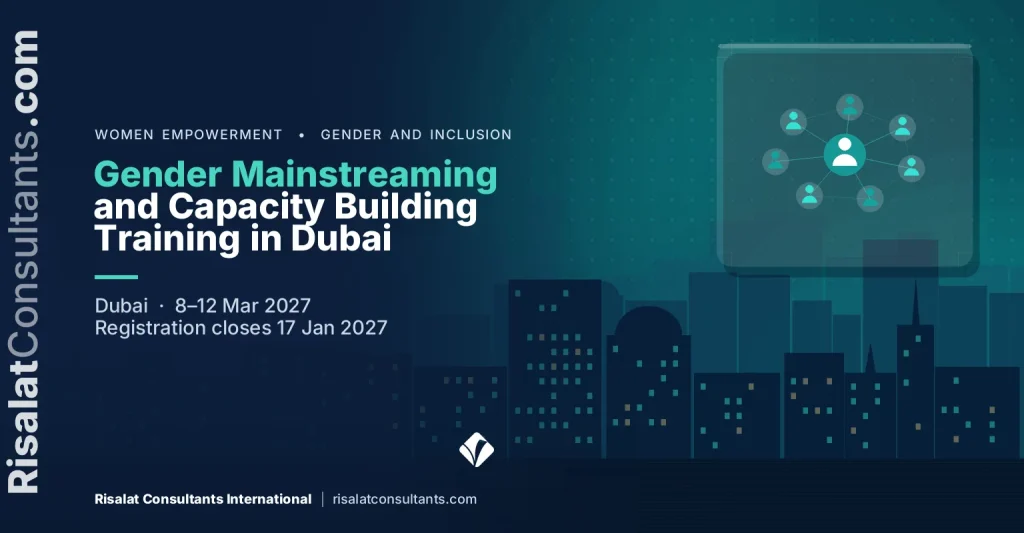
- 8–12 mars 2027 (5 jours)
- Lieu
- Studio M Arabian Plaza, Dubai, United Arab Emirates
- Frais par participant
- 2 850 £ (GBP)
- Paiement
- Sur facture et par virement bancaire
- Clôture des inscriptions
- 17 janv. 2027
- Format
- 5-day short course: a practical capacity-building programme for government, NGO and project teams in Dubai
- Certificat
- Certificat de participation
- Option intra
- Organisez-le pour votre équipe, à vos dates
Sur cette page 16 sections
Présentation du programme
This practical gender mainstreaming programme in Dubai is designed for professionals who must turn established technical guidance into reliable institutional practice. Participants examine the decisions, evidence, controls and working relationships that determine whether improvements endure beyond an individual course.
The learning journey covers gender concepts and structural barriers, institutional gender policy and mandates and gender analysis of services and budgets. Each topic is treated as an operational responsibility, not simply a theoretical concept.
Current primary guidance informs the programme, including World Bank Group Gender Strategy 2024-2030. Participants learn to identify which requirements apply to their organisation and how to document the reasoning behind their decisions.
The programme is hosted in Dubai, UAE. Case studies are adapted to the participant group; no external institutional visit, accreditation, funding allocation or regulatory endorsement is implied unless separately agreed and verified.
The Programme Strengthens Institutional Capability
- Gender concepts and structural barriers
- Institutional gender policy and mandates
- Gender analysis of services and budgets
- Sex-disaggregated and intersectional data
- Gender-responsive stakeholder engagement
- Inclusive consultation and participation
- Budgétisation sensible au genre
- Gender action plans and responsibilities
- Preventing discrimination and exclusion
- Gender-sensitive indicators and results
- Safeguarding and grievance mechanisms
- Institutional gender audit and learning
- Apply a documented decision rule to gender mainstreaming
- Review evidence and data limitations for gender mainstreaming
- Define accountable owners and approval points for gender mainstreaming
- Record practical risks and corrective actions for gender mainstreaming
The emphasis is on practical templates, defensible decisions and an implementation plan that can be reviewed by a line manager.
The Growing Importance of Gender Mainstreaming
Institutions are expected to show how their gender mainstreaming arrangements work in practice. Written policies alone cannot demonstrate sound decisions, quality assurance or follow-up when responsibilities are fragmented.
Official guidance provides a useful reference point: World Bank Group Gender Strategy 2024-2030. The programme converts that guidance into questions, checks and evidence that a team can use in its own operating environment.
A structured approach makes it easier to distinguish a genuine control weakness from a documentation gap, set priorities and communicate progress without relying on unsupported performance claims.
Les organisations ont de plus en plus besoin de professionnels capables de :
- Gender concepts and structural barriers
- Institutional gender policy and mandates
- Gender analysis of services and budgets
- Sex-disaggregated and intersectional data
- Gender-responsive stakeholder engagement
- Inclusive consultation and participation
- Budgétisation sensible au genre
- Gender action plans and responsibilities
- Preventing discrimination and exclusion
- Gender-sensitive indicators and results
- Appliquer une règle de décision documentée à la performance institutionnelle
Strong gender mainstreaming systems help organisations:
- Clarify decision rights and accountability
- Réduire les erreurs évitables et le travail redondant
- Use evidence consistently across teams
- Identify implementation risks earlier
- Make records easier to review
- Improve coordination between functions
- Prioritise limited staff time
- Support defensible reporting to leadership
- Track corrective actions to completion
The course focuses on improvements that can be implemented with realistic resources and assigned owners.
Who Should Attend This Gender Mainstreaming Training?
Ce programme s'adresse à :
- Gender focal points
- Ministry policy advisers
- Chefs de projet
- Safeguards specialists
- Community engagement officers
- HR directors
- Budget analysts
- Monitoring officers
- Civil society partners
- Spécialistes du développement social
- Procurement officers
- Programme evaluators
Mixed teams are welcome where technical, operational and management perspectives need to be aligned. Participants should be able to discuss a current institutional process or case.
Cochez ce que votre équipe doit être capable de faire.
Gender Mainstreaming Training Objectives
Upon successful completion of this Gender Mainstreaming Training, participants will be able to:
- Explain the relevant official framework and its scope
- Diagnose a current institutional capability gap
- Select fit-for-purpose methods and controls
- Prepare a traceable evidence and decision record
- Design an achievable improvement plan
- Set indicators and reporting responsibilities
- Présenter clairement les conclusions à la haute direction
- Gender concepts and structural barriers
- Institutional gender policy and mandates
- Gender analysis of services and budgets
- Sex-disaggregated and intersectional data
- Gender-responsive stakeholder engagement
Each objective is tested through an exercise, peer review or practical output during the programme.
1. What should an institution do before changing its gender mainstreaming procedures?
The official reference material on gender mainstreaming must be interpreted in its applicable context: https://www.worldbank.org/en/brief/2024/10/10/gender-strategy-update-2024-30-accelerating-equality-and-empowerment-for-all
2. Which output best supports implementation after training?
Un plan de mise en œuvre documenté aide à traduire les principes de la Stratégie pour l'égalité hommes-femmes 2024-2030 du Groupe de la Banque mondiale en pratique opérationnelle.
3. When may a training provider claim that an external organisation endorses a course?
Publishing an official guideline does not by itself confer endorsement or accreditation.
Contenu et structure du programme
- Gender concepts and structural barriers
- Institutional gender policy and mandates
- Gender analysis of services and budgets
- Sex-disaggregated and intersectional data
- Gender-responsive stakeholder engagement
- Inclusive consultation and participation
- Appliquer une règle de décision documentée à l'analyse de genre et aux mandats institutionnels
- Gender analysis of services and budgets
- Sex-disaggregated and intersectional data
- Gender-responsive stakeholder engagement
- Inclusive consultation and participation
- Budgétisation sensible au genre
- Gender action plans and responsibilities
- Apply a documented decision rule to gender-responsive programme design
- Gender-responsive stakeholder engagement
- Inclusive consultation and participation
- Budgétisation sensible au genre
- Gender action plans and responsibilities
- Preventing discrimination and exclusion
- Gender-sensitive indicators and results
- Apply a documented decision rule to participation safeguards and inclusion
- Budgétisation sensible au genre
- Gender action plans and responsibilities
- Preventing discrimination and exclusion
- Gender-sensitive indicators and results
- Safeguarding and grievance mechanisms
- Institutional gender audit and learning
- Apply a documented decision rule to budgeting indicators and accountability
- Preventing discrimination and exclusion
- Gender-sensitive indicators and results
- Safeguarding and grievance mechanisms
- Institutional gender audit and learning
- Gender concepts and structural barriers
- Institutional gender policy and mandates
- Appliquer une règle de décision documentée à la planification de l'action genre et au changement institutionnel
Contenu détaillé jour par jour
The five-day learning pathway moves from fundamentals to applied decisions, review and implementation.
- Day 1: Gender analysis and institutional mandates
- Day 2: Gender-responsive programme design
- Day 3: Participation safeguards and inclusion
- Day 4: Budgeting indicators and accountability
- Day 5: Gender action planning and institutional change
Contenu détaillé jour par jour
First Day | Gender analysis and institutional mandates
- Gender concepts and structural barriers
- Institutional gender policy and mandates
- Gender analysis of services and budgets
- Sex-disaggregated and intersectional data
- Gender-responsive stakeholder engagement
- Inclusive consultation and participation
- Appliquer une règle de décision documentée à l'analyse de genre et aux mandats institutionnels
- Review evidence and data limitations for gender analysis and institutional mandates
- Define accountable owners and approval points for gender analysis and institutional mandates
Workshop: Gender analysis and institutional mandates in practice
Working with a realistic gender mainstreaming scenario, participants review the available records, identify the decisions that require justification and produce a practical output. The group tests assumptions, records risks and receives structured peer feedback. The result is a reusable template and a clear next step for the participant’s organisation.
Deuxième jour | Conception de programmes tenant compte du genre
- Gender analysis of services and budgets
- Sex-disaggregated and intersectional data
- Gender-responsive stakeholder engagement
- Inclusive consultation and participation
- Budgétisation sensible au genre
- Gender action plans and responsibilities
- Apply a documented decision rule to gender-responsive programme design
- Review evidence and data limitations for gender-responsive programme design
- Define accountable owners and approval points for gender-responsive programme design
Case Study: Gender-responsive programme design in practice
Working with a realistic gender mainstreaming scenario, participants review the available records, identify the decisions that require justification and produce a practical output. The group tests assumptions, records risks and receives structured peer feedback. The result is a reusable template and a clear next step for the participant’s organisation.
Third Day | Participation safeguards and inclusion
- Gender-responsive stakeholder engagement
- Inclusive consultation and participation
- Budgétisation sensible au genre
- Gender action plans and responsibilities
- Preventing discrimination and exclusion
- Gender-sensitive indicators and results
- Apply a documented decision rule to participation safeguards and inclusion
- Review evidence and data limitations for participation safeguards and inclusion
- Define accountable owners and approval points for participation safeguards and inclusion
Workshop: Participation safeguards and inclusion in practice
Working with a realistic gender mainstreaming scenario, participants review the available records, identify the decisions that require justification and produce a practical output. The group tests assumptions, records risks and receives structured peer feedback. The result is a reusable template and a clear next step for the participant’s organisation.
Fourth Day | Budgeting indicators and accountability
- Budgétisation sensible au genre
- Gender action plans and responsibilities
- Preventing discrimination and exclusion
- Gender-sensitive indicators and results
- Safeguarding and grievance mechanisms
- Institutional gender audit and learning
- Apply a documented decision rule to budgeting indicators and accountability
- Examiner les données probantes et les limites des données pour les indicateurs budgétaires et la reddition de comptes
- Définir des responsables comptables et des points d'approbation pour les indicateurs budgétaires et la reddition de comptes
Case Study: Budgeting indicators and accountability in practice
Working with a realistic gender mainstreaming scenario, participants review the available records, identify the decisions that require justification and produce a practical output. The group tests assumptions, records risks and receives structured peer feedback. The result is a reusable template and a clear next step for the participant’s organisation.
Fifth Day | Gender action planning and institutional change
- Preventing discrimination and exclusion
- Gender-sensitive indicators and results
- Safeguarding and grievance mechanisms
- Institutional gender audit and learning
- Gender concepts and structural barriers
- Institutional gender policy and mandates
- Appliquer une règle de décision documentée à la planification de l'action genre et au changement institutionnel
- Review evidence and data limitations for gender action planning and institutional change
- Define accountable owners and approval points for gender action planning and institutional change
Exercice de synthèse : Planification d'action genre et changement institutionnel en pratique
Working with a realistic gender mainstreaming scenario, participants review the available records, identify the decisions that require justification and produce a practical output. The group tests assumptions, records risks and receives structured peer feedback. The result is a reusable template and a clear next step for the participant’s organisation.
Gender Mainstreaming Training Methodology
Facilitated instruction is paired with guided analysis, realistic case files, group exercises and short individual reflections. Participants are encouraged to bring non-confidential examples and adapt the templates to their own procedures.
Le programme associe :
- Courts exposés d'experts
- Official framework interpretation
- Guided document review
- Practical worksheets
- Role-specific simulations
- Group problem-solving
- Case comparisons
- Peer feedback
- Facilitator demonstrations
- Decision logs
- Réflexions quotidiennes sur l'apprentissage
- Final action planning
Exercises emphasise evidence quality, transparent assumptions and the limits of what a particular source or case can establish.
Résultats attendus
Upon completion of this Gender Mainstreaming Training, participants will be able to:
- Explain the governing principles relevant to their role
- Identify the most material process weaknesses
- Use a documented checklist to assess current practice
- Prepare a decision and evidence log
- Select appropriate operational indicators
- Communicate findings to non-specialists
- Identify roles and resource needs
- Draft a phased improvement roadmap
- Plan a review of progress and unresolved risks
Participants leave with a draft improvement plan and practical working materials, rather than an unsupported claim of organisational certification.
2 850 £ par participant · facture et virement bancaire · réduction pour les groupes de 5 personnes ou plus
Cinq personnes ou plus d'une même organisation : demandez le tarif de groupe lors de votre demande de facture.
Ten or more: an in-house version for your institution may cost less per person. Ask for an in-house quote.
Registration closes in 56 days (17 Jan 2027)
Application institutionnelle de la formation sur l'intégration de la dimension genre
Ce programme aide les organisations à renforcer :
- Gender concepts and structural barriers
- Institutional gender policy and mandates
- Gender analysis of services and budgets
- Sex-disaggregated and intersectional data
- Gender-responsive stakeholder engagement
- Inclusive consultation and participation
- Budgétisation sensible au genre
- Gender action plans and responsibilities
- Preventing discrimination and exclusion
- Gender-sensitive indicators and results
- Apply a documented decision rule to institutional accountability
Les participants repartent avec des outils pratiques pour améliorer :
- Process mapping and responsibility allocation
- Evidence and document review
- Risk and issue registers
- Quality checklists
- Management briefings
- Action plans with owners
- Performance indicators
- Peer review and escalation
- Post-training learning transfer
Teams can use the outputs in internal planning, supervision and professional development without assuming that a specific donor has allocated funds for this course.
Pertinence régionale & mise en application
Asie
For organisations working in Asia, gender mainstreaming capabilities can support cross-border professional learning, service delivery and institutional reporting. The exercises are adaptable to local requirements; participants must verify the standards and laws that govern their own institution.
Europe
For organisations working in Europe, gender mainstreaming capabilities can support regulatory interpretation, documentation and accountable management. The exercises are adaptable to local requirements; participants must verify the standards and laws that govern their own institution.
Afrique
For organisations working in Africa, gender mainstreaming capabilities can support capacity-building, programme implementation and resource prioritisation. The exercises are adaptable to local requirements; participants must verify the standards and laws that govern their own institution.
Moyen-Orient
For organisations working in Middle East, gender mainstreaming capabilities can support institutional modernisation and performance management. The exercises are adaptable to local requirements; participants must verify the standards and laws that govern their own institution.
Regional examples are illustrative learning contexts, not claims that any particular project has commissioned or financed this programme.
Profil du pays d'accueil – EAU
Dubai provides an international setting for structured professional learning, peer exchange and reflection away from routine office demands. The programme retains the original advertised destination.
The training content uses official international reference material and participant case studies. No claim is made that an institution in Dubai has endorsed the course or agreed to receive a study visit.
Travel documentation, visa eligibility, local entry rules and accommodation arrangements should be checked individually before booking. The programme team can provide administrative guidance but cannot guarantee admission or a visa.
Gender Mainstreaming Training Deliverables
The following learning and participation services form the standard Risalat programme package, subject to the participant agreement and final logistical confirmation.
Avant le programme
- Pré-évaluation des participants
- Gender Mainstreaming Readiness Assessment
- Kit de ressources pour l'intégration du genre
- Lectures préparatoires
- Aide et conseils gratuits pour le visa
Pendant le programme
- Accueil à l'aéroport & assistance à l'arrivée
- Hébergement avec petit-déjeuner : 6 nuits, arrivée le dimanche 7 mars 2027, départ le samedi 13 mars 2027 (une nuit avant et une nuit après le programme)
- Dîner de bienvenue et de réseautage
- Kit de formation Risalat (sac, gourde, mug, t-shirt, casquette, protège-passeport, stylos, carnet, magnet & porte-clés)
- Comprehensive Gender Mainstreaming Training Manual
- Assessment checklist
- Decision log template
- Registre des risques et des mesures
- Evidence review worksheet
- Management briefing template
- Ateliers pratiques & simulations
- Discussions de groupe & apprentissage entre pairs
- Déjeuner et pauses-café quotidiens
- Accès complet aux installations du lieu de formation
- Mini tablette avec supports pédagogiques numériques
- Field Visit (where applicable, subject to confirmation)
- Visite récréative de la ville
Après le programme
- Certificat de participation
- Distinction Risalat de participation au programme
- Documents de référence après la formation
- Feuille de route pour l'amélioration personnelle
- Institutional action tracker
- Post-training reflection checklist
- Accompagnement après la formation & conseils de suivi
- Rapport du programme
Institutions may request a tailored in-house version through the Risalat proposal request form.
Common Challenges in Gender Mainstreaming, And How This Training Helps
How can our team identify the most urgent capability gaps?
Day 1 addresses this challenge through a guided exercise on gender analysis and institutional mandates. Participants use a checklist, discuss competing choices and document an action that can be tested in their own institution.
How can we interpret official guidance consistently?
Day 2 addresses this challenge through a guided exercise on gender-responsive programme design. Participants use a checklist, discuss competing choices and document an action that can be tested in their own institution.
How can we improve decisions without adding unnecessary bureaucracy?
Day 3 addresses this challenge through a guided exercise on participation safeguards and inclusion. Participants use a checklist, discuss competing choices and document an action that can be tested in their own institution.
How can we demonstrate that evidence is reliable?
Le jour 4 aborde ce défi à travers un exercice guidé sur les indicateurs budgétaires et la responsabilisation. Les participants utilisent une liste de contrôle, discutent des choix concurrents et documentent une action qui peut être testée dans leur propre institution.
How can we involve technical and management colleagues effectively?
Day 5 addresses this challenge through a guided exercise on gender action planning and institutional change. Participants use a checklist, discuss competing choices and document an action that can be tested in their own institution.
How can we turn training into an institutional action plan?
Day 5 addresses this challenge through a guided exercise on gender action planning and institutional change. Participants use a checklist, discuss competing choices and document an action that can be tested in their own institution.
How can we monitor improvements after participants return?
Day 5 addresses this challenge through a guided exercise on gender action planning and institutional change. Participants use a checklist, discuss competing choices and document an action that can be tested in their own institution.
Explore further professional development options through Risalat programme categories and use the training needs assessment to prioritise team learning requirements.
Questions fréquentes
Who is this programme intended for?
It is intended for professionals responsible for gender mainstreaming decisions, supervision or reporting.
Is previous experience required?
Professional familiarity is useful. A pre-assessment helps tailor the level of practical exercises.
Are institutional visits guaranteed?
No. Any external visit depends on host approval, access and logistics and is confirmed separately.
Qu'est-ce que les participants rapporteront dans leur travail ?
Templates, case notes, a documented action plan and post-training reference materials.
Le programme peut-il être dispensé en intra ?
Yes. Risalat can adapt the content to an institutional team and its operational priorities.
Who Will Deliver This Programme
Each date is delivered by a team assigned from Risalat's expert network for this subject. For this programme we assign:
How we choose them: Experience in the region of the participants or comparable settings; Command of the financier rules that apply (World Bank, ADB, AfDB, EU, UN) where relevant; Delivery in English; other languages on request for in-house groups; No conflict of interest with participants' institutions.
Training courses in DubaiWomen Empowerment training courses
Pourquoi Dubaï pour ce programme
Dubaï est une plateforme accessible en un seul vol depuis l'Afrique, l'Asie et l'Europe, avec des visas simples pour de nombreuses nationalités et des lieux de formation modernes.
The Gender Mainstreaming and Capacity Building Training in Dubai programme in March 2027 brings together officials and professionals from across the Middle East region and beyond. Sessions combine short inputs, case studies and group work on participants' own files, and the city's institutions can be added as a study visit on request.
Accès : aéroport international de Dubaï (DXB).
Vérifiez si vous avez besoin d'un visa avec le vérificateur de visa gratuit, et demandez une lettre d'invitation une fois inscrit.
Le même thème dans d'autres villes
- Decentralised Renewable Energy Concessions and Solar Hybrid Systems in Nairobi (Nairobi)
- Agribusiness Value Addition and Smallholder Market Linkages in Accra (Accra)
- Productive Safety Nets and Electronic Social Registry Implementation in Nairobi (Nairobi)
- Last-Mile Solar Mini-Grid Deployment and Productive Use Programmes in Nairobi (Nairobi)
- Rural Road Maintenance Systems and Community Access Planning in Kuala Lumpur (Kuala Lumpur)
- Agri-Nutrition Strategy, Extension Delivery and Value Addition in Bangkok (Bangkok)
Autres programmes à Dubaï
Teams often travel here from Maldives, Sri Lanka, Bangladesh, Nepal, Pakistan, Afghanistan, Kazakhstan, Uzbekistan. Funding, visa letters and group rates are explained on each country page.
Free roadmap: Training and Capacity Building: a 12-month plan for your team
Pour les équipes et les institutions
Bring your team
Teams that learn together apply more at work. Tell us how many people and how you would like to take part: we reply with a group quote within two working days.
Watch: this programme in short

Other dates and cities for this subject: Gender Mainstreaming and Women's Economic Empowerment training courses (24 upcoming dates).
More training courses in the United Arab Emirates · Tous les programmes au Moyen-Orient · Calendrier complet des formations
Plan this programme in a roadmap: why it matters, why to approve it, the dates to plan and the career it builds.