Points clés
- Dates
- 26–30 Apr 2027 (5 days)
- Lieu
- TBD, Copenhagen, Denmark
- Frais par participant
- 4 650 £ (GBP)
- Paiement
- Sur facture et par virement bancaire
- Clôture des inscriptions
- 29 Jan 2027
- À qui s'adresse-t-il
- Project implementation unit (PIU) staff; Environmental and social safeguards specialists; Government and public sector officials
- Certificat
- Certificat de participation
- Option intra
- Organisez-le pour votre équipe, à vos dates
Présentation du programme
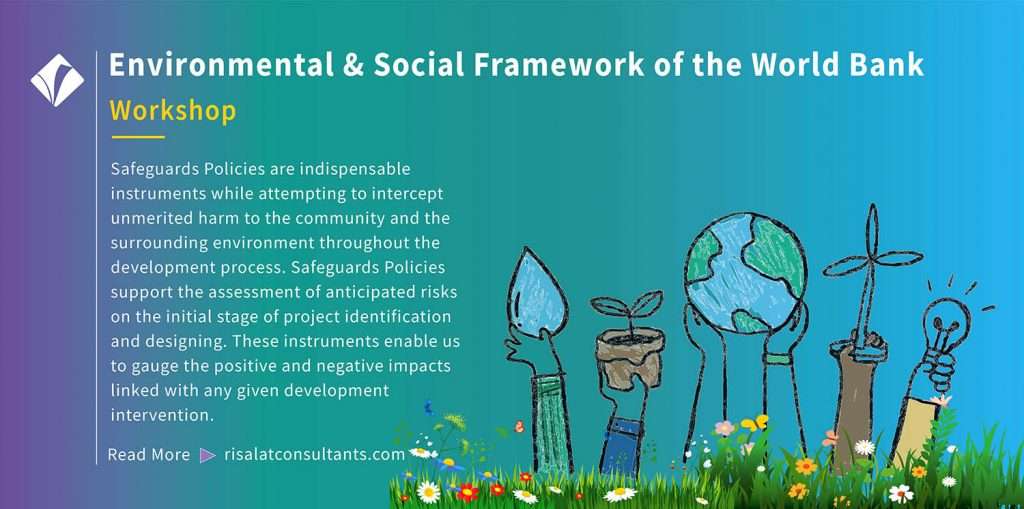
World Bank Environmental and Social Framework (ESF) Training focuses on strengthening the capacity of governments, project implementation units, development partners, and donor-funded project teams to effectively understand, apply, and manage environmental and social risk requirements across World Bank-financed projects.
As development financing increasingly emphasizes sustainability, accountability, and stakeholder protection, organizations implementing infrastructure, public sector, energy, transport, and social development projects must comply with strong environmental and social safeguards. Many institutions face challenges in understanding ESF requirements, managing environmental and social risks, stakeholder engagement, labor standards, land acquisition, community health and safety, and grievance redress systems.
This programme addresses these challenges by equipping participants with practical tools, internationally aligned frameworks, and strategic approaches to implementing the World Bank Environmental and Social Framework (ESF), including approaches applied in practical safeguards implementation frameworks covering risk assessment, compliance monitoring, stakeholder consultation, environmental and social commitment planning, and institutional safeguards management.
Participants will gain hands-on experience in environmental and social risk screening, ESF implementation planning, compliance systems, project monitoring, reporting obligations, and institutional coordination. The programme emphasizes real-world application, enabling participants to strengthen safeguards systems, improve project compliance, and support successful project delivery.
Additionally, strong environmental and social safeguards systems are essential for protecting communities, improving development outcomes, reducing implementation risks, and ensuring compliance with World Bank project financing requirements.
Public cible
This programme is designed for professionals involved in project implementation, safeguards management, compliance, and donor-funded development programmes, including:
- Personnel des unités de gestion de projet (UGP)
- Spécialistes des sauvegardes environnementales et sociales
- Fonctionnaires et agents du secteur public
- Infrastructure and public works project teams
- Professionnels de la passation des marchés et de la gestion des contrats
- Partenaires du développement et personnel des projets financés par les bailleurs
- Professionnels du suivi et de l'évaluation
- Compliance officers and risk management teams
- NGOs and social development practitioners
- Consultants working on World Bank-financed projects
Cochez ce que votre équipe doit être capable de faire.
Objectives of World Bank Environmental and Social Framework (ESF) Training
À l'issue de la formation, les participants seront en mesure de :
- Understand the structure and requirements of the World Bank ESF
- Apply Environmental and Social Standards (ESSs) effectively
- Conduct environmental and social risk screening and assessment
- Strengthen stakeholder engagement and consultation systems
- Improve labor management and community health safeguards
- Manage land acquisition, resettlement, and social inclusion requirements
- Strengthen grievance redress mechanisms and accountability systems
- Improve institutional compliance monitoring and reporting
- Align project delivery with donor safeguards requirements
- Develop practical ESF implementation and compliance action plans
World Bank Environmental and Social Framework (ESF) Training Structure & Content
- Introduction to the World Bank Environmental and Social Framework
- Understanding the Environmental and Social Standards (ESSs)
- Institutional responsibilities and borrower obligations
- Classification des risques environnementaux et sociaux
- Principles of proportionality, mitigation, and compliance
- Environmental impact assessment and mitigation planning
- Biodiversity protection and pollution prevention
- Resource efficiency and sustainable project implementation
- Community health and safety requirements
- Climate risk considerations within ESF implementation
- Stakeholder engagement and consultation planning
- Labor management procedures and working conditions
- Land acquisition and involuntary resettlement
- Vulnerable groups and social inclusion strategies
- Community grievance redress mechanisms
- Environmental and social commitment plans (ESCPs)
- Monitoring, supervision, and compliance reporting
- Contractor management and safeguards responsibilities
- Incident reporting and corrective action systems
- Internal controls and institutional accountability mechanisms
- Building institutional safeguards management systems
- Integrating ESF into project governance and procurement
- Strengthening cross-sector coordination and accountability
- Linking safeguards compliance with project performance outcomes
- Developing sustainable environmental and social compliance systems
Contenu détaillé jour par jour
First Day | Foundations of the Environmental and Social Framework
- Introduction to the World Bank Environmental and Social Framework
- Understanding the Environmental and Social Standards (ESSs)
- Institutional responsibilities and borrower obligations
- Classification des risques environnementaux et sociaux
- Principles of proportionality, mitigation, and compliance
Exercise: ESF risk identification and screening
Second Day | Environmental Risk Management and Assessment
- Environmental impact assessment and mitigation planning
- Biodiversity protection and pollution prevention
- Resource efficiency and sustainable project implementation
- Community health and safety requirements
- Climate risk considerations within ESF implementation
These systems are closely aligned with sustainable infrastructure and environmental governance frameworks used in major development projects.
Workshop: Environmental safeguards planning
Third Day | Social Risk Management and Stakeholder Engagement
- Stakeholder engagement and consultation planning
- Labor management procedures and working conditions
- Land acquisition and involuntary resettlement
- Vulnerable groups and social inclusion strategies
- Community grievance redress mechanisms
Strong social safeguards systems are further strengthened through effective community development planning and stakeholder coordination approaches, as demonstrated in real-world safeguards workshop experience across donor-funded development projects.
Case Study: Managing stakeholder risks in project implementation
Fourth Day | Institutional Compliance and Monitoring Systems
- Environmental and social commitment plans (ESCPs)
- Monitoring, supervision, and compliance reporting
- Contractor management and safeguards responsibilities
- Incident reporting and corrective action systems
- Internal controls and institutional accountability mechanisms
Modern safeguards systems also require stronger governance, documentation, and compliance oversight to ensure successful project delivery, supported by lessons from practical workshops on environmental and social safeguards across development projects.
Simulation: Compliance monitoring and corrective action response
Jour 5 | Renforcement institutionnel et intégration stratégique
- Building institutional safeguards management systems
- Integrating ESF into project governance and procurement
- Strengthening cross-sector coordination and accountability
- Linking safeguards compliance with project performance outcomes
- Developing sustainable environmental and social compliance systems
Capstone Exercise: Institutional ESF implementation strategy
Effective ESF implementation integrates safeguards management, compliance systems, stakeholder engagement, and institutional accountability within project delivery systems.
Méthodologie du programme
This World Bank Environmental and Social Framework (ESF) Training uses an applied, practice-oriented methodology combining expert-led sessions, real-world case studies, simulations, and interactive workshops.
Participants will engage in hands-on exercises focused on environmental risk screening, social safeguards planning, compliance monitoring, stakeholder engagement, and institutional safeguards implementation to ensure direct application within their organizations.
Principales méthodes pédagogiques :
- Case studies from real World Bank-financed projects
- Practical safeguards planning exercises
- Compliance simulations and risk assessments
- Stakeholder consultation workshops
- Tools, templates, and ESF compliance frameworks
- Sessions d'apprentissage entre pairs et de plan d'action institutionnel
Participants leave with practical tools and strategies to strengthen safeguards systems and improve ESF compliance across development projects. Participants can also explore practical implementation examples through this safeguards training video, showcasing real-world safeguards application and institutional learning outcomes.
Expected Outcomes of World Bank Environmental and Social Framework (ESF) Training
Participants will strengthen their ability to manage environmental and social risks and ensure compliance with World Bank safeguards requirements.
Ils seront en mesure de :
- Improve ESF implementation and compliance systems
- Strengthen safeguards planning and institutional coordination
- Reduce project risks and implementation delays
- Improve stakeholder engagement and grievance management
- Strengthen environmental and social monitoring systems
- Enhance institutional transparency and accountability
- Support successful delivery of donor-funded development projects
4 650 £ par participant · facture et virement bancaire · remise pour les groupes de 5 personnes ou plus
Cinq personnes ou plus d'une même organisation : demandez le tarif de groupe lors de votre demande de facture.
Ten or more: an in-house version for your institution may cost less per person. Ask for an in-house quote.
Registration closes in 88 days (29 Jan 2027)
Application institutionnelle
This programme supports organizations in strengthening safeguards systems, improving ESF compliance, and reducing implementation risks across donor-funded and public sector development projects.
Participants will return with practical tools to improve project controls, strengthen safeguards accountability, and support effective environmental and social risk management.
Strong environmental and social compliance systems are essential for safeguarding communities, ensuring regulatory compliance, and delivering sustainable development outcomes.
Ces approches sont renforcées par des systèmes intégrés de gouvernance, de passation des marchés, de suivi et de performance institutionnelle alignés sur les meilleures pratiques internationales.
Regional Relevance & Application of ESF Training
Environmental and social safeguards challenges continue to affect infrastructure investments, public sector programmes, and donor-funded development projects across rapidly developing regions where institutional systems and compliance mechanisms are evolving.
This World Bank Environmental and Social Framework (ESF) Training is highly relevant for professionals working in:
- Africa, where infrastructure expansion and donor-funded projects require strong safeguards compliance and stakeholder protection
- South Asia, where large-scale transport, energy, and public works programmes demand stronger environmental and social risk management
- Southeast Asia, where rapid urbanization and development financing require improved safeguards governance and project accountability
- Middle East, where major infrastructure and development investments require stronger compliance systems and social safeguards implementation
Across these regions, institutions face increasing pressure to improve safeguards compliance, strengthen accountability, and ensure alignment with international development financing standards.
This programme equips participants with practical tools and globally aligned methodologies to improve safeguards implementation, manage environmental and social risks effectively, and strengthen institutional performance across complex project environments.
Host Country Profile – Copenhagen
As one of Europe’s leading cities in sustainable urban development, climate resilience, and inclusive governance, Copenhagen offers valuable exposure to modern approaches in environmental safeguards, stakeholder engagement, social inclusion, and responsible project implementation, supported by real environmental and social safeguards workshop experiences in Copenhagen. Its strong institutional reputation makes it a highly respected destination for executive and government-focused professional training.
Denmark’s emphasis on sustainability, transparency, environmental protection, and social accountability aligns closely with global efforts to strengthen safeguards compliance and responsible development financing across public sector and donor-funded projects, supported by institutions such as State of Green and the Danish Ministry of Environment, which play key roles in advancing sustainable development, environmental governance, and responsible infrastructure planning.
Hosting this programme in Copenhagen allows participants to gain practical insights into international best practices in environmental and social safeguards management while benefiting from a professional, high-level, and sustainability-driven learning environment.
Livrables de la formation
Les participants bénéficient d'une expérience complète et de grande qualité, conçue pour favoriser un apprentissage efficace, l'application pratique et un impact institutionnel durable.
Avant le programme
- Participant Pre-Assessment aligned with ESF and safeguards competencies
- Customized preparatory materials on World Bank safeguards systems
- Aide et conseils gratuits pour le visa
- Accueil à l'aéroport et assistance à l'arrivée
- Hébergement avec petit-déjeuner quotidien pendant toute la durée du programme
- Dîner de bienvenue et de réseautage avec les participants et l'équipe Risalat
Pendant le programme
- Kit de formation Risalat Executive comprenant : sac, gourde, mug, t-shirt, casquette, protège-passeport, stylos, carnet, magnet et porte-clés
- Mini tablette préchargée avec les supports de formation (que les participants conservent)
- Manuel de cours complet et supports de formation
- ESF Implementation Toolkit including templates, compliance checklists, stakeholder engagement plans, and safeguards monitoring frameworks
- Sample reporting tools, safeguards dashboards, and compliance tracking templates
- Exercices pratiques, simulations et ateliers de groupe
- Déjeuner et pauses-café quotidiens pendant les sessions de formation
- Accès complet aux installations du lieu de formation et aux ressources pédagogiques
- Accès aux supports d'apprentissage en ligne et aux ressources après les sessions
- Field visit (where applicable) to observe safeguards implementation systems
- Visite récréative de la ville et découverte culturelle
Après le programme
- Certificat de participation
- Distinction Risalat de participation au programme
- Accompagnement après la formation et conseils de suivi
- Access to additional tools, templates, and updated safeguards resources
- Rapport du programme et synthèse des acquis
Participants will leave equipped with practical tools, strategic frameworks, and applied knowledge to strengthen ESF compliance, improve safeguards systems, reduce project risks, and deliver stronger institutional development outcomes.
Pour une participation en groupe, une formation sur mesure ou un partenariat institutionnel, contactez Risalat Consultants International afin de réserver vos places et d'obtenir des options de programme adaptées. Le nombre de places limité garantit une expérience d'apprentissage ciblée et à fort impact.
Tous les programmes à CopenhaguePlus de programmes Changement climatique & environnement
Pourquoi Copenhague pour ce programme
Copenhague (Danemark) a été choisie pour ce programme car elle est facilement accessible pour les participants attendus et dispose de lieux adaptés à une formation pratique et interactive.
The World Bank Environmental and Social Framework (ESF) Training programme in April 2027 brings together officials and professionals. Sessions combine short inputs, case studies and group work on participants' own files, and the city's institutions can be added as a study visit on request.
Vérifiez si vous avez besoin d'un visa avec le vérificateur de visa gratuit, et demandez une lettre d'invitation une fois inscrit.
Le même thème dans d'autres villes
- Formation à la gestion des risques E&S dans la reconstruction après inondations à Istanbul (Istanbul)
- Réhabilitation d'infrastructures publiques résilientes & gestion de la qualité des travaux de génie civil (Nadi)
- Formation à la protection sociale numérique : protection sociale assistée par l'IA & gestion intégrée des dossiers (Lisbonne)
- Formation aux fondamentaux de la construction & de l'entretien routiers (Hanoï)
- Formation à l'accès à la finance climatique & à l'élaboration de propositions (Genève)
- Gestion financière pour le développement durable de projets (Sydney)
Autres programmes à Copenhague
- Programme stratégie & leadership pour directeurs financiers & immersion
- Formation aux sauvegardes environnementales & sociales (CES de la Banque mondiale, normes de performance de l'IFC & SPS de la BAD)
- Formation et voyage d'étude sur la transition énergétique décentralisée à Copenhague
- Formation et visite sur les sauvegardes environnementales et sociales à Copenhague
Plus de formations au Danemark · Tous les programmes en Europe · Calendrier complet des formations