Key facts
- Dates
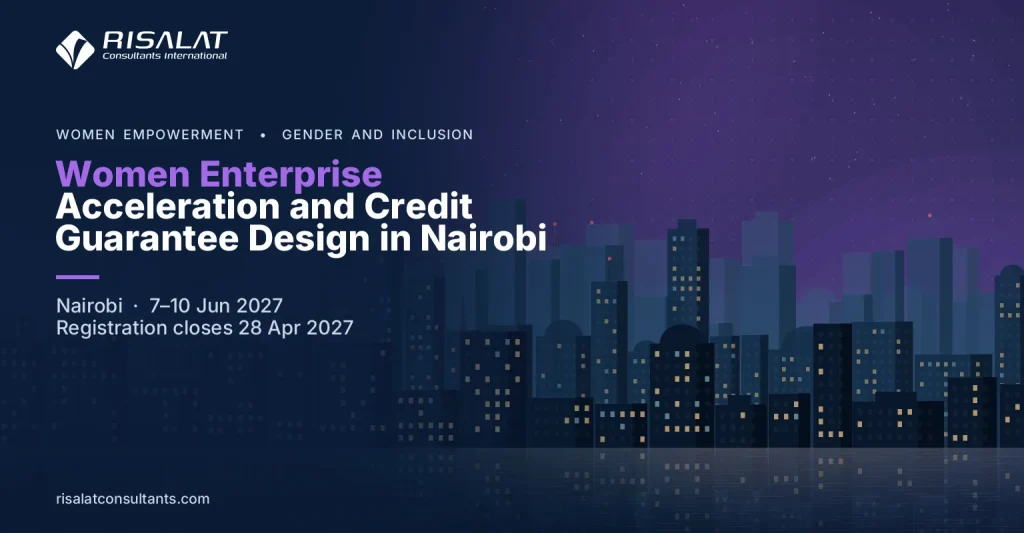
- 7–10 Jun 2027 (4 days)
- Where
- Nairobi, Kenya
- Fee per participant
- £2,350 (GBP)
- Payment
- By invoice and bank transfer
- Registration closes
- 28 Apr 2027
- Format
- 4-day short course: a practical capacity-building programme for government, NGO and project teams in Nairobi
- In-house option
- Run it for your team, on your dates
On this page 9 sections
Women Enterprise Acceleration and Credit Guarantee Design in Nairobi
Programme Overview
Women entrepreneurs across East Africa continue to face persistent barriers to capital and formal business services. This four-day intensive programme in Nairobi addresses the strategic and operational mechanics of female enterprise growth, focusing on the interface between targeted business development services and blended finance structures. Participants analyse how to tailor financing mechanisms to overcome collateral constraints, information asymmetries, and institutional biases that routinely limit female-led micro and small enterprises from scaling up sustainably.
The curriculum equips technical specialists with the tools required to formulate viable credit risk-sharing facilities, portfolio guarantee models, and performance-based enterprise grants. Through real-world donor operational modalities, participants examine how to structure partial credit guarantee schemes alongside non-financial advisory pipelines. The course links capital access with enterprise productivity, ensuring that financial intermediaries and business development service providers coordinate effectively within public sector and donor-financed interventions.
Emphasis is placed on project governance, compliance with international environmental and social standards, and robust performance management. Delegates will gain hands-on expertise in developing operational eligibility criteria, social safeguarding plans, and monitoring frameworks suitable for multi-stakeholder enterprise support programmes. The sessions prepare practitioners to implement transparent, accountable, and high-impact interventions that meet the rigorous appraisal and supervision standards of international development institutions.
The programme strengthens institutional capability in:
- Diagnostics of female enterprise ecosystems and institutional constraints in East Africa
- Addressing collateral deficits: Moveable assets, psychometrics, and alternative credit appraisal
- Evaluating microfinance, tier-four institutions, and commercial bank downscaling approaches
- Structuring targeted business acceleration: Advisory services, business incubators, and mentorship pipelines
- Case analysis of regional enterprise promotion initiatives and institutional delivery gaps
- Mechanics of partial credit guarantees (PCGs): Individual, portfolio, and hybrid structures
- Pricing, coverage ratios, capitalisation options, and counter-indemnity arrangements
- Operational workflows between project implementation units and participating financial intermediaries
- Budget preparation and execution
- Financial reporting and accounting standards
- Cash and treasury management
- Internal control over payments and assets
Why this matters now
Organisations increasingly require professionals capable of:
- Prepare and execute budgets in line with plans
- Produce accurate, timely financial reports
- Apply controls over payments and assets
- Meet financier financial management requirements
- Use financial information to support decisions
Strong public financial management and finance systems help organisations:
- Improve budget credibility and execution
- Produce reliable reports and clean audits
- Reduce payment delays and errors
- Build trust with financiers and oversight bodies
Who Should Attend
This programme is designed for:
- Enterprise development specialists managing donor-funded interventions
- Social fund coordinators overseeing livelihood and inclusion portfolios
- Microfinance programme officers structuring female-focused financial products
- Project Implementation Unit (PIU) personnel handling economic inclusion programmes
- Financial inclusion advisors in ministries of trade, gender, or finance
- Credit and risk officers from participating financial intermediaries
- Business development service (BDS) facility managers and technical advisors
- Monitoring and evaluation specialists responsible for private sector support operations
- Finance managers and accountants
- Budget officers and analysts
- Treasury and cash management staff
- Financial management specialists in PIUs
Tick what your team needs to be able to do.
Programme Objectives
By the end of this programme participants will be able to:
- Analyse structural financing barriers and market failures affecting female-led enterprises in East Africa
- Design partial credit guarantee instruments and risk-sharing facilities tailored for women micro-entrepreneurs
- Structure blended finance and matching grant mechanisms linked with formal business advisory pipelines
- Formulate transparent eligibility criteria and verification protocols for enterprise selection and onboarding
- Integrate international environmental and social standards into women enterprise acceleration operations
- Develop performance-based contracting frameworks for third-party business development service providers
- Establish robust monitoring, reporting, and evaluation frameworks for multi-stakeholder enterprise interventions
- Explain the budget cycle and the role of each actor
- Prepare and monitor budgets linked to plans
- Apply the main principles of the relevant reporting standards
Training Structure & Contents
- Diagnostics of female enterprise ecosystems and institutional constraints in East Africa
- Addressing collateral deficits: Moveable assets, psychometrics, and alternative credit appraisal
- Evaluating microfinance, tier-four institutions, and commercial bank downscaling approaches
- Structuring targeted business acceleration: Advisory services, business incubators, and mentorship pipelines
- Case analysis of regional enterprise promotion initiatives and institutional delivery gaps
- Workshop: Applying Day 1 methods to institutional examples and agreeing practical next steps
- Mechanics of partial credit guarantees (PCGs): Individual, portfolio, and hybrid structures
- Pricing, coverage ratios, capitalisation options, and counter-indemnity arrangements
- Operational workflows between project implementation units and participating financial intermediaries
- Credit risk assessment, default claim administration, and recovery management procedures
- Integrating performance grants with loan guarantees to foster enterprise graduation
- Workshop: Applying Day 2 methods to institutional examples and agreeing practical next steps
- Drafting objective enterprise selection criteria and transparent beneficiary targeting mechanisms
- Applying the World Bank Environmental and Social Framework (ESF) to financial intermediary subprojects
- Establishing grievance redress mechanisms (GRM) tailored for female entrepreneurs and communities
- Preventing and mitigating sexual exploitation, abuse, and harassment (SEAH) in enterprise facilities
- Anti-money laundering and know-your-customer (KYC) proportional compliance for informal firms
- Case Study: Governance, Eligibility Criteria, and Environmental and Social Safeguards in Practice
- Developing gender-disaggregated key performance indicators and results measurement frameworks
- Designing management information systems (MIS) for real-time portfolio and advisory tracking
- Procurement and contract management for business development service providers and mentors
- Drafting project operational manuals (POM) and risk-mitigation matrices for financial facilities
- Participant presentations: Action planning for national women enterprise acceleration facilities
- Capstone Exercise: Women Enterprise Acceleration and Credit Guarantee Design Action Plan for your institution
- Review of credit risk-sharing structures, portfolio guarantees, and matching grant modalities
- Consolidation of environmental, social, and governance standards across operational workflows
- Refinement of performance-based contracts and business development service pipelines
- Peer review of participant institutional action plans, risk matrices, and operational manuals
- Facilitated group evaluation of multi-stakeholder monitoring and results frameworks
Full day-by-day contents
First Day | Day 1: Female Enterprise Financing Diagnostics and Ecosystem Mapping
- Diagnostics of female enterprise ecosystems and institutional constraints in East Africa
- Addressing collateral deficits: Moveable assets, psychometrics, and alternative credit appraisal
- Evaluating microfinance, tier-four institutions, and commercial bank downscaling approaches
- Structuring targeted business acceleration: Advisory services, business incubators, and mentorship pipelines
- Case analysis of regional enterprise promotion initiatives and institutional delivery gaps
- Workshop: Applying Day 1 methods to institutional examples and agreeing practical next steps
Second Day | Day 2: Credit Guarantee Facility Architecture and Risk-Sharing Design
- Mechanics of partial credit guarantees (PCGs): Individual, portfolio, and hybrid structures
- Pricing, coverage ratios, capitalisation options, and counter-indemnity arrangements
- Operational workflows between project implementation units and participating financial intermediaries
- Credit risk assessment, default claim administration, and recovery management procedures
- Integrating performance grants with loan guarantees to foster enterprise graduation
- Workshop: Applying Day 2 methods to institutional examples and agreeing practical next steps
Third Day | Day 3: Governance, Eligibility Criteria, and Environmental and Social Safeguards
- Drafting objective enterprise selection criteria and transparent beneficiary targeting mechanisms
- Applying the World Bank Environmental and Social Framework (ESF) to financial intermediary subprojects
- Establishing grievance redress mechanisms (GRM) tailored for female entrepreneurs and communities
- Preventing and mitigating sexual exploitation, abuse, and harassment (SEAH) in enterprise facilities
- Anti-money laundering and know-your-customer (KYC) proportional compliance for informal firms
- Case Study: Governance, Eligibility Criteria, and Environmental and Social Safeguards in Practice
Fourth Day | Day 4: Monitoring, Operational Planning, and Multi-Stakeholder Coordination
- Developing gender-disaggregated key performance indicators and results measurement frameworks
- Designing management information systems (MIS) for real-time portfolio and advisory tracking
- Procurement and contract management for business development service providers and mentors
- Drafting project operational manuals (POM) and risk-mitigation matrices for financial facilities
- Participant presentations: Action planning for national women enterprise acceleration facilities
- Capstone Exercise: Women Enterprise Acceleration and Credit Guarantee Design Action Plan for your institution
Fifth Day | Review, Consolidation, and Implementation Planning
- Review of credit risk-sharing structures, portfolio guarantees, and matching grant modalities
- Consolidation of environmental, social, and governance standards across operational workflows
- Refinement of performance-based contracts and business development service pipelines
- Peer review of participant institutional action plans, risk matrices, and operational manuals
- Facilitated group evaluation of multi-stakeholder monitoring and results frameworks
Training Methodology
The training employs an applied, practitioner-focused delivery model based on adult learning principles. Instruction blends structured presentations on international project standards with facilitated working groups, technical drafting exercises, and comparative analysis of live East African enterprise funds. Participants work directly on operational templates, testing eligibility scoring matrices, guarantee settlement terms, and safeguarding workflows in peer-reviewed practical formats.
- Expert-led instructional presentations on operational modalities and standards
- Small-group workshops applying methods directly to participant institutions
- Case study analysis comparing choices against good practice
- Technical drafting exercises and operational template testing
- Peer-reviewed practical assignments and capstone institutional action planning
Expected Outcomes
- Capability to design and implement partial credit guarantee schemes and blended finance facilities for female-led enterprises
- Proficiency in setting up objective targeting mechanisms, eligibility criteria, and verification procedures
- Ability to embed environmental and social safeguards, including grievance redress and harassment prevention protocols, into project finance operations
- Competence in managing performance-based contracts for business development service providers and monitoring enterprise acceleration results
- Completed institutional action plans tailored with priorities and implementation steps for participants’ own organisations
£2,350 per participant · invoice and bank transfer · groups of 5 or more receive a discount
Five or more from one organisation: ask for the group rate on the invoice request.
Ten or more: an in-house version for your institution may cost less per person. Ask for an in-house quote.
Registration closes in 150 days (28 Apr 2027)
Who Will Deliver This Programme
Each date is delivered by a team assigned from Risalat's expert network for this subject. For this programme we assign:
How we choose them: Experience in the region of the participants or comparable settings; Command of the financier rules that apply (World Bank, ADB, AfDB, EU, UN) where relevant; Delivery in English; other languages on request for in-house groups; No conflict of interest with participants' institutions.
Training courses in NairobiWomen Empowerment training courses
Why Nairobi for this programme
Nairobi hosts UNEP, UN-Habitat and many regional offices, with flights across Africa.
The Women Enterprise Acceleration and Credit Guarantee Design in Nairobi programme in June 2027 brings together officials and professionals from across the Africa region and beyond. Sessions combine short inputs, case studies and group work on participants' own files, and the city's institutions can be added as a study visit on request.
Getting there: Jomo Kenyatta (NBO).
Check whether you need a visa with the free Visa Checker, and ask for an invitation letter once you are registered.
Other programmes in Nairobi
- Sustainable Finance and Green Taxonomies in Nairobi
- AI in Monitoring, Evaluation and Learning Training in Nairobi
- Fraud Detection, Investigation and Prevention in Nairobi
- Modern Agricultural Irrigation Systems & Drainage Asset Management in Nairobi
- Seed Systems, Agronomic Extension and Climate-Resilient Cropping in Nairobi
Questions before you nominate your team? Book a 30-minute call with us, or ask for this programme in-house.
Teams often travel here from Sudan, Somalia, Ethiopia, Kenya, Uganda, Tanzania, Rwanda, South Sudan. Funding, visa letters and group rates are explained on each country page.
Is there gender and inclusion training for government officials in Nairobi in June 2027?
Can "Women Enterprise Acceleration and Credit Guarantee Design in Nairobi" be delivered in-house for one organisation?
Which other gender and inclusion programmes does Risalat run?
How do organisations register and pay?
For teams and institutions
Bring your team
Teams that learn together apply more at work. Tell us how many people and how you would like to take part: we reply with a group quote within two working days.
Watch: this programme in short


Other dates and cities for this subject: Gender Mainstreaming and Women's Economic Empowerment training courses (25 upcoming dates).
More training courses in Kenya · All programmes in Africa · Full training calendar
Plan this programme in a roadmap: why it matters, why to approve it, the dates to plan and the career it builds.