Key facts
- Dates
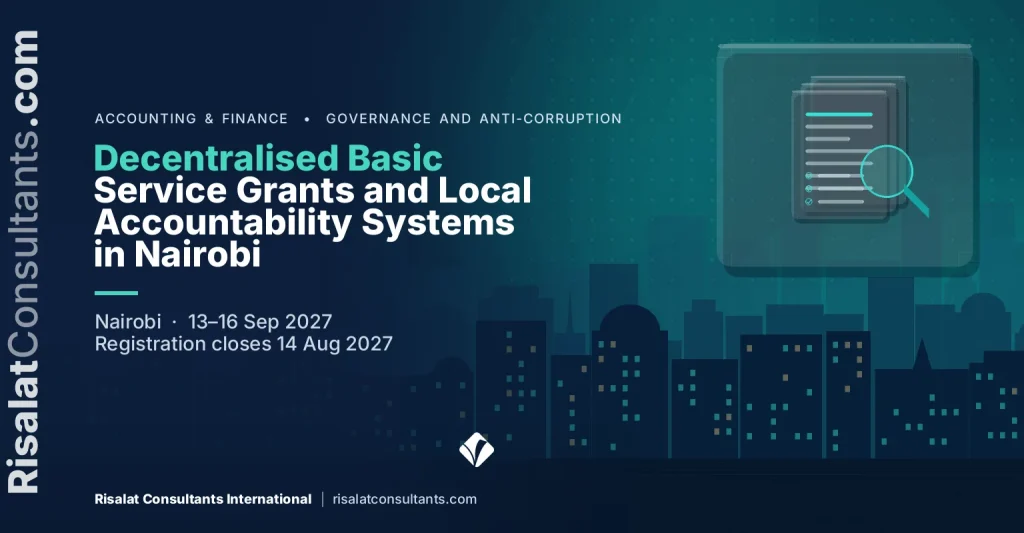
- 13–16 Sep 2027 (4 days)
- Where
- Nairobi, Kenya
- Fee per participant
- £1,850 (GBP)
- Payment
- By invoice and bank transfer
- Registration closes
- 14 Aug 2027
- Who it is for
- Sub-national finance administrators managing regional grant transfers; Woreda administrators and district-level chief executives; Service accountab…
- Certificate
- Certificate of completion
- In-house option
- Run it for your team, on your dates
On this page 12 sections
Programme Overview
Sub-national governments face critical responsibilities in delivering frontline public services, requiring robust financial architecture and responsive governance. This course provides comprehensive training on intergovernmental fiscal transfers, transparent grant administration, and institutional oversight mechanisms. Participants analyse the structuring of decentralised basic service grants, focusing on balancing equity, efficiency, and administrative feasibility. Through comparative regional analysis, administrators examine how transparent financing mechanisms translate into measurable improvements in essential public services, particularly across healthcare, education, agricultural extension, water, and rural roads sectors.
The curriculum examines the technical management of formula-based block grant allocations, expenditure tracking, and public financial accountability frameworks. Public officials interrogate the operational linkages between regional treasury disbursements and local-level budget execution, identifying systemic bottlenecks that impede resource flows. Emphasis is placed on international public sector accounting principles, multi-sector service delivery norms, and rigorous auditing frameworks. Participants gain practical competencies in establishing local expenditure tracking systems that minimise fiduciary exposure while maintaining budget discipline and timely service outputs across decentralised jurisdictions.
Beyond financial management, the programme explores civic engagement channels, grievance redress mechanisms, and social accountability infrastructure. Officials learn to institutionalise citizen-driven monitoring systems, community scorecards, and participatory budgeting practices within formal local government operations. By bridging sub-national finance departments and community stakeholders, the course fosters institutional transparency and responsive administrative leadership. Participants leave equipped to align sub-national administrative procedures with standard international monitoring criteria, safeguarding equitable access to vital basic services for vulnerable and remote populations.
Sub-national administrations are managing unprecedented volumes of decentralised capital to deliver essential services amid tightening fiscal constraints and heightened demands for equity. Large-scale development investments, including the US$925m Enhancing Shared Prosperity through Equitable Services project, require regional and woreda administrations to demonstrate transparent resource allocation, verifiable financial reporting, and functional grievance redress channels. Building institutional competence in formula-based grant management and citizen-led accountability ensures that decentralised financing directly mitigates geographic disparities in education and healthcare without administrative delay or leakage.
Delivered by Risalat Consultants International in Nairobi, Kenya, it combines expert-led sessions, real cases and group work, so that participants can apply what they learn in their own institution.
The Programme Strengthens Institutional Capability
- Architecture of intergovernmental fiscal transfer systems in decentralised states
- Design principles for equitable formula-based horizontal and vertical block grants
- Disbursement linked indicators and performance-based financing criteria in service delivery
- Data collection protocols and verification methods for sub-national grant formulas
- Comparative review of regional equalization grant mechanisms and service minimums
- Methodology and deployment of local Public Expenditure Tracking Surveys
- Woreda-level cash management, commitment controls, and procurement oversight
- Treasury single account systems and sub-national financial management information linkages
- Fraud risk assessment and fraud risk registers
- Design and testing of internal controls
- The Three Lines model and the role of oversight
- Audit planning, evidence and documentation
It is designed for sub-national finance administrators managing regional grant transfers, woreda administrators and district-level chief executives, service accountability and public grievance redress directors and others who want practical, current skills in fraud, audit and internal control.
The Growing Importance of Decentralised Basic Service Grants and Local Accountability Systems in Nairobi
Public bodies and donor-financed projects are expected to show that funds are used for their intended purpose. Auditors, oversight bodies and financiers increasingly look beyond the financial statements to the controls, records and behaviours behind them.
Fraud and control weaknesses rarely come from one failure. They grow where roles are unclear, records are incomplete and warning signs are not followed up. Teams that understand how fraud happens, and how controls stop it, protect both their institution and the people it serves.
Organisations increasingly require professionals capable of:
- Identify and rate fraud and control risks in their own processes
- Design controls that are proportionate and testable
- Gather and document reliable audit evidence
- Recognise red flags early and escalate them correctly
- Turn findings into practical, agreed actions
Strong fraud, audit and internal control systems help organisations:
- Reduce losses and ineligible expenditure
- Pass external audits with fewer findings
- Strengthen trust with financiers and citizens
- Respond to allegations in a fair and documented way
This Decentralised Basic Service Grants and Local Accountability Systems in Nairobi programme brings these elements together in a practical format, so that participants understand not only what good practice looks like but also how to introduce it in their own setting, with the people and resources they have.
Who Should Attend This Decentralised Basic Service Grants and Local Accountability Systems in Nairobi Training?
This programme is designed for:
- Sub-national finance administrators managing regional grant transfers
- Woreda administrators and district-level chief executives
- Service accountability and public grievance redress directors
- Regional planning and economic development bureau heads
- Decentralisation and local governance technical advisers
- Monitoring and evaluation specialists within social sector ministries
- Public expenditure tracking specialists in ministries of finance
- Donor-financed project coordination unit officers managing basic service grants
- Internal auditors responsible for sub-national expenditure oversight
- Internal auditors and audit managers
- Finance managers and accountants
- Compliance and risk officers
The programme suits experienced professionals as well as those moving into new responsibilities. Groups that mix institutions and countries are encouraged, because participants learn a great deal from each other’s experience.
Tick what your team needs to be able to do.
Decentralised Basic Service Grants and Local Accountability Systems in Nairobi Training Objectives
Upon successful completion of this Decentralised Basic Service Grants and Local Accountability Systems in Nairobi Training, participants will be able to:
- Review formula-based intergovernmental grant allocation models to enhance territorial equity in frontline basic service provision
- Structure local expenditure tracking surveys to identify funding leakages and disbursement bottlenecks between tiers of government
- Design institutional grievance redress mechanisms that adhere to international social risk management standards
- Implement community scorecards and social accountability tools to evaluate clinic and school-level service standards
- Align woreda-level procurement, accounting, and reporting systems with standard international public financial management guidelines
- Formulate responsive regional budget execution frameworks that protect social sector recurrent expenditures from arbitrary reallocations
- Establish actionable administrative roadmaps to resolve systemic citizen grievances and improve operational equity across basic services
- Explain how and why fraud happens, using recognised fraud risk models
- Carry out a fraud and control risk assessment for a real process
- Map controls to risks using the Three Lines model
Each objective is practised during the programme through exercises, cases or group work, so that participants leave able to do it, not only to describe it.
Programme Contents and Structure
- Architecture of intergovernmental fiscal transfer systems in decentralised states
- Design principles for equitable formula-based horizontal and vertical block grants
- Disbursement linked indicators and performance-based financing criteria in service delivery
- Data collection protocols and verification methods for sub-national grant formulas
- Comparative review of regional equalization grant mechanisms and service minimums
- Methodology and deployment of local Public Expenditure Tracking Surveys
- Woreda-level cash management, commitment controls, and procurement oversight
- Treasury single account systems and sub-national financial management information linkages
- Managing operational and salary expenditures to maintain essential service delivery ratios
- Internal audit standards, compliance monitoring, and mitigating sub-national fiduciary risks
- Principles of civic oversight within sub-national public administration systems
- Structuring and facilitating Community Scorecards for local clinics and schools
- Participatory budgeting approaches within statutory sub-national planning cycles
- Analysing healthcare and education equity indices to identify underserved groups
- Closing the feedback loop: integrating community monitoring data into woreda executive decisions
- Establishing accessible and confidential grievance redress mechanisms at local level
- Standard operating procedures for intake, escalation, investigation, and dispute resolution
- Digital and paper-based grievance logging, tracking, and management information systems
- Reporting grievance metrics to regional cabinets and donor oversight bodies
- Formulating woreda institutional improvement plans based on audit and social accountability findings
Full day-by-day contents
The programme runs over 4 days. Each day combines expert input, practical work and a closing workshop or case study:
- First Day: Intergovernmental Fiscal Transfers and Formula-Based Basic Service Grants
- Second Day: Sub-National Expenditure Tracking, Budget Execution, and Public Financial Management
- Third Day: Social Accountability Scorecards, Citizen Engagement, and Service Equity
- Fourth Day: Grievance Redress Systems, Institutional Response, and Operational Integration
Full day-by-day contents
First Day | Intergovernmental Fiscal Transfers and Formula-Based Basic Service Grants
- Architecture of intergovernmental fiscal transfer systems in decentralised states
- Design principles for equitable formula-based horizontal and vertical block grants
- Disbursement linked indicators and performance-based financing criteria in service delivery
- Data collection protocols and verification methods for sub-national grant formulas
- Comparative review of regional equalization grant mechanisms and service minimums
Workshop: Intergovernmental Fiscal Transfers and Formula-Based Basic Service Grants: Applying It to Your Institution
Working in small groups, participants apply the day's methods to examples from their own institutions and agree practical next steps.
Second Day | Sub-National Expenditure Tracking, Budget Execution, and Public Financial Management
- Methodology and deployment of local Public Expenditure Tracking Surveys
- Woreda-level cash management, commitment controls, and procurement oversight
- Treasury single account systems and sub-national financial management information linkages
- Managing operational and salary expenditures to maintain essential service delivery ratios
- Internal audit standards, compliance monitoring, and mitigating sub-national fiduciary risks
Workshop: Sub-National Expenditure Tracking, Budget Execution, and Public Financial Management: Applying It to Your Institution
Working in small groups, participants apply the day's methods to examples from their own institutions and agree practical next steps.
Third Day | Social Accountability Scorecards, Citizen Engagement, and Service Equity
- Principles of civic oversight within sub-national public administration systems
- Structuring and facilitating Community Scorecards for local clinics and schools
- Participatory budgeting approaches within statutory sub-national planning cycles
- Analysing healthcare and education equity indices to identify underserved groups
- Closing the feedback loop: integrating community monitoring data into woreda executive decisions
Case Study: Social Accountability Scorecards, Citizen Engagement, and Service Equity in Practice
Participants analyse a realistic case, compare the choices made with good practice and draw lessons they can use in their own setting.
Fourth Day | Grievance Redress Systems, Institutional Response, and Operational Integration
- Establishing accessible and confidential grievance redress mechanisms at local level
- Standard operating procedures for intake, escalation, investigation, and dispute resolution
- Digital and paper-based grievance logging, tracking, and management information systems
- Reporting grievance metrics to regional cabinets and donor oversight bodies
- Formulating woreda institutional improvement plans based on audit and social accountability findings
Capstone Exercise: Decentralised Basic Service Grants and Local Accountability Systems in Nairobi Action Plan for Your Institution
Participants bring the week together in an action plan for their own institution, with priorities, owners and first steps, and present it for feedback from peers and facilitators.
- Transaction
- Record
- Control
- Evidence
- Opinion
Decentralised Basic Service Grants and Local Accountability Systems in Nairobi Training Methodology
The training employs a practical, adult-learning methodology suited to public officials. Sessions balance structured presentations on international frameworks with comparative regional case analyses, financial modelling workshops, and practical simulations. Participants work in small administrative clusters to dissect grant distribution formulas, stress-test expenditure tracking tools, and simulate grievance redress workflows. Peer-to-peer exchanges allow cross-jurisdictional learning, culminating in the preparation of actionable administrative reform blueprints contextualised to participants' immediate operational mandates.
The programme combines:
- Expert-led sessions on current practice
- Regional and international case studies
- Group work and practical exercises
- Simulations and role plays where relevant
- Discussion of participants' own challenges
- Peer learning across institutions and countries
- Practical tools and templates to take back to work
- Daily reflection and action planning
Before the programme, a short pre-assessment helps the facilitators understand each participant’s role and priorities, so that examples and exercises can be adjusted to the group. Each day ends with a short reflection in which participants note what they will apply at work.
Expected Outcomes
Upon completion of this Decentralised Basic Service Grants and Local Accountability Systems in Nairobi Training, participants will be able to:
- Ability to calculate and refine equitable block grant allocations using standardised demographic and sector indicators
- Competence in designing and executing local expenditure tracking exercises across frontline administrative units
- Practical skill in launching and moderating community scorecards to assess woreda-level basic service standards
- Functional capability to operate a compliant public grievance redress mechanism that registers, tracks, and resolves complaints
- Proficiency in producing transparent sub-national budget execution reports compliant with national oversight bodies
- A customised administrative action plan to resolve operational bottlenecks in local education and healthcare delivery
- Assess fraud and control risks in their own processes
- Design and test proportionate controls
Participants leave with a personal action plan and practical tools they can use in their institution from the first week back. Institutions that send several participants can use the programme to agree shared methods and templates across teams, which makes improvements easier to sustain.
£1,850 per participant · invoice and bank transfer · groups of 5 or more receive a discount
Five or more from one organisation: ask for the group rate on the invoice request.
Ten or more: an in-house version for your institution may cost less per person. Ask for an in-house quote.
Registration closes in 279 days (14 Aug 2027)
Institutional Application of Decentralised Basic Service Grants and Local Accountability Systems in Nairobi Training
This programme supports organisations in strengthening:
- Fraud and corruption risk management
- Internal control frameworks
- Audit and oversight arrangements
- Follow-up of audit findings
- Integrity and reporting channels
Participants return with practical tools to improve:
- Risk registers and control maps
- Audit planning and testing
- Evidence and documentation
- Reporting to management and boards
- Prevention of ineligible expenditure
The programme is built so that learning moves from the classroom into the institution. Participants work on their own processes and documents where possible, and leave with an action plan that their managers can review and support.
Regional Relevance & Application
Europe
European institutions apply fraud, audit and internal control within detailed regulatory frameworks and reform agendas. Participants from Europe can compare their practice with colleagues from other regions and test how established methods work under different conditions.
Africa
Across Africa, ministries, agencies and project teams working in fraud, audit and internal control increasingly operate alongside donor-financed programmes that expect clear systems and evidence. The programme helps participants adapt good practice to the institutions and resources they work with.
Middle East
In the Middle East, national development strategies and diversification plans place growing demands on fraud, audit and internal control. Participants explore how to build the capability these plans need inside public bodies and companies.
Asia
Institutions across Asia combine rapid growth with ambitious modernisation programmes. Participants from Asia can share their experience of scaling systems quickly and learn from approaches used elsewhere.
Pacific
Small island and Pacific states face particular constraints of size, distance and capacity. The programme highlights practical, proportionate approaches to fraud, audit and internal control that suit smaller institutions.
Holding the programme in Nairobi, Kenya brings participants together away from their daily pressures, so they can compare how fraud, audit and internal control is handled in different settings. The same programme can also be delivered in-house for one institution, in its own country or online, with cases taken from its current work.
Host Country Profile – Kenya
Programmes, Workshops, Exposures, Training Courses in Nairobi, Kenya by Risalat Consultants International
Studying away from their own country gives participants time to focus, a fresh view of their own institution and the chance to build a network with colleagues from other countries.
Decentralised Basic Service Grants and Local Accountability Systems in Nairobi Training Deliverables
Participants receive support before, during and after the programme, so that preparation, learning and follow-up form one continuous experience.
Before the Programme
- Participant Pre-Assessment
- Decentralised Basic Service Grants and Local Accountability Systems in Nairobi Readiness Assessment
- Decentralised Basic Service Grants and Local Accountability Systems in Nairobi Resource Pack
- Preparatory Reading Materials
- Complimentary Visa Support & Advisory
During the Programme
- Airport Pickup & Welcome Assistance
- Accommodation with Breakfast
- Welcome Networking Dinner
- Risalat Training Kit (Bag, Bottle, Mug, T-Shirt, Cap, Passport Cover, Pens, Notebook, Magnet & Keychain)
- Comprehensive Decentralised Basic Service Grants and Local Accountability Systems in Nairobi Training Manual
- Fraud Risk Register Template
- Control Mapping Matrix
- Audit Evidence Checklist
- Findings and Follow-up Tracker
- Practical Workshops & Simulations
- Group Discussions & Peer Learning
- Daily Lunch and Refreshments
- Full Access to Training Venue Facilities
- Mini Pad / Tablet with Digital Learning Materials
- Field Visit (where applicable)
- Entertaining City Tour
After the Programme
- Certificate of Completion
- Risalat Programme Participation Recognition Award
- Post-Training Reference Materials
- Fraud Risk Self-Assessment Guide
- Control Testing Checklist
- Post-Training Support & Follow-Up Guidance
- Programme Report
Institutions can also request a tailored in-house version of this programme, delivered at their premises or online. Request a proposal.
Common Challenges in Decentralised Basic Service Grants and Local Accountability Systems in Nairobi, And How This Training Helps
How can institutions identify and rate fraud and control risks in their own processes?
The programme addresses this directly on the first day (Intergovernmental Fiscal Transfers and Formula-Based Basic Service Grants), where participants practise the methods involved and adapt them to their own institution, then build it into their action plan.
How can institutions design controls that are proportionate and testable?
The programme addresses this directly on the second day (Sub-National Expenditure Tracking, Budget Execution, and Public Financial Management), where participants practise the methods involved and adapt them to their own institution, then build it into their action plan.
How can institutions gather and document reliable audit evidence?
The programme addresses this directly on the third day (Social Accountability Scorecards, Citizen Engagement, and Service Equity), where participants practise the methods involved and adapt them to their own institution, then build it into their action plan.
How can institutions recognise red flags early and escalate them correctly?
The programme addresses this directly on the fourth day (Grievance Redress Systems, Institutional Response, and Operational Integration), where participants practise the methods involved and adapt them to their own institution, then build it into their action plan.
How can institutions turn findings into practical, agreed actions?
The programme addresses this directly on the first day (Intergovernmental Fiscal Transfers and Formula-Based Basic Service Grants), where participants practise the methods involved and adapt them to their own institution, then build it into their action plan.
Frequently Asked Questions
When and where does the Decentralised Basic Service Grants and Local Accountability Systems in Nairobi programme take place?
It runs from 13 Sep 2027 to 16 Sep 2027, in Nairobi, Kenya. The registration deadline is shown at the top of this page.
Who should attend?
The programme is designed for sub-national finance administrators managing regional grant transfers, woreda administrators and district-level chief executives, service accountability and public grievance redress directors, regional planning and economic development bureau heads, and others who want practical skills in fraud, audit and internal control.
Will I receive a certificate?
Yes. Participants who complete the programme receive a Certificate of Completion from Risalat Consultants International.
Can this programme be delivered for our institution only?
Yes. We can deliver a tailored in-house version at your premises, in another city or online, built around your own cases. Use the proposal request on this page.
Do I need prior experience in fraud, audit and internal control?
No specialist background is required beyond experience in a related role. A short pre-assessment helps the facilitators adapt the sessions to the group.
Training courses in NairobiAccounting & Finance training courses
Why Nairobi for this programme
Nairobi hosts UNEP, UN-Habitat and many regional offices, with flights across Africa.
The Decentralised Basic Service Grants and Local Accountability Systems in Nairobi programme in September 2027 brings together officials and professionals from across the Africa region and beyond. Sessions combine short inputs, case studies and group work on participants' own files, and the city's institutions can be added as a study visit on request.
Getting there: Jomo Kenyatta (NBO).
Check whether you need a visa with the free Visa Checker, and ask for an invitation letter once you are registered.
The same topic in other cities
- Education Data Systems and School Grants Administration in Istanbul (Istanbul)
- Community-Driven Resilience Planning and Local Infrastructure in Dubai (Dubai)
- School-Based Management, Teacher Mentoring and Learning Assessment in Chiang Mai (Chiang Mai)
- Community-Driven Rural Infrastructure Planning and Asset Management in Baku (Baku)
- Decentralised Energy Transition Training and Study Tour in Copenhagen (Copenhagen)
Other programmes in Nairobi
- Last-Mile Solar Mini-Grid Deployment and Productive Use Programmes in Nairobi
- Women Enterprise Acceleration and Credit Guarantee Design in Nairobi
- Grid Expansion and Last-Mile Distribution Management in Nairobi
- Public Investment Management and Public Sector Performance Auditing in Nairobi
- Broadband Infrastructure Rollout and Digital Connectivity Governance in Nairobi
More training courses in Kenya · All programmes in Africa · Full training calendar
Plan this programme in a roadmap: why it matters, why to approve it, the dates to plan and the career it builds.