Points clés
- Dates
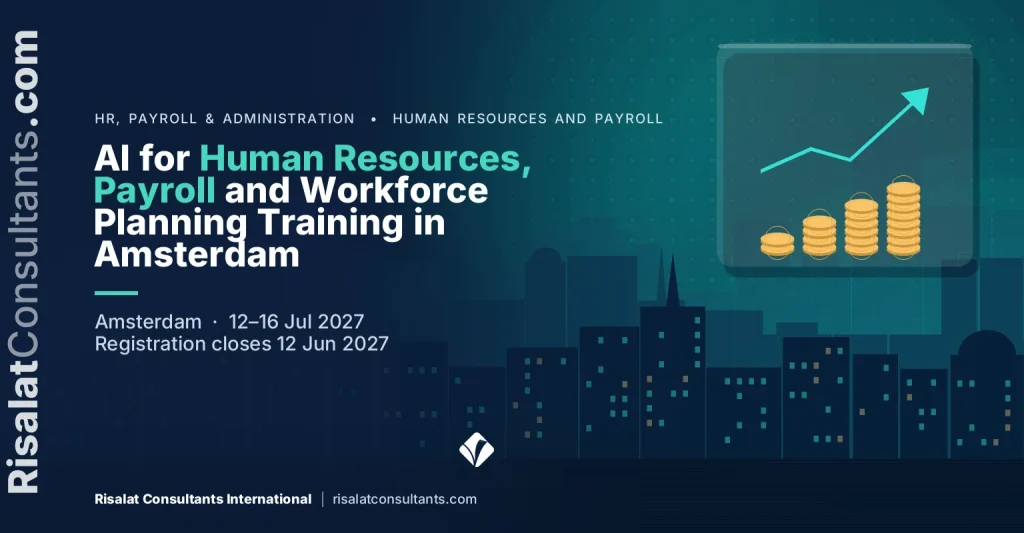
- 12–16 juill. 2027 (5 jours)
- Lieu
- Amsterdam, Pays-Bas
- Frais par participant
- 3 960 £ (GBP)
- Paiement
- Sur facture et par virement bancaire
- Clôture des inscriptions
- 12 Jun 2027
- Certificat
- Certificat de participation
- Option intra
- Organisez-le pour votre équipe, à vos dates
Sur cette page 16 sections
Présentation du programme
Public sector institutions and donor-funded project implementation units face urgent demands to modernise administrative operations while maintaining strict governance standards. This five-day course equips professionals with practical competencies to deploy artificial intelligence across talent acquisition, staff development, predictive workforce planning, and payroll oversight. Participants examine how automated systems transform routine administrative workflows, reduce transaction processing times, and strengthen strategic decision-making within ministries, statutory bodies, and development agencies.
Free self-check: the digital readiness assessment gives how ready your institution is for digital services, data and AI, in about 10 minutes.
The curriculum addresses the operational complexities of deploying algorithmic tools within highly regulated public employment environments. Attendees investigate how natural language processing, predictive analytics, and automated decision-making integrate with existing human resource information systems and national payroll engines. Through structured technical exercises, participants learn to improve candidate assessment precision, identify organisational skills deficits, and automate anomaly detection in wage disbursement, while preserving necessary human review and procedural accountability.
Ethical deployment and regulatory compliance form the core of each module. Held in Amsterdam, the training grounds technical workflows in international standards, addressing automated bias, digital surveillance concerns, and employee data privacy. Public officials and project managers explore operational protocols that align civil service reforms with recognised global principles, ensuring that administrative digitisation protects workforce welfare and strengthens transparency across institutions funded by international development partners.
Governments and international development projects are adopting artificial intelligence rapidly to improve public administration efficiency and eliminate payroll leakages. This operational shift is guided by global frameworks including the OECD AI Principles, the UNESCO Recommendation on the Ethics of Artificial Intelligence, and the European Union AI Act. Public institutions and project teams now face immediate pressure to standardise internal capabilities, ensuring personnel can deploy algorithmic tools safely, mitigate algorithmic bias, safeguard civil servant data, and meet rigorous donor standards for automated administrative workflows.
Animé par Risalat Consultants International à Amsterdam (Pays-Bas), ce programme associe des sessions dirigées par des experts, des cas réels et des travaux de groupe, afin que les participants puissent appliquer ce qu'ils apprennent dans leur propre institution.
The Programme Strengthens Institutional Capability
- Overview of artificial intelligence tools in human resource operations and donor project environments
- Algorithmic candidate screening, CV parsing, and job matching architectures
- Evaluating automated interview platforms and psychometric scoring systems
- Mitigating demographic bias in recruitment algorithms under the UNESCO Ethics Recommendation
- Establishing human-in-the-loop validation protocols for merit-based civil service recruitment
- Personalised professional development pathways powered by machine learning
- Automated skills inventory mapping and real-time gap analysis across public institutions
- AI-enabled performance evaluation frameworks and objective appraisal validation
- Préparation et exécution du budget
- Information financière et normes comptables
- Gestion de la trésorerie
- Contrôle interne des paiements et des actifs
It is designed for directors of human resources in civil service agencies and line ministries, payroll directors and financial controllers in public institutions, workforce planning managers in government secretariats and others who want practical, current skills in public financial management and finance.
The Growing Importance of AI for Human Resources, Payroll and Workforce Planning
Une gestion financière saine est la base de budgets crédibles, de paiements dans les délais et d'audits sans réserve. Les gouvernements et les bailleurs attendent une information financière exacte, une exécution budgétaire rigoureuse et une utilisation transparente des fonds.
L'évolution des normes d'information financière, des systèmes de paiement numériques et des exigences des bailleurs oblige les équipes financières à maintenir leurs compétences à jour. Une gestion financière solide libère aussi du temps et des moyens pour les services essentiels.
Les organisations ont de plus en plus besoin de professionnels capables de :
- Préparer et exécuter les budgets conformément aux plans
- Produire des rapports financiers exacts et dans les délais
- Appliquer des contrôles sur les paiements et les actifs
- Satisfaire aux exigences des bailleurs en matière de gestion financière
- Utiliser l'information financière pour éclairer les décisions
Des systèmes solides de gestion des finances publiques et de finance aident les organisations à :
- Améliorer la crédibilité et l'exécution du budget
- Produire des rapports fiables et obtenir des audits sans réserve
- Réduire les retards et les erreurs de paiement
- Gagner la confiance des bailleurs et des organes de contrôle
This AI for Human Resources, Payroll and Workforce Planning programme brings these elements together in a practical format, so that participants understand not only what good practice looks like but also how to introduce it in their own setting, with the people and resources they have.
Who Should Attend This AI for Human Resources, Payroll and Workforce Planning Training?
Ce programme s'adresse à :
- Directors of human resources in civil service agencies and line ministries
- Payroll directors and financial controllers in public institutions
- Workforce planning managers in government secretariats
- Project coordinators and HR specialists in World Bank-financed project implementation units
- Administrative and operations leads within UN agency country offices
- HR and procurement officers managing Asian Development Bank and African Development Bank projects
- Members and technical advisers of public service commissions
- Public sector labour relations officers and civil service reform leads
- Internal auditors responsible for public sector payroll compliance and controls
- Digital transformation leads overseeing administrative automation in the public sector
- Responsables financiers et comptables
- Responsables et analystes budgétaires
Le programme convient aussi bien aux professionnels expérimentés qu’à ceux qui prennent de nouvelles responsabilités. Les groupes réunissant plusieurs institutions et pays sont encouragés, car les participants apprennent beaucoup de l’expérience des autres.
Cochez ce que votre équipe doit être capable de faire.
AI for Human Resources, Payroll and Workforce Planning Training Objectives
Upon successful completion of this AI for Human Resources, Payroll and Workforce Planning Training, participants will be able to:
- Assess operational use cases for artificial intelligence across recruitment, talent management, payroll, and workforce planning
- Evaluate automated hiring and assessment tools against recognised algorithmic bias standards to prevent discrimination
- Implement automated controls and anomaly detection methods within public sector and project payroll administration
- Construct predictive workforce models to forecast future skills requirements and civil service staffing capacity
- Apply international data protection standards and ethical frameworks to digital personnel records and worker monitoring
- Design change management plans to transition public sector workers through artificial intelligence-driven administrative changes
- Establish institutional governance protocols for procuring, validating, and monitoring algorithmic human resource software
- Expliquer le cycle budgétaire et le rôle de chaque acteur
- Préparer et suivre des budgets liés aux plans
- Appliquer les grands principes des normes d'information financière pertinentes
Chaque objectif est mis en pratique pendant le programme à travers des exercices, des études de cas ou des travaux de groupe, afin que les participants repartent capables de le faire, et pas seulement de le décrire.
Contenu et structure du programme
- Overview of artificial intelligence tools in human resource operations and donor project environments
- Algorithmic candidate screening, CV parsing, and job matching architectures
- Evaluating automated interview platforms and psychometric scoring systems
- Mitigating demographic bias in recruitment algorithms under the UNESCO Ethics Recommendation
- Establishing human-in-the-loop validation protocols for merit-based civil service recruitment
- Personalised professional development pathways powered by machine learning
- Automated skills inventory mapping and real-time gap analysis across public institutions
- AI-enabled performance evaluation frameworks and objective appraisal validation
- Managing automated staff feedback, sentiment monitoring, and employee engagement tools
- Governance safeguards against punitive uses of workplace performance analytics
- Principles of predictive analytics for civil service headcount and attrition forecasting
- Modelling workforce retirement projections, succession pipelines, and institutional knowledge retention
- Scenario modelling for organisational restructuring within public sector modernisation programmes
- Aligning predictive workforce forecasts with donor-financed operational budgets
- Reporting strategic workforce insights to public service oversight bodies and treasury departments
- Machine learning architectures for public sector payroll management and reconciliation
- Automated detection of ghost workers, duplicate payments, and payroll calculation errors
- Auditing automated overtime, benefits calculations, and civil service allowances
- Ensuring audit trail integrity in automated payroll systems for donor assurance reviews
- Continuous compliance monitoring for national statutory deductions and tax rules
- Operationalising the OECD AI Principles and the EU AI Act in human resource workflows
- Worker data protection, consent requirements, and biometric data rules in the workplace
- Trade union engagement, staff consultation, and transparent communication on algorithmic tools
- Reskilling civil servants and institutional teams to work alongside automated workplace systems
- Drafting institutional human resource AI acceptable use policies and procurement standards
Contenu détaillé jour par jour
Le programme se déroule sur 5 jours. Chaque journée associe apports d'experts, travail pratique et un atelier ou une étude de cas de clôture :
- First Day: Day 1: AI Integration in Public Sector Talent Acquisition and Recruitment
- Second Day: Day 2: Automated Learning, Talent Management, and Civil Service Performance
- Third Day: Day 3: Strategic Workforce Analytics and Predictive Capacity Planning
- Fourth Day: Day 4: AI in Payroll Operations, Fraud Prevention, and Anomaly Detection
- Fifth Day: Day 5: AI Ethics, Data Governance, and Organisational Transition
Contenu détaillé jour par jour
First Day | Day 1: AI Integration in Public Sector Talent Acquisition and Recruitment
- Overview of artificial intelligence tools in human resource operations and donor project environments
- Algorithmic candidate screening, CV parsing, and job matching architectures
- Evaluating automated interview platforms and psychometric scoring systems
- Mitigating demographic bias in recruitment algorithms under the UNESCO Ethics Recommendation
- Establishing human-in-the-loop validation protocols for merit-based civil service recruitment
Workshop: Day 1: AI Integration in Public Sector Talent Acquisition and Recruitment: Applying It to Your Institution
En petits groupes, les participants appliquent les méthodes du jour à des exemples tirés de leurs institutions et conviennent d'étapes concrètes pour la suite.
Second Day | Day 2: Automated Learning, Talent Management, and Civil Service Performance
- Personalised professional development pathways powered by machine learning
- Automated skills inventory mapping and real-time gap analysis across public institutions
- AI-enabled performance evaluation frameworks and objective appraisal validation
- Managing automated staff feedback, sentiment monitoring, and employee engagement tools
- Governance safeguards against punitive uses of workplace performance analytics
Workshop: Day 2: Automated Learning, Talent Management, and Civil Service Performance: Applying It to Your Institution
En petits groupes, les participants appliquent les méthodes du jour à des exemples tirés de leurs institutions et conviennent d'étapes concrètes pour la suite.
Third Day | Day 3: Strategic Workforce Analytics and Predictive Capacity Planning
- Principles of predictive analytics for civil service headcount and attrition forecasting
- Modelling workforce retirement projections, succession pipelines, and institutional knowledge retention
- Scenario modelling for organisational restructuring within public sector modernisation programmes
- Aligning predictive workforce forecasts with donor-financed operational budgets
- Reporting strategic workforce insights to public service oversight bodies and treasury departments
Case Study: Day 3: Strategic Workforce Analytics and Predictive Capacity Planning in Practice
Les participants analysent un cas réaliste, comparent les choix effectués aux bonnes pratiques et en tirent des enseignements applicables à leur propre contexte.
Fourth Day | Day 4: AI in Payroll Operations, Fraud Prevention, and Anomaly Detection
- Machine learning architectures for public sector payroll management and reconciliation
- Automated detection of ghost workers, duplicate payments, and payroll calculation errors
- Auditing automated overtime, benefits calculations, and civil service allowances
- Ensuring audit trail integrity in automated payroll systems for donor assurance reviews
- Continuous compliance monitoring for national statutory deductions and tax rules
Workshop: Day 4: AI in Payroll Operations, Fraud Prevention, and Anomaly Detection: Applying It to Your Institution
En petits groupes, les participants appliquent les méthodes du jour à des exemples tirés de leurs institutions et conviennent d'étapes concrètes pour la suite.
Fifth Day | Day 5: AI Ethics, Data Governance, and Organisational Transition
- Operationalising the OECD AI Principles and the EU AI Act in human resource workflows
- Worker data protection, consent requirements, and biometric data rules in the workplace
- Trade union engagement, staff consultation, and transparent communication on algorithmic tools
- Reskilling civil servants and institutional teams to work alongside automated workplace systems
- Drafting institutional human resource AI acceptable use policies and procurement standards
Capstone Exercise: AI for Human Resources, Payroll and Workforce Planning Action Plan for Your Institution
Les participants synthétisent la semaine dans un plan d'action pour leur institution, avec des priorités, des responsables et des premières étapes, puis le présentent à leurs pairs et aux animateurs pour recueillir leurs retours.
AI for Human Resources, Payroll and Workforce Planning Training Methodology
This training is delivered through interactive lectures, practical case studies, and hands-on system demonstration labs. Participants analyse real-world administrative datasets to test bias identification, evaluate predictive staffing scenarios, and configure automated payroll audit rules. Group exercises require attendees to audit algorithmic human resource tools against international ethical standards, draft operational governance guidelines, and simulate institutional implementation challenges within public sector agencies.
Le programme associe :
- Sessions animées par des experts sur les pratiques actuelles
- Études de cas régionales et internationales
- Travaux de groupe et exercices pratiques
- Simulations et jeux de rôle le cas échéant
- Discussion des défis rencontrés par les participants dans l'exercice de leurs fonctions
- Apprentissage entre pairs, d'institutions et de pays différents
- Des outils et modèles pratiques à réutiliser au travail
- Réflexion quotidienne et plan d'action
Avant le programme, une courte pré-évaluation aide les animateurs à comprendre le rôle et les priorités de chaque participant, afin d’adapter les exemples et les exercices au groupe. Chaque journée se termine par une brève réflexion au cours de laquelle les participants notent ce qu’ils appliqueront dans leur travail.
Résultats attendus
Upon completion of this AI for Human Resources, Payroll and Workforce Planning Training, participants will be able to:
- Capability to identify, evaluate, and deploy operational AI solutions in recruitment, talent management, and payroll
- Competence in auditing automated recruitment and evaluation tools for systemic and algorithmic bias
- Ability to run predictive workforce planning models to support institutional headcount and budget decisions
- Skill in applying automated anomaly detection techniques to eliminate payroll leakages and irregularities
- Comprehensive understanding of worker data rights and institutional compliance under international AI frameworks
- Readiness to direct workforce reskilling and operational change programmes required for administrative AI adoption
- Préparer et suivre des budgets liés aux plans
- Produire des rapports financiers exacts
Les participants repartent avec un plan d'action personnel et des outils pratiques utilisables dans leur institution dès la première semaine de retour. Les institutions qui envoient plusieurs participants peuvent s'appuyer sur le programme pour convenir de méthodes et de modèles communs entre équipes, ce qui facilite la pérennité des améliorations.
3 960 £ par participant · facture et virement bancaire · remise pour les groupes de 5 personnes ou plus
Cinq personnes ou plus d'une même organisation : demandez le tarif de groupe lors de votre demande de facture.
Ten or more: an in-house version for your institution may cost less per person. Ask for an in-house quote.
Registration closes in 205 days (12 Jun 2027)
Institutional Application of AI for Human Resources, Payroll and Workforce Planning Training
Ce programme aide les organisations à renforcer :
- Préparation et exécution du budget
- Information financière
- Contrôles des paiements et de la trésorerie
- Gestion financière des fonds des bailleurs
- Préparation à l'audit
Les participants repartent avec des outils pratiques pour améliorer :
- Suivi budgétaire
- Rapports financiers intermédiaires
- Rapprochements
- Gestion des actifs
- Suivi des recommandations d'audit
Le programme est conçu pour que l'apprentissage passe de la salle de formation à l'institution. Les participants travaillent, dans la mesure du possible, sur leurs propres processus et documents, et repartent avec un plan d'action que leurs responsables peuvent examiner et soutenir.
Pertinence régionale & mise en application
Europe
Les institutions européennes pratiquent la gestion des finances publiques et la finance dans le cadre de réglementations détaillées et de programmes de réforme. Les participants venus d'Europe peuvent comparer leurs pratiques avec celles de collègues d'autres régions et vérifier comment des méthodes éprouvées fonctionnent dans d'autres conditions.
Afrique
En Afrique, les ministères, agences et équipes de projet œuvrant dans la gestion des finances publiques et la finance travaillent de plus en plus aux côtés de programmes financés par les bailleurs qui exigent des systèmes clairs et des données probantes. Le programme aide les participants à adapter les bonnes pratiques aux institutions et aux ressources avec lesquelles ils travaillent.
Moyen-Orient
Au Moyen-Orient, les stratégies nationales de développement et les plans de diversification sollicitent de plus en plus la gestion des finances publiques et la finance. Les participants examinent comment bâtir, au sein des organismes publics et des entreprises, les capacités dont ces plans ont besoin.
Asie
Les institutions asiatiques conjuguent croissance rapide et programmes de modernisation ambitieux. Les participants venus d'Asie peuvent partager leur expérience du déploiement rapide de systèmes à grande échelle et découvrir les approches adoptées ailleurs.
Pacifique
Les petits États insulaires et du Pacifique font face à des contraintes particulières de taille, de distance et de capacités. Le programme met en avant des approches pratiques et proportionnées de la gestion des finances publiques et de la finance, adaptées aux institutions de petite taille.
Holding the programme in Amsterdam, Netherlands brings participants together away from their daily pressures, so they can compare how public financial management and finance is handled in different settings. The same programme can also be delivered in-house for one institution, in its own country or online, with cases taken from its current work.
- Collecter
- Nettoyer
- Stocker
- Analyser
- Décider
Profil du pays d'accueil – Pays-Bas
Programmes, ateliers, immersions et formations à Amsterdam, Pays-Bas, par Risalat Consultants International
Se former hors de son pays permet aux participants de se concentrer, de porter un regard neuf sur leur propre institution et de constituer un réseau avec des collègues d'autres pays.
AI for Human Resources, Payroll and Workforce Planning Training Deliverables
Les participants sont accompagnés avant, pendant et après le programme, afin que la préparation, l'apprentissage et le suivi forment une expérience continue.
Avant le programme
- Pré-évaluation des participants
- AI for Human Resources, Payroll and Workforce Planning Readiness Assessment
- AI for Human Resources, Payroll and Workforce Planning Resource Pack
- Lectures préparatoires
- Aide et conseils gratuits pour le visa
Pendant le programme
- Accueil à l'aéroport & assistance à l'arrivée
- Accommodation with breakfast: 6 nights, check-in Sunday 11 July 2027, check-out Saturday 17 July 2027 (one night before and one night after the programme)
- Dîner de bienvenue et de réseautage
- Kit de formation Risalat (sac, gourde, mug, t-shirt, casquette, protège-passeport, stylos, carnet, magnet & porte-clés)
- Comprehensive AI for Human Resources, Payroll and Workforce Planning Training Manual
- Modèle de suivi budgétaire
- Modèle de rapport financier intermédiaire
- Liste de contrôle des rapprochements
- Liste de contrôle de préparation à l'audit
- Ateliers pratiques & simulations
- Discussions de groupe & apprentissage entre pairs
- Déjeuner et pauses-café quotidiens
- Accès complet aux installations du lieu de formation
- Mini tablette avec supports pédagogiques numériques
- Visite de terrain (le cas échéant)
- Visite récréative de la ville
Après le programme
- Certificat de participation
- Distinction Risalat de participation au programme
- Documents de référence après la formation
- Autoévaluation de la gestion financière
- Liste de contrôle des paiements
- Accompagnement après la formation & conseils de suivi
- Rapport du programme
Institutions can also request a tailored in-house version of this programme, delivered at their premises or online. Request a proposal.
Common Challenges in AI for Human Resources, Payroll and Workforce Planning, And How This Training Helps
Comment les institutions peuvent-elles préparer et exécuter les budgets conformément aux plans ?
The programme addresses this directly on the first day (Day 1: AI Integration in Public Sector Talent Acquisition and Recruitment), where participants practise the methods involved and adapt them to their own institution, then build it into their action plan.
Comment les institutions peuvent-elles produire des rapports financiers exacts et dans les délais ?
The programme addresses this directly on the second day (Day 2: Automated Learning, Talent Management, and Civil Service Performance), where participants practise the methods involved and adapt them to their own institution, then build it into their action plan.
Comment les institutions peuvent-elles appliquer des contrôles sur les paiements et les actifs ?
The programme addresses this directly on the third day (Day 3: Strategic Workforce Analytics and Predictive Capacity Planning), where participants practise the methods involved and adapt them to their own institution, then build it into their action plan.
Comment les institutions peuvent-elles satisfaire aux exigences des bailleurs en matière de gestion financière ?
The programme addresses this directly on the fourth day (Day 4: AI in Payroll Operations, Fraud Prevention, and Anomaly Detection), where participants practise the methods involved and adapt them to their own institution, then build it into their action plan.
Comment les institutions peuvent-elles utiliser l'information financière pour éclairer les décisions ?
The programme addresses this directly on the fifth day (Day 5: AI Ethics, Data Governance, and Organisational Transition), where participants practise the methods involved and adapt them to their own institution, then build it into their action plan.
Questions fréquentes
When and where does the AI for Human Resources, Payroll and Workforce Planning programme take place?
It runs from 12 Jul 2027 to 16 Jul 2027, in Amsterdam, Netherlands. The registration deadline is shown at the top of this page.
Qui devrait participer ?
The programme is designed for directors of human resources in civil service agencies and line ministries, payroll directors and financial controllers in public institutions, workforce planning managers in government secretariats, project coordinators and HR specialists in World Bank-financed project implementation units, and others who want practical skills in public financial management and finance.
Recevrai-je un certificat ?
Oui. Les participants qui terminent le programme reçoivent un certificat de participation délivré par Risalat Consultants International.
Ce programme peut-il être dispensé pour notre seule institution ?
Oui. Nous pouvons proposer une version intra sur mesure dans vos locaux, dans une autre ville ou en ligne, construite autour de vos propres cas. Utilisez la demande de proposition sur cette page.
Faut-il une expérience préalable en gestion des finances publiques et en finance ?
Aucune formation spécialisée n'est requise au-delà d'une expérience dans une fonction similaire. Une courte pré-évaluation aide les animateurs à adapter les sessions au groupe.
Who Will Deliver This Programme
Each date is delivered by a team assigned from Risalat's expert network for this subject. For this programme we assign:
How we choose them: Experience in the region of the participants or comparable settings; Command of the financier rules that apply (World Bank, ADB, AfDB, EU, UN) where relevant; Delivery in English; other languages on request for in-house groups; No conflict of interest with participants' institutions.
Names and short CVs of the assigned experts are shared with registered participants and sponsoring organisations before the programme, on request. Are you an expert in this subject? Join our expert network.
Training courses in AmsterdamHR, Payroll & Administration training courses
Pourquoi Amsterdam pour ce programme
Amsterdam allie de bonnes liaisons à des exemples concrets de gestion de l'eau, de logistique et d'urbanisme.
The AI for Human Resources, Payroll and Workforce Planning Training in Amsterdam programme in July 2027 brings together officials and professionals from across Europe, Africa, the Middle East and Asia. Sessions combine short inputs, case studies and group work on participants' own files, and the city's institutions can be added as a study visit on request.
Accès : aéroport de Schiphol (AMS).
Vérifiez si vous avez besoin d'un visa avec le vérificateur de visa gratuit, et demandez une lettre d'invitation une fois inscrit.
Le même thème dans d'autres villes
- Education Sector Staff Roster Auditing and Teacher Allocation Systems in Porto (Porto)
- Civil Service Payroll Control, Biometric Audits and HR Verification in Lisbon (Lisbon)
- Health Sector Human Resource Deployment and District Clinic Retention in Brussels (Brussels)
- Public Expenditure Oversight, Payroll Auditing and Sub-National PFM in Kigali (Kigali)
- Sub-National Payroll Auditing and Intergovernmental Fiscal Verification in Istanbul (Istanbul)
- Targeted Cash Transfer Eligibility Verification and Fraud Mitigation in Amman (Amman)
Autres programmes à Amsterdam
- Formation à la FinTech, à la banque numérique & à l'IA dans les services financiers
- Formation à la stratégie de start-up & à l'élaboration de plans d'affaires
- Formation en santé et sécurité au travail à Amsterdam
- Formation à la supervision fondée sur les risques et à la bonne gouvernance des fonds de pension
- Formation certifiante en administration de fonds de pension à Amsterdam
Voir aussi : Gouvernance de l'IA pour les institutions publiques · outil gratuit de préparation à la gouvernance de l'IA · tous les programmes
For teams and institutions
Bring your team
Teams that learn together apply more at work. Tell us how many people and how you would like to take part: we reply with a group quote within two working days.
Other dates and cities for this subject: HR, Training Needs and Capacity Development training courses (25 upcoming dates).
More training courses in the Netherlands · Tous les programmes en Europe · Calendrier complet des formations
Plan this programme in a roadmap: why it matters, why to approve it, the dates to plan and the career it builds.