Key facts
- Dates
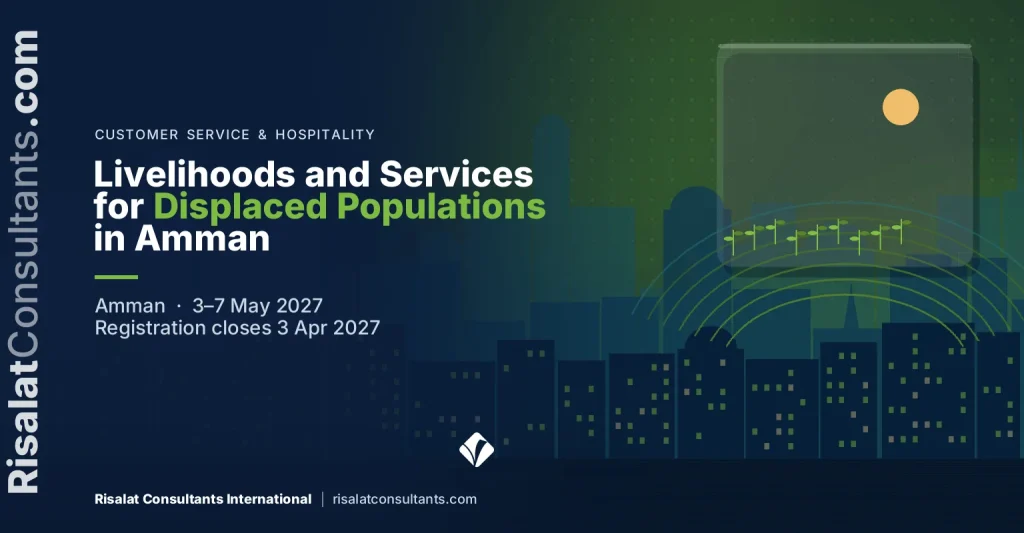
- 3–7 May 2027 (5 days)
- Where
- Amman, Jordan
- Fee per participant
- £3,500 (GBP)
- Payment
- By invoice and bank transfer
- Registration closes
- 24 Mar 2027
- Format
- 5-day short course: a practical capacity-building programme for government, NGO and project teams in Amman
- Certificate
- Certificate of completion
- In-house option
- Run it for your team, on your dates
On this page 16 sections
Programme Overview
Protracted displacement places complex demands on public administrations, municipal authorities, and international development agencies. This course provides public sector professionals with practical methods to design and deliver inclusive livelihood interventions and basic service delivery frameworks. Participants examine how to transition from short-term humanitarian assistance to sustainable, development-oriented social and economic programmes. The curriculum addresses the needs of refugees, internally displaced persons, and vulnerable host communities, emphasising regulatory alignment, municipal capacity, social cohesion, and the protection of basic socio-economic rights across urban and peri-urban environments.
Delivered in Amman, this programme draws upon international standards established by multilateral institutions to address the operational realities of forced displacement. Participants explore market-based livelihood interventions, financial inclusion models, skills certification, and labour market access alongside social protection integration. The training also analyses public service delivery across health, education, water, and sanitation, assessing mechanisms to scale public infrastructure effectively. Special focus is directed towards the application of environmental and social safeguards, conflict-sensitive programming, and rights-based frameworks that underpin major multilateral investment operations.
The course also focuses on data governance, monitoring, and inter-institutional coordination. Attendees will gain technical competencies in displacement-specific vulnerability assessments, socio-economic profiling, and collaborative delivery structures between line ministries, local governments, and development partners. Through practical case studies and structured policy exercises, specialists will learn how to design bankable, compliant project proposals and implementation plans. By balancing theoretical principles with applied operational tools, the programme equips practitioners to implement targeted reforms that foster long-term economic self-reliance and community resilience.
Governments and development institutions are actively restructuring displacement responses to shift away from recurrent emergency aid towards long-term socio-economic inclusion. Multilateral development banks, the European Union, and United Nations agencies are channeling substantial concessional finance into projects that strengthen national systems, municipal infrastructure, and economic opportunities in displacement-affected areas. To implement these complex portfolios successfully, line ministries and project delivery units require immediate technical capacity to navigate policy reforms, establish integrated service delivery frameworks, and execute investments that meet rigorous international social and environmental standards.
Delivered by Risalat Consultants International in Amman, Jordan, it combines expert-led sessions, real cases and group work, so that participants can apply what they learn in their own institution.
The Programme Strengthens Institutional Capability
- International legal frameworks: 1951 Refugee Convention, Guiding Principles on Internal Displacement, and local legal realities
- Transitioning from humanitarian assistance to sustainable national systems and social protection inclusion
- Assessing the rights to work, property ownership, business formalisation, and movement for displaced groups
- Social cohesion dynamics and mitigating tensions between displaced persons and host communities
- Analysis of national policy responses and multi-year displacement frameworks
- Conducting market systems analyses and value chain assessments in displacement-hosting areas
- Designing technical, vocational, and entrepreneurship training matched to documented labour market demand
- Overcoming legal and practical obstacles to formal labour market participation and work permits
- Environmental and social risk screening
- Assessment instruments and management plans
- Stakeholder engagement planning
- Grievance mechanisms that work
It is designed for officials from ministries of planning, social development, labour, and local government, project directors and technical specialists from donor-financed project implementation units, municipal leaders and urban planners managing service provision in displacement-affected towns and others who want practical, current skills in environmental, social and stakeholder management.
The Growing Importance of Livelihoods and Services for Displaced Populations in Amman
Financiers now require projects to identify and manage environmental and social risks from the start, and to involve the people affected. Weak safeguards management causes delays, suspended disbursements and lasting harm to communities.
Good practice in stakeholder engagement, grievance handling, inclusion and resettlement protects people and keeps projects on track. Teams who understand the standards and apply them early save time and build trust.
Organisations increasingly require professionals capable of:
- Screen and classify environmental and social risks
- Prepare and implement management plans
- Engage stakeholders meaningfully throughout the project
- Run grievance mechanisms that resolve issues
- Monitor and report on commitments to financiers
Strong environmental, social and stakeholder management systems help organisations:
- Avoid delays and suspended disbursements
- Protect communities and workers
- Meet financier standards and commitments
- Build trust with affected people and the public
This Livelihoods and Services for Displaced Populations in Amman programme brings these elements together in a practical format, so that participants understand not only what good practice looks like but also how to introduce it in their own setting, with the people and resources they have.
Who Should Attend This Livelihoods and Services for Displaced Populations in Amman Training?
This programme is designed for:
- Officials from ministries of planning, social development, labour, and local government
- Project directors and technical specialists from donor-financed project implementation units
- Municipal leaders and urban planners managing service provision in displacement-affected towns
- Social protection specialists designing targeted safety nets and cash transfer mechanisms
- Economic development and livelihood advisers in international and regional organisations
- Monitoring, evaluation, and data governance officers in public agencies and non-governmental bodies
- Public service managers overseeing municipal health, education, and water infrastructure
- Safeguards specialists responsible for social risk management and community engagement
- Policy analysts formulating displacement, return, and local integration frameworks
- Environmental and social specialists
- Safeguards officers in PIUs
- Project and programme managers
The programme suits experienced professionals as well as those moving into new responsibilities. Groups that mix institutions and countries are encouraged, because participants learn a great deal from each other’s experience.
Tick what your team needs to be able to do.
Livelihoods and Services for Displaced Populations in Amman Training Objectives
Upon successful completion of this Livelihoods and Services for Displaced Populations in Amman Training, participants will be able to:
- Analyse the policy and regulatory barriers that influence economic participation and service access for displaced populations
- Design market-driven livelihood and skills development interventions aligned with national economic development priorities
- Formulate operational models for inclusive municipal service delivery covering water, sanitation, health, and primary education
- Apply international social and environmental safeguard standards to mitigate project risks in displacement-affected environments
- Develop socio-economic profiling and needs assessment systems utilising standardised data governance protocols
- Structure collaborative financing and coordination mechanisms across line ministries, local governments, and external partners
- Construct comprehensive results frameworks to monitor protection, self-reliance, and social cohesion indicators
- Explain the environmental and social standards that apply to their projects
- Screen and classify risks and impacts
- Prepare the key instruments and management plans
Each objective is practised during the programme through exercises, cases or group work, so that participants leave able to do it, not only to describe it.
Programme Contents and Structure
- International legal frameworks: 1951 Refugee Convention, Guiding Principles on Internal Displacement, and local legal realities
- Transitioning from humanitarian assistance to sustainable national systems and social protection inclusion
- Assessing the rights to work, property ownership, business formalisation, and movement for displaced groups
- Social cohesion dynamics and mitigating tensions between displaced persons and host communities
- Analysis of national policy responses and multi-year displacement frameworks
- Conducting market systems analyses and value chain assessments in displacement-hosting areas
- Designing technical, vocational, and entrepreneurship training matched to documented labour market demand
- Overcoming legal and practical obstacles to formal labour market participation and work permits
- Expanding financial inclusion: microfinance, digital cash transfers, and asset development models
- Graduation approaches: tailoring livelihood interventions to varied levels of household vulnerability
- Assessing the carrying capacity and operational bottlenecks of municipal basic services
- Inclusive urban planning models for rapid demographic expansion in cities and peri-urban zones
- Upgrading public water, sanitation, and waste management services in high-density informal settlements
- Integrating displaced children and youth into national education systems and accredited training
- Strengthening primary healthcare facilities and emergency referral systems under service pressure
- Methodologies for displacement profiling, socio-economic surveys, and poverty mapping
- Data protection, privacy rights, and ethical considerations in managing displaced population registries
- Interoperability of public administrative databases and international partner registration systems
- Targeting mechanisms: balancing categorical, geographical, and proxy means testing approaches
- Establishing grievance redress mechanisms and inclusive community feedback loops
- Aligning project proposals with multilateral standards, including World Bank Environmental and Social Frameworks
- Conflict sensitivity and do-no-harm operational methodologies in resource-scarce environments
- Designing cross-sectoral coordination structures between central ministries, municipalities, and donors
- Developing key performance indicators and results measurement frameworks for self-reliance projects
- Final project synthesis: presenting practical implementation blueprints for donor-financed operations
Full day-by-day contents
The programme runs over 5 days. Each day combines expert input, practical work and a closing workshop or case study:
- First Day: Policy Frameworks, Protection, and Socio-Economic Inclusion
- Second Day: Livelihood Strategies, Economic Inclusion, and Financial Access
- Third Day: Municipal Infrastructure and Public Service Delivery
- Fourth Day: Data Governance, Targeting, and Vulnerability Assessments
- Fifth Day: Project Design, Safeguards, and Inter-Institutional Coordination
Full day-by-day contents
First Day | Policy Frameworks, Protection, and Socio-Economic Inclusion
- International legal frameworks: 1951 Refugee Convention, Guiding Principles on Internal Displacement, and local legal realities
- Transitioning from humanitarian assistance to sustainable national systems and social protection inclusion
- Assessing the rights to work, property ownership, business formalisation, and movement for displaced groups
- Social cohesion dynamics and mitigating tensions between displaced persons and host communities
- Analysis of national policy responses and multi-year displacement frameworks
Workshop: Policy Frameworks, Protection, and Socio-Economic Inclusion: Applying It to Your Institution
Working in small groups, participants apply the day's methods to examples from their own institutions and agree practical next steps.
Second Day | Livelihood Strategies, Economic Inclusion, and Financial Access
- Conducting market systems analyses and value chain assessments in displacement-hosting areas
- Designing technical, vocational, and entrepreneurship training matched to documented labour market demand
- Overcoming legal and practical obstacles to formal labour market participation and work permits
- Expanding financial inclusion: microfinance, digital cash transfers, and asset development models
- Graduation approaches: tailoring livelihood interventions to varied levels of household vulnerability
Workshop: Livelihood Strategies, Economic Inclusion, and Financial Access: Applying It to Your Institution
Working in small groups, participants apply the day's methods to examples from their own institutions and agree practical next steps.
Third Day | Municipal Infrastructure and Public Service Delivery
- Assessing the carrying capacity and operational bottlenecks of municipal basic services
- Inclusive urban planning models for rapid demographic expansion in cities and peri-urban zones
- Upgrading public water, sanitation, and waste management services in high-density informal settlements
- Integrating displaced children and youth into national education systems and accredited training
- Strengthening primary healthcare facilities and emergency referral systems under service pressure
Case Study: Municipal Infrastructure and Public Service Delivery in Practice
Participants analyse a realistic case, compare the choices made with good practice and draw lessons they can use in their own setting.
Fourth Day | Data Governance, Targeting, and Vulnerability Assessments
- Methodologies for displacement profiling, socio-economic surveys, and poverty mapping
- Data protection, privacy rights, and ethical considerations in managing displaced population registries
- Interoperability of public administrative databases and international partner registration systems
- Targeting mechanisms: balancing categorical, geographical, and proxy means testing approaches
- Establishing grievance redress mechanisms and inclusive community feedback loops
Workshop: Data Governance, Targeting, and Vulnerability Assessments: Applying It to Your Institution
Working in small groups, participants apply the day's methods to examples from their own institutions and agree practical next steps.
Fifth Day | Project Design, Safeguards, and Inter-Institutional Coordination
- Aligning project proposals with multilateral standards, including World Bank Environmental and Social Frameworks
- Conflict sensitivity and do-no-harm operational methodologies in resource-scarce environments
- Designing cross-sectoral coordination structures between central ministries, municipalities, and donors
- Developing key performance indicators and results measurement frameworks for self-reliance projects
- Final project synthesis: presenting practical implementation blueprints for donor-financed operations
Capstone Exercise: Livelihoods and Services for Displaced Populations in Amman Action Plan for Your Institution
Participants bring the week together in an action plan for their own institution, with priorities, owners and first steps, and present it for feedback from peers and facilitators.
Livelihoods and Services for Displaced Populations in Amman Training Methodology
The training is delivered through an interactive, practitioner-oriented methodology combining technical presentations, comparative international policy analysis, and practical group working sessions. Participants examine actual operational models used in public sector and donor-financed initiatives, testing them against realistic scenarios. Peer review exercises, diagnostic assessments, and structured design clinics allow attendees to apply taught concepts directly to project formulation, regulatory analysis, and service-delivery problems relevant to their institutions.
The programme combines:
- Expert-led sessions on current practice
- Regional and international case studies
- Group work and practical exercises
- Simulations and role plays where relevant
- Discussion of participants' own challenges
- Peer learning across institutions and countries
- Practical tools and templates to take back to work
- Daily reflection and action planning
Before the programme, a short pre-assessment helps the facilitators understand each participant’s role and priorities, so that examples and exercises can be adjusted to the group. Each day ends with a short reflection in which participants note what they will apply at work.
Expected Outcomes
Upon completion of this Livelihoods and Services for Displaced Populations in Amman Training, participants will be able to:
- Demonstrate advanced competency in designing sustainable livelihood programmes for displaced populations and host communities
- Formulate institutional plans to upgrade and maintain critical basic services under demographic strain
- Produce high-quality project proposals that comply with international donor safeguards and fiduciary standards
- Implement ethical, robust socio-economic data collection frameworks to inform evidence-based public planning
- Establish functional cross-sectoral coordination structures that bridge national ministries, municipal offices, and external partners
- Apply conflict-sensitive project designs that actively promote social cohesion and reduce resource-based tensions
- Screen and classify environmental and social risks
- Prepare and apply management plans
Participants leave with a personal action plan and practical tools they can use in their institution from the first week back. Institutions that send several participants can use the programme to agree shared methods and templates across teams, which makes improvements easier to sustain.
£3,500 per participant · invoice and bank transfer · groups of 5 or more receive a discount
Five or more from one organisation: ask for the group rate on the invoice request.
Ten or more: an in-house version for your institution may cost less per person. Ask for an in-house quote.
Registration closes in 124 days (24 Mar 2027)
Institutional Application of Livelihoods and Services for Displaced Populations in Amman Training
This programme supports organisations in strengthening:
- Environmental and social risk management
- Stakeholder engagement
- Grievance redress
- Contractor management
- Inclusion of vulnerable groups
Participants return with practical tools to improve:
- Management plans
- Engagement plans
- Grievance logs
- Monitoring reports
- Incident reporting
The programme is built so that learning moves from the classroom into the institution. Participants work on their own processes and documents where possible, and leave with an action plan that their managers can review and support.
Regional Relevance & Application
Europe
European institutions apply environmental, social and stakeholder management within detailed regulatory frameworks and reform agendas. Participants from Europe can compare their practice with colleagues from other regions and test how established methods work under different conditions.
Africa
Across Africa, ministries, agencies and project teams working in environmental, social and stakeholder management increasingly operate alongside donor-financed programmes that expect clear systems and evidence. The programme helps participants adapt good practice to the institutions and resources they work with.
Middle East
In the Middle East, national development strategies and diversification plans place growing demands on environmental, social and stakeholder management. Participants explore how to build the capability these plans need inside public bodies and companies.
Asia
Institutions across Asia combine rapid growth with ambitious modernisation programmes. Participants from Asia can share their experience of scaling systems quickly and learn from approaches used elsewhere.
Pacific
Small island and Pacific states face particular constraints of size, distance and capacity. The programme highlights practical, proportionate approaches to environmental, social and stakeholder management that suit smaller institutions.
Holding the programme in Amman, Jordan brings participants together away from their daily pressures, so they can compare how environmental, social and stakeholder management is handled in different settings. The same programme can also be delivered in-house for one institution, in its own country or online, with cases taken from its current work.
- Collect
- Clean
- Store
- Analyse
- Decide
Host Country Profile – Jordan
Programmes, Workshops, Exposures, Training Courses in Amman, Jordan by Risalat Consultants International
Studying away from their own country gives participants time to focus, a fresh view of their own institution and the chance to build a network with colleagues from other countries.
Livelihoods and Services for Displaced Populations in Amman Training Deliverables
Participants receive support before, during and after the programme, so that preparation, learning and follow-up form one continuous experience.
Before the Programme
- Participant Pre-Assessment
- Livelihoods and Services for Displaced Populations in Amman Readiness Assessment
- Livelihoods and Services for Displaced Populations in Amman Resource Pack
- Preparatory Reading Materials
- Complimentary Visa Support & Advisory
During the Programme
- Airport Pickup & Welcome Assistance
- Accommodation with breakfast: 6 nights, check-in Sunday 2 May 2027, check-out Saturday 8 May 2027 (one night before and one night after the programme)
- Welcome Networking Dinner
- Risalat Training Kit (Bag, Bottle, Mug, T-Shirt, Cap, Passport Cover, Pens, Notebook, Magnet & Keychain)
- Comprehensive Livelihoods and Services for Displaced Populations in Amman Training Manual
- Risk Screening Checklist
- Stakeholder Engagement Plan Template
- Grievance Log Template
- Environmental and Social Monitoring Template
- Practical Workshops & Simulations
- Group Discussions & Peer Learning
- Daily Lunch and Refreshments
- Full Access to Training Venue Facilities
- Mini Pad / Tablet with Digital Learning Materials
- Field Visit (where applicable)
- Entertaining City Tour
After the Programme
- Certificate of Completion
- Risalat Programme Participation Recognition Award
- Post-Training Reference Materials
- Commitment Tracking Sheet
- Contractor Compliance Checklist
- Post-Training Support & Follow-Up Guidance
- Programme Report
Institutions can also request a tailored in-house version of this programme, delivered at their premises or online. Request a proposal.
Common Challenges in Livelihoods and Services for Displaced Populations in Amman, And How This Training Helps
How can institutions screen and classify environmental and social risks?
The programme addresses this directly on the first day (Policy Frameworks, Protection, and Socio-Economic Inclusion), where participants practise the methods involved and adapt them to their own institution, then build it into their action plan.
How can institutions prepare and implement management plans?
The programme addresses this directly on the second day (Livelihood Strategies, Economic Inclusion, and Financial Access), where participants practise the methods involved and adapt them to their own institution, then build it into their action plan.
How can institutions engage stakeholders meaningfully throughout the project?
The programme addresses this directly on the third day (Municipal Infrastructure and Public Service Delivery), where participants practise the methods involved and adapt them to their own institution, then build it into their action plan.
How can institutions run grievance mechanisms that resolve issues?
The programme addresses this directly on the fourth day (Data Governance, Targeting, and Vulnerability Assessments), where participants practise the methods involved and adapt them to their own institution, then build it into their action plan.
How can institutions monitor and report on commitments to financiers?
The programme addresses this directly on the fifth day (Project Design, Safeguards, and Inter-Institutional Coordination), where participants practise the methods involved and adapt them to their own institution, then build it into their action plan.
Frequently Asked Questions
When and where does the Livelihoods and Services for Displaced Populations in Amman programme take place?
It runs from 3 May 2027 to 7 May 2027, in Amman, Jordan. The registration deadline is shown at the top of this page.
Who should attend?
The programme is designed for officials from ministries of planning, social development, labour, and local government, project directors and technical specialists from donor-financed project implementation units, municipal leaders and urban planners managing service provision in displacement-affected towns, social protection specialists designing targeted safety nets and cash transfer mechanisms, and others who want practical skills in environmental, social and stakeholder management.
Will I receive a certificate?
Yes. Participants who complete the programme receive a Certificate of Completion from Risalat Consultants International.
Can this programme be delivered for our institution only?
Yes. We can deliver a tailored in-house version at your premises, in another city or online, built around your own cases. Use the proposal request on this page.
Do I need prior experience in environmental, social and stakeholder management?
No specialist background is required beyond experience in a related role. A short pre-assessment helps the facilitators adapt the sessions to the group.
Who Will Deliver This Programme
Each date is delivered by a team assigned from Risalat's expert network for this subject. For this programme we assign:
How we choose them: Experience in the region of the participants or comparable settings; Command of the financier rules that apply (World Bank, ADB, AfDB, EU, UN) where relevant; Delivery in English; other languages on request for in-house groups; No conflict of interest with participants' institutions.
Names and short CVs of the assigned experts are shared with registered participants and sponsoring organisations before the programme, on request. Are you an expert in this subject? Join our expert network.
Training courses in AmmanHumanitarians training courses
Why Amman for this programme
Amman is a calm base for Middle East delegations and humanitarian topics.
The Livelihoods and Services for Displaced Populations in Amman programme in May 2027 brings together officials and professionals from across the Middle East region and beyond. Sessions combine short inputs, case studies and group work on participants' own files, and the city's institutions can be added as a study visit on request.
Getting there: Queen Alia (AMM).
Check whether you need a visa with the free Visa Checker, and ask for an invitation letter once you are registered.
The same topic in other cities
- Refugee and Host Community Programme Management in Dubai (Dubai)
- Community-Based Protection and Inclusive Grievance Mechanisms in Casablanca (Casablanca)
- Labour Market Reintegration and Youth Economic Inclusion in Muscat (Muscat)
- Active Labour Market Programmes and Shock-Responsive Employment Services in Bangkok (Bangkok)
- Displacement, Forced Migration & Human Rights Training in Barcelona (Barcelona)
Other programmes in Amman
- Environmental and Social Management of Mining Operations in Amman
- Mining Licensing, Contracts and Revenue Management in Amman
- Document Control for Project Implementation Units in Amman
- Training of Trainers: Design, Delivery and Evaluation in Amman
- Contracting Primary Care Networks and Essential Health Service Packages in Amman
Teams often travel here from Iraq, Jordan, Lebanon, Palestine, Yemen, Egypt. Funding, visa letters and group rates are explained on each country page.
For teams and institutions
Bring your team
Teams that learn together apply more at work. Tell us how many people and how you would like to take part: we reply with a group quote within two working days.
Watch: this programme in short


Other dates and cities for this subject: Resettlement and Livelihood Restoration training courses (21 upcoming dates).
More training courses in Jordan · All programmes in Middle East · Full training calendar
Plan this programme in a roadmap: why it matters, why to approve it, the dates to plan and the career it builds.