Key facts
- Dates
- 21–25 Jun 2027 (5 days)
- Where
- Crowne Plaza Amman, Shmeisani (proposed), Amman, Jordan
- Fee per participant
- £2,350 (GBP)
- Payment
- By invoice and bank transfer
- Registration closes
- 12 May 2027
- Format
- 5-day short course: a practical capacity-building programme for government, NGO and project teams in Amman
- Certificate
- Certificate of completion
- Groups
- Teams of 3 or more qualify for a group discount, offered case by case: ask for a group quote.
- In-house option
- Run it for your team, on your dates
On this page 10 sections
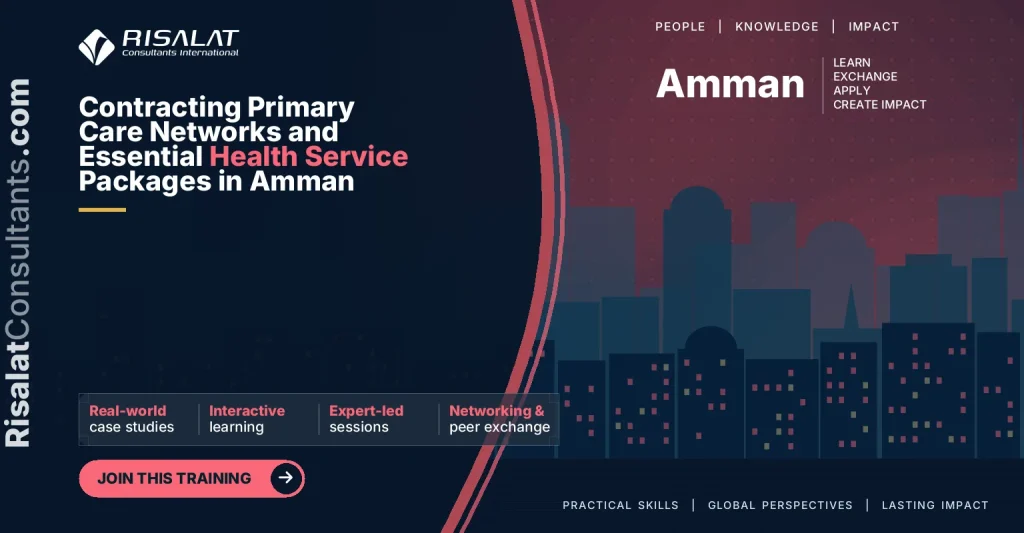
Contracting Primary Care Networks and Essential Health Service Packages in Amman
Programme Overview
This five-day professional training programme equips public health planners, procurement specialists, and contract administrators with operational methods to commission and manage primary healthcare services through non-state providers. Governments facing structural capacity constraints increasingly utilise performance-based contracts to expand healthcare coverage. Delivered in Amman, Jordan, this course provides participants with actionable tools to formulate commissioning strategies, construct legally robust service agreements, and align essential health service packages with public health priorities in challenging environments.
Delegates will examine administrative and legal frameworks governing partnerships between health ministries and non-state health service providers, including international and national non-governmental organisations. The curriculum covers the translation of national essential healthcare service priorities into contractually enforceable specifications. Participants analyse practical payment mechanisms, key performance indicators, risk-sharing provisions, and output-linked disbursements used widely by multilateral development banks and United Nations agencies in fragile and conflict-affected settings.
The final stages of the programme concentrate on contract oversight, independent verification, and remote quality monitoring. Attendees evaluate clinical verification protocols, data assurance techniques, and supervisory systems designed to safeguard service continuity and public financial accountability. By reviewing established international standards and procurement guidelines, participants gain the technical expertise required to administer high-value health service contracts, manage disputes professionally, and ensure that primary health facilities provide safe, equitable, and verifiable care. Delivered by Risalat Consultants International in Amman, Jordan, it combines expert-led sessions, real cases and group work, so that participants can apply what they learn in their own institution.
The programme strengthens institutional capability in:
- Analysis of public commissioning models for primary healthcare delivery in fragile environments
- Legal archetypes for agreements between health ministries and non-state service providers
- Aligning public health strategy with donor fiduciary frameworks (World Bank, UN, regional development banks)
- Delineating ministerial stewardship versus delegated provider management responsibilities
- Structuring procurement packages: territorial catchment models versus functional facility lots
- Deconstructing Essential Packages of Health Services (EPHS) into clinical deliverable schedules
- Drafting enforceable Service Level Agreements (SLAs) for maternal, neonatal, and child health
- Supply chain responsibilities: pharmaceuticals, diagnostic commodities, and cold chain continuity
- Service planning and management
- Quality improvement and standards
- Human resources and workforce planning
- Financing and budgeting for services
Why this matters now
Organisations increasingly require professionals capable of:
- Plan and manage services to meet demand
- Improve quality against standards
- Manage staff and resources effectively
- Use data to guide decisions
- Work with communities and partners
Strong health, education and social services systems help organisations:
- Deliver better services to more people
- Use budgets and staff efficiently
- Meet quality standards
- Show results to government and partners
- Collect
- Clean
- Store
- Analyse
- Decide
Who Should Attend
This programme is designed for:
- Health planners from the Federal Ministry of Health and State Health Directorates
- Procurement specialists managing health sector donor-financed portfolios
- Contract administrators overseeing public-private partnerships in healthcare
- Public health officers supervising Primary Care Network operations
- Monitoring and evaluation specialists responsible for health data verification
- Project Implementation Unit (PIU) personnel handling health service packages
- Legal advisers drafting health sector non-state provider agreements
- Finance officers managing performance-based disbursements in health projects
- Quality assurance officers auditing primary healthcare facility standards
- Service managers and administrators
- Directors and senior officials
- Planning and policy officers
Tick what your team needs to be able to do.
Programme Objectives
By the end of this programme participants will be able to:
- Appraise legal and administrative structures for contracting non-state health providers under multilateral financing rules
- Structure essential health service packages into measurable, contractually enforceable technical specifications
- Design performance-based financing formulas, incentive structures, and risk mitigation clauses for primary care networks
- Formulate clinical verification protocols to audit quality of care and validate reported service volumes
- Establish remote monitoring frameworks for health facilities operating in insecure or hard-to-reach areas
- Apply international procurement regulations to manage health service provider selection, evaluation, and award
- Administer contract execution, default protocols, and formal variation processes in accordance with fiduciary standards
- Explain the main challenges facing their sector
- Plan services that match demand and resources
- Apply quality improvement methods
Training Structure & Contents
- Analysis of public commissioning models for primary healthcare delivery in fragile environments
- Legal archetypes for agreements between health ministries and non-state service providers
- Aligning public health strategy with donor fiduciary frameworks (World Bank, UN, regional development banks)
- Delineating ministerial stewardship versus delegated provider management responsibilities
- Structuring procurement packages: territorial catchment models versus functional facility lots
- Workshop: Institutional Commissioning Frameworks and Contractual Models: Applying It to Your Institution
- Deconstructing Essential Packages of Health Services (EPHS) into clinical deliverable schedules
- Drafting enforceable Service Level Agreements (SLAs) for maternal, neonatal, and child health
- Supply chain responsibilities: pharmaceuticals, diagnostic commodities, and cold chain continuity
- Staffing thresholds, minimum qualification standards, and clinical workforce deployment rules
- Defining cross-cutting service obligations: environmental health safeguards and waste management
- Workshop: Translating Essential Service Packages into Contract Specifications: Applying It to Your Institution
- Structuring mixed payment systems: capitation grants, operational cost advances, and performance bonuses
- Selecting and weighting Key Performance Indicators (KPIs) for primary health delivery
- Designing milestone verification tables for maternal and child health interventions
- Mitigating perverse incentives, clinical risk-skimming, and phantom patient reporting
- Financial management covenants, operational audit rights, and expenditure review protocols
- Case Study: Financial Architecture and Performance-Based Payment Design in Practice
- Methodologies for primary care verification: routine audits versus third-party monitoring
- Validating District Health Information Software (DHIS2) returns against physical facility registers
- Remote facility monitoring approaches using digital data collection and mobile verification tools
- Implementing the WHO Service Availability and Readiness Assessment (SARA) quality dimensions
- Managing community feedback mechanisms, patient grievances, and equity compliance
- Workshop: Clinical Verification and Quality Monitoring Protocols: Applying It to Your Institution
- Managing contract modifications, territorial boundary realignments, and emergency response riders
- Enforcing non-compliance remedies: withholding payments, cure notices, and contract termination
- Formal dispute resolution mechanisms under international administrative law and local jurisdictions
- Managing provider transition: handover of public physical assets and continuity of patient records
- Formulating exit strategies and institutional roadmaps for long-term health system integration
- Capstone Exercise: Contracting Primary Care Networks and Essential Health Service Packages
Full day-by-day contents
First Day | Institutional Commissioning Frameworks and Contractual Models
- Analysis of public commissioning models for primary healthcare delivery in fragile environments
- Legal archetypes for agreements between health ministries and non-state service providers
- Aligning public health strategy with donor fiduciary frameworks (World Bank, UN, regional development banks)
- Delineating ministerial stewardship versus delegated provider management responsibilities
- Structuring procurement packages: territorial catchment models versus functional facility lots
- Workshop: Institutional Commissioning Frameworks and Contractual Models: Applying It to Your Institution
Second Day | Translating Essential Service Packages into Contract Specifications
- Deconstructing Essential Packages of Health Services (EPHS) into clinical deliverable schedules
- Drafting enforceable Service Level Agreements (SLAs) for maternal, neonatal, and child health
- Supply chain responsibilities: pharmaceuticals, diagnostic commodities, and cold chain continuity
- Staffing thresholds, minimum qualification standards, and clinical workforce deployment rules
- Defining cross-cutting service obligations: environmental health safeguards and waste management
- Workshop: Translating Essential Service Packages into Contract Specifications: Applying It to Your Institution
Third Day | Financial Architecture and Performance-Based Payment Design
- Structuring mixed payment systems: capitation grants, operational cost advances, and performance bonuses
- Selecting and weighting Key Performance Indicators (KPIs) for primary health delivery
- Designing milestone verification tables for maternal and child health interventions
- Mitigating perverse incentives, clinical risk-skimming, and phantom patient reporting
- Financial management covenants, operational audit rights, and expenditure review protocols
- Case Study: Financial Architecture and Performance-Based Payment Design in Practice
Fourth Day | Clinical Verification and Quality Monitoring Protocols
- Methodologies for primary care verification: routine audits versus third-party monitoring
- Validating District Health Information Software (DHIS2) returns against physical facility registers
- Remote facility monitoring approaches using digital data collection and mobile verification tools
- Implementing the WHO Service Availability and Readiness Assessment (SARA) quality dimensions
- Managing community feedback mechanisms, patient grievances, and equity compliance
- Workshop: Clinical Verification and Quality Monitoring Protocols: Applying It to Your Institution
Fifth Day | Contract Administration, Dispute Resolution, and System Transition
- Managing contract modifications, territorial boundary realignments, and emergency response riders
- Enforcing non-compliance remedies: withholding payments, cure notices, and contract termination
- Formal dispute resolution mechanisms under international administrative law and local jurisdictions
- Managing provider transition: handover of public physical assets and continuity of patient records
- Formulating exit strategies and institutional roadmaps for long-term health system integration
- Capstone Exercise: Contracting Primary Care Networks and Essential Health Service Packages
Training Methodology
Delivered by Risalat Consultants International in Amman, Jordan, the course combines expert-led sessions, real cases and group work, so that participants can apply what they learn in their own institution. Each objective is practised during the programme through exercises, cases or group work, so that participants leave able to do it, not only to describe it.
- Expert-led input and instructional sessions
- Interactive small group work and peer discussions
- Practical institutional workshops to agree next steps
- Realistic case studies comparing practice against international standards
- A hands-on capstone practical exercise
Expected Outcomes
- Ability to introduce and apply good commissioning practice in home settings using available people and resources
- Enhanced proficiency to transition from administrative budgets to output-based commissioning models financed by multilateral facilities
- Immediate operational capability in contract drafting, clinical verification, and remote facility monitoring
- Capacity to enforce accountability, ensure standard-aligned care delivery, and safeguard public resources under complex operating conditions
- Readiness to support large-scale health operations, such as the US$100m Improving Healthcare Services in Somalia Project (Damal Caafimaad)
£2,350 per participant · invoice and bank transfer · groups of 5 or more receive a discount
Five or more from one organisation: ask for the group rate on the invoice request.
Ten or more: an in-house version for your institution may cost less per person. Ask for an in-house quote.
Registration closes in 163 days (12 May 2027)
Who Will Deliver This Programme
Each date is delivered by a team assigned from Risalat's expert network for this subject. For this programme we assign:
How we choose them: Experience in the region of the participants or comparable settings; Command of the financier rules that apply (World Bank, ADB, AfDB, EU, UN) where relevant; Delivery in English; other languages on request for in-house groups; No conflict of interest with participants' institutions.
Training courses in AmmanHealthcare training courses
Why Amman for this programme
Amman is a calm base for Middle East delegations and humanitarian topics.
The Contracting Primary Care Networks and Essential Health Service Packages in Amman programme in June 2027 brings together officials and professionals from across the Middle East region and beyond. Sessions combine short inputs, case studies and group work on participants' own files, and the city's institutions can be added as a study visit on request.
Getting there: Queen Alia (AMM).
Check whether you need a visa with the free Visa Checker, and ask for an invitation letter once you are registered.
The same topic in other cities
- District Health Infrastructure Commissioning and Clinical Works in Casablanca (Casablanca)
- Emergency Nutrition & Essential Health Package Delivery in Conflict in Cairo (Cairo)
- Emergency Medical Supply Warehousing and Last-Mile Distribution in Penang (Penang)
- Health Facility Infrastructure Upgrading & Operational Planning in Accra (Accra)
- Healthcare Facility Design Standards and Quality Infrastructure in London (London)
- Primary Healthcare Service Package Delivery and Clinical Quality Auditing in Amman (Amman)
Other programmes in Amman
- Environmental and Social Management of Mining Operations in Amman
- Training of Trainers: Design, Delivery and Evaluation in Amman
- Document Control for Project Implementation Units in Amman
- Mining Licensing, Contracts and Revenue Management in Amman
- Third-Party Monitoring and Field Verification in Fragile Zones in Amman
Related: Procurement and contract management · free Procurement Maturity diagnostic · all programmes
Questions before you nominate your team? Book a 30-minute call with us, or ask for this programme in-house.
Teams often travel here from Iraq, Jordan, Lebanon, Palestine, Yemen, Egypt. Funding, visa letters and group rates are explained on each country page.
Local participant, or arranging your own stay?
The fee without accommodation is £1,850 per participant instead of £2,350 (£100 less for each of the 5 days). Everything else in the package stays the same: training, materials, lunches, the kit, the city tour and the certificate.
Register without accommodation →Venue: Crowne Plaza Amman, Shmeisani. Proposed venue, or a similar hotel with a training room; it may change with circumstances, and participants are told at once of any change.
- World Bank Projects and Operations World Bank
- World Health Organization World Health Organization
Is there health systems training for government officials in Amman in June 2027?
Can "Contracting Primary Care Networks and Essential Health Service Packages in Amman" be delivered in-house for one organisation?
Which other health systems programmes does Risalat run?
How do organisations register and pay?
For teams and institutions
Bring your team
Teams that learn together apply more at work. Tell us how many people and how you would like to take part: we reply with a group quote within two working days.
Watch: this programme in short
Other dates and cities for this subject: Health Systems and Health Project Management training courses (112 upcoming dates).
More training courses in Jordan · All programmes in Middle East · Full training calendar
Plan this programme in a roadmap: why it matters, why to approve it, the dates to plan and the career it builds.