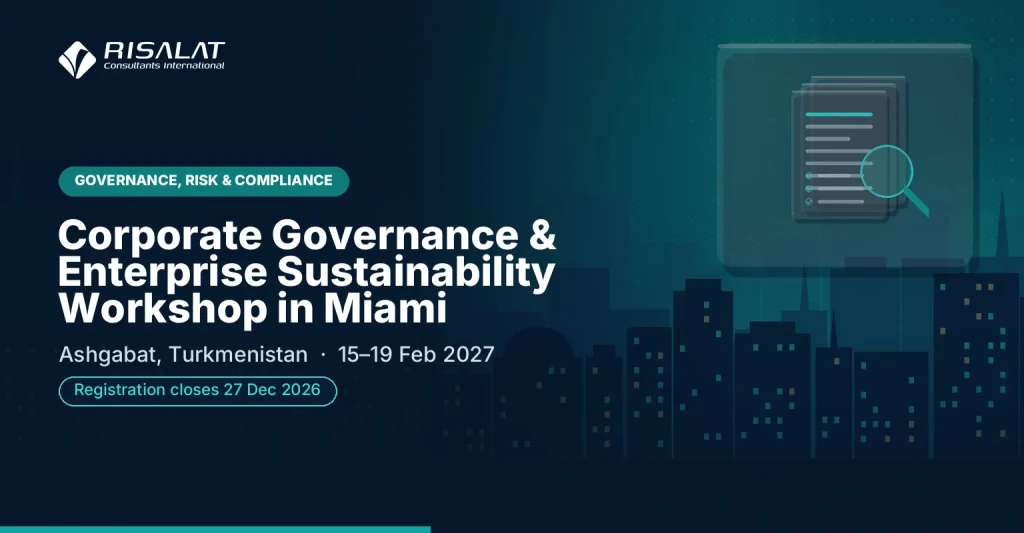
Key facts
- Dates
- 15–19 Feb 2027 (5 days)
- Where
- Hilton Garden Inn Miami Brickell South, Ashgabat, Turkmenistan
- Fee per participant
- £5,100 (GBP)
- Payment
- By invoice and bank transfer
- Registration closes
- 27 Dec 2026
- Who it is for
- The programme suits experienced professionals as well as those moving into new responsibilities. Groups that mix institutions and countries are enc…
- Certificate
- Certificate of completion
- In-house option
- Run it for your team, on your dates
On this page 13 sections
Programme Overview
Corporate governance is the way a corporation polices itself. In short, it is a method of governing the company like a sovereign state, instating its own customs, policies and laws to its employees from the highest to the lowest levels. Corporate governance is intended to increase the accountability of your company and to avoid massive disasters before they occur. The importance of corporate governance in today’s progressive and aggressive business environment cannot be denied. This course is designed for both directors, management, and those with responsibilities for introducing Corporate Governance into organizations. The programme will enable you to understand the importance of corporate governance, identify the corporate failure determinants and discuss the best practices available.
Delivered by Risalat Consultants International in Ashgabat, Turkmenistan, it combines expert-led sessions, real cases and group work, so that participants can apply what they learn in their own institution.
The programme strengthens institutional capability in:
- Introduction to Corporate Governance
- Major Functions & Responsibilities of the Board
- Defining the Organizational strategy & Corporate Values
- Role of Company Director
- Executive & Non-executive Directors
- Corporate Governance Issues, Concepts & Domain
- The ineffective Board & Company Failure
- Cases studies about Corporate Failure
- Fraud risk assessment and fraud risk registers
- Design and testing of internal controls
- The Three Lines model and the role of oversight
- Audit planning, evidence and documentation
It is designed for directors & Board Members, organization Governance Professionals, senior Management and others who want practical, current skills in fraud, audit and internal control.
Why Corporate Governance & Enterprise Sustainability Matters Now
Public bodies and donor-financed projects are expected to show that funds are used for their intended purpose. Auditors, oversight bodies and financiers increasingly look beyond the financial statements to the controls, records and behaviours behind them.
Fraud and control weaknesses rarely come from one failure. They grow where roles are unclear, records are incomplete and warning signs are not followed up. Teams that understand how fraud happens, and how controls stop it, protect both their institution and the people it serves.
This Corporate Governance & Enterprise Sustainability programme brings these elements together in a practical format, so that participants understand not only what good practice looks like but also how to introduce it in their own setting, with the people and resources they have.
Institutions increasingly need professionals who can:
- Identify and rate fraud and control risks in their own processes
- Design controls that are proportionate and testable
- Gather and document reliable audit evidence
- Recognise red flags early and escalate them correctly
- Turn findings into practical, agreed actions
Strong capability helps institutions:
- Reduce losses and ineligible expenditure
- Pass external audits with fewer findings
- Strengthen trust with financiers and citizens
- Respond to allegations in a fair and documented way
Who Should Attend This Corporate Governance & Enterprise Sustainability Training
The programme suits experienced professionals as well as those moving into new responsibilities. Groups that mix institutions and countries are encouraged, because participants learn a great deal from each other’s experience.
This programme is designed for:
- Directors & Board Members
- Organization Governance Professionals
- Senior Management
- Analysts & Regulators
- Investors & Fund Managers
- Audit Committee Members
- Internal auditors and audit managers
- Finance managers and accountants
- Compliance and risk officers
- Procurement officers and managers
- Project and programme managers
- Project implementation unit (PIU) staff
Tick what your team needs to be able to do.
Programme Objectives
The objectives focus on what participants will be able to do after the programme, not only on what they will know. Each one is practised during the week through exercises, cases or group work.
By the end of this programme participants will be able to:
- Demonstrate the comprehensive understanding of Corporate Governance Best Practices and implement them within the institution
- Determine the major functions and responsibilities of the Board
- Handle Corporate Governance issues and adopt internal control systems
- Structure and Communicate Corporate Governance Procedures to Stakeholders
- Implement Governance Directives within the management and maximize financial benefit through employing effective corporate governance policies and procedures
- Explain how and why fraud happens, using recognised fraud risk models
- Carry out a fraud and control risk assessment for a real process
- Map controls to risks using the Three Lines model
- Plan an audit or review and choose suitable tests
- Recognise common red flags in procurement, payments and payroll
Corporate Governance & Enterprise Sustainability Training Structure & Contents
- Introduction to Corporate Governance
- Corporate Governance Issues, Concepts & Domain
- Internal Controls & Accountability
- Corporate Social Responsibility
- Fraud, error and corruption: definitions and differences
- Why people commit fraud: pressure, opportunity and rationalisation
- Common fraud schemes in public bodies and projects
- Major Functions & Responsibilities of the Board
- The ineffective Board & Company Failure
- Corporate Risk Management
- Identifying fraud risks process by process
- Rating likelihood and impact
- Building a fraud risk register
- Linking risks to existing controls
- Defining the Organizational strategy & Corporate Values
- Cases studies about Corporate Failure
- Financial Market Supervision & Control
- Preventive, detective and corrective controls
- Segregation of duties and approval limits
- The Three Lines model in practice
- Testing whether controls work
- Role of Company Director
- External Governance, Laws & Regulations
- Governance & Financial Market Economics
- Red flags and data analysis for detection
- Audit planning and sampling
- Evidence, documentation and the audit trail
- Handling allegations and investigation basics
- Executive & Non-executive Directors
- Best Practices and norms of behavior
- Protecting Shareholders & Stakeholders
- Writing findings that lead to action
- Management responses and follow-up
- Speak-up channels and protection of reporters
- Building an ethical culture
Full day-by-day contents
First Day | How fraud happens and why it matters
The day sets the foundations and links the topic to participants' own institutions.
- Introduction to Corporate Governance
- Corporate Governance Issues, Concepts & Domain
- Internal Controls & Accountability
- Corporate Social Responsibility
- Fraud, error and corruption: definitions and differences
- Why people commit fraud: pressure, opportunity and rationalisation
- Common fraud schemes in public bodies and projects
Second Day | Fraud risk assessment
Participants move from principles to practice, working on realistic examples.
- Major Functions & Responsibilities of the Board
- The ineffective Board & Company Failure
- Corporate Risk Management
- Identifying fraud risks process by process
- Rating likelihood and impact
- Building a fraud risk register
- Linking risks to existing controls
Third Day | Controls and the Three Lines model
The focus is on applying methods and tools through structured group work.
- Defining the Organizational strategy & Corporate Values
- Cases studies about Corporate Failure
- Financial Market Supervision & Control
- Preventive, detective and corrective controls
- Segregation of duties and approval limits
- The Three Lines model in practice
- Testing whether controls work
Fourth Day | Detection, audit and investigation
Cases and exercises show how the approach works in real projects and institutions.
- Role of Company Director
- External Governance, Laws & Regulations
- Governance & Financial Market Economics
- Red flags and data analysis for detection
- Audit planning and sampling
- Evidence, documentation and the audit trail
- Handling allegations and investigation basics
Fifth Day | Reporting, follow-up and action planning
Participants bring the week together and prepare the actions they will take back to work.
- Executive & Non-executive Directors
- Best Practices and norms of behavior
- Protecting Shareholders & Stakeholders
- Writing findings that lead to action
- Management responses and follow-up
- Speak-up channels and protection of reporters
- Building an ethical culture
- Transaction
- Record
- Control
- Evidence
- Opinion
Training Methodology
Corporate Governance & Enterprise Sustainability Workshop in Miami, US has been designed in order to enhance the knowledge of professionals interested in the field. The trainer will use modern & highly effective training methodology to ensure the successful results & maximum understanding of participants including presentations, case studies, team assignments, role plays, video illustrations, etc.
Before the programme, a short pre-assessment helps the facilitators understand each participant’s role and priorities, so that examples and exercises can be adjusted to the group. Each day ends with a short reflection in which participants note what they will apply at work.
- Expert-led sessions on current practice
- Regional and international case studies
- Group work and practical exercises
- Simulations and role plays where relevant
- Discussion of participants' own challenges
- Daily reflection and action planning
Institutional Application
The programme is built so that learning moves from the classroom into the institution. Participants work on their own processes and documents where possible, and leave with an action plan that their managers can review and support.
This programme supports institutions in strengthening:
- Fraud and corruption risk management
- Internal control frameworks
- Audit and oversight arrangements
- Follow-up of audit findings
- Integrity and reporting channels
Participants return with practical tools to improve:
- Risk registers and control maps
- Audit planning and testing
- Evidence and documentation
- Reporting to management and boards
- Prevention of ineligible expenditure
Regional Relevance & Application
Holding the programme in Ashgabat, Turkmenistan brings together participants from different countries and institutions, so they can compare how fraud, audit and internal control is handled in different settings.
The same programme can also be delivered in-house for one institution, in its own country or online, with cases taken from its current work.
Examples and exercises are chosen to reflect the realities of public institutions and donor-financed projects, and participants are encouraged to bring a current challenge from their own work so that the action plan they leave with is directly usable.
Host Country Profile – Turkmenistan
Ashgabat is the capital and largest city of Turkmenistan. It lies between the Karakum Desert and the Köpetdag mountain range in Central Asia, approximately 50 km away from the Iran-Turkmenistan border. The city has a population of 1,030,063. Source: Wikipedia.
The programme takes place at Hilton Garden Inn Miami Brickell South.
Expected Outcomes of Corporate Governance & Enterprise Sustainability Training
Participants will be able to:
- Assess fraud and control risks in their own processes
- Design and test proportionate controls
- Recognise red flags and escalate them correctly
- Document reliable evidence
- Report findings that lead to agreed action
- Lead practical improvements in their institution
Participants leave with a personal action plan and practical tools they can use in their institution from the first week back. Institutions that send several participants can use the programme to agree shared methods and templates across teams, which makes improvements easier to sustain.
£5,100 per participant · invoice and bank transfer · groups of 5 or more receive a discount
Five or more from one organisation: ask for the group rate on the invoice request.
Ten or more: an in-house version for your institution may cost less per person. Ask for an in-house quote.
Registration closes in 49 days (27 Dec 2026)
Course Deliverables
Participants receive support before, during and after the programme, so that preparation, learning and follow-up form one continuous experience.
Before the Programme
- Participant Pre-Assessment
- Corporate Governance & Enterprise Sustainability Readiness Assessment
- Corporate Governance & Enterprise Sustainability Resource Pack
- Preparatory Reading Materials
- Complimentary Visa Support & Advisory
During the Programme
- Airport Pickup & Welcome Assistance
- Accommodation with Breakfast
- Welcome Networking Dinner
- Risalat Training Kit (Bag, Bottle, Mug, T-Shirt, Cap, Passport Cover, Pens, Notebook, Magnet & Keychain)
- Comprehensive Corporate Governance & Enterprise Sustainability Training Manual
- Fraud Risk Register Template
- Control Mapping Matrix
- Audit Evidence Checklist
- Findings and Follow-up Tracker
- Practical Workshops & Simulations
- Group Discussions & Peer Learning
- Daily Lunch and Refreshments
- Full Access to Training Venue Facilities
- Mini Pad / Tablet with Digital Learning Materials
- Field Visit (where applicable)
- Entertaining City Tour
After the Programme
- Certificate of Completion
- Risalat Programme Participation Recognition Award
- Post-Training Reference Materials
- Fraud Risk Self-Assessment Guide
- Control Testing Checklist
- Post-Training Support & Follow-Up Guidance
- Programme Report
Institutions can also request a tailored in-house version of this programme, delivered at their premises or online. Request a proposal.
Frequently Asked Questions
When and where does the Corporate Governance & Enterprise Sustainability programme take place?
It runs from 15 Feb 2027 to 19 Feb 2027, in Ashgabat, Turkmenistan (Hilton Garden Inn Miami Brickell South). The registration deadline is shown at the top of this page.
Who should attend?
The programme is designed for directors & Board Members, organization Governance Professionals, senior Management, analysts & Regulators, and others who want practical skills in fraud, audit and internal control.
Will I receive a certificate?
Yes. Participants who complete the programme receive a Certificate of Completion from Risalat Consultants International.
Can this programme be delivered for our institution only?
Yes. We can deliver a tailored in-house version at your premises, in another city or online, built around your own cases. Use the proposal request on this page.
Do I need prior experience in fraud, audit and internal control?
No specialist background is required beyond experience in a related role. A short pre-assessment helps the facilitators adapt the sessions to the group.
Training courses in AshgabatGovernance, Risk & Compliance training courses
Why Ashgabat for this programme
Ashgabat, Turkmenistan, was chosen for this programme because it is easy to reach for the participants we expect and has suitable venues for practical, interactive training.
The Corporate Governance & Enterprise Sustainability Workshop in Miami programme in February 2027 brings together officials and professionals. Sessions combine short inputs, case studies and group work on participants' own files, and the city's institutions can be added as a study visit on request.
Check whether you need a visa with the free Visa Checker, and ask for an invitation letter once you are registered.
The same topic in other cities
- Agribusiness Value Addition and Productive Alliance Structuring in Bangkok (Bangkok)
- Sustainable Supply Chain Practices Training in Singapore (Singapore)
- Green & Transition Finance Executive Training in Beijing (Beijing)
- Strategic Internal Audit, Risk & Governance Training (Baku)
- CFO Strategy & Leadership Training in Sydney (Sydney)
- Carbon Pricing and Policymaking Training and Exposure in Helsinki (Helsinki)
More training courses in Turkmenistan · All programmes in Asia · Full training calendar