Key facts
- Dates
- 15–18 Feb 2027 (4 days)
- Where
- Novotel Dubai Al Barsha, Al Barsha (proposed), Dubai, United Arab Emirates
- Fee per participant
- £2,350 (GBP)
- Payment
- By invoice and bank transfer
- Registration closes
- 6 Jan 2027
- Format
- 4-day short course: a practical capacity-building programme for government, NGO and project teams in Dubai
- Certificate
- Certificate of completion
- Groups
- Teams of 3 or more qualify for a group discount, offered case by case: ask for a group quote.
- In-house option
- Run it for your team, on your dates
On this page 10 sections
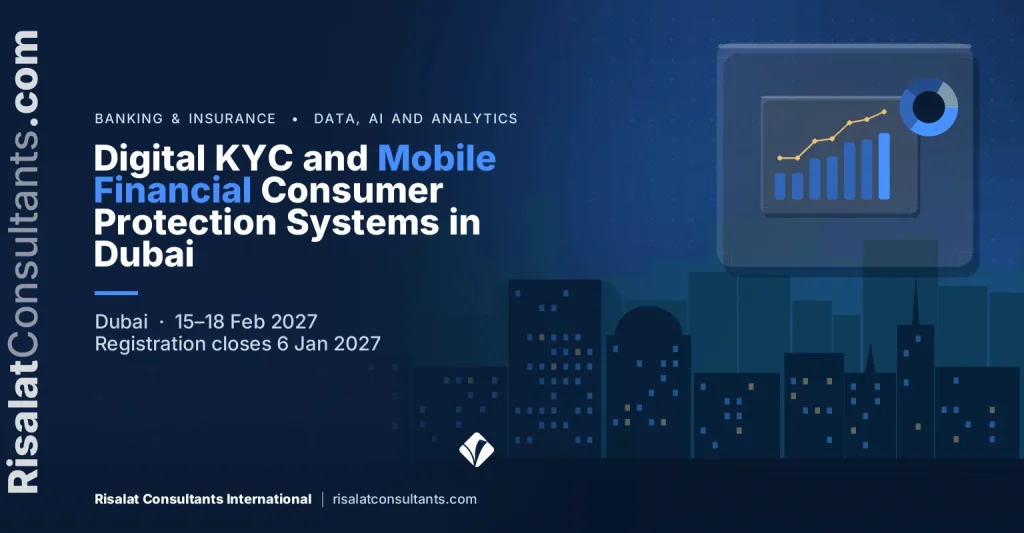
Digital KYC and Mobile Financial Consumer Protection Systems in Dubai
Programme Overview
Rapid expansion of mobile network operators and agent networks has transformed financial inclusion, yet it brings substantial regulatory complexity. In jurisdictions with fragmented telecommunications systems and uneven civil registration, supervisory authorities require robust tools to ensure integrity. This programme delivers practical capabilities to design and implement electronic Know Your Customer mechanisms, verify identities remotely, and oversee digital transaction streams effectively. Participants examine how regulatory technology supports compliance across cash-in, cash-out, and merchant payment ecosystems.
Free self-check: the digital readiness assessment gives how ready your institution is for digital services, data and AI, in about 10 minutes.
Financial consumer protection is essential to maintaining public trust in digital store-of-value products. The course provides structured exposure to supervisory frameworks addressing predatory fees, opaque pricing, network downtime, and digital fraud. Regulators and project specialists analyse the technical architecture of mobile wallets, interoperable switches, and automated transaction monitoring systems. Through regional case studies and regulatory models, attendees learn to establish balance between financial stability, anti-money laundering controls, and inclusive access.
Delivered in Dubai, this intensive four-day course equips participants with operational methodologies to supervise non-bank financial service providers. The curriculum integrates international standards from the Financial Action Task Force and the Basel Committee on Banking Supervision with emerging market realities. Delegates acquire the competence to draft regulatory instructions, monitor consumer dispute resolution protocols, and establish functional data-sharing mechanisms among central banks, telecommunications authorities, and digital financial service operators.
The programme strengthens institutional capability in:
- Alignment with Financial Action Task Force guidance on digital identity and non-face-to-face onboarding
- Assessing mobile network operator subscriber data for remote identity verification and authentication
- Structuring tiered Know Your Customer rules aligned with low-value transaction thresholds
- Managing verification gaps in environments lacking unified national civil registration databases
- Data governance, identity theft risks, and participant obligations under emerging data protection norms
- Technical structures of mobile wallets, unbanked ledgers, and core banking application interfaces
- Legal protection of pooled funds: trust accounts, custodial arrangements, and bank failure isolation
- Supervising agent networks: liquidity management, conduct of business, and operational resilience
- Digital strategy and transformation planning
- Data governance and data quality
- Data analysis and visualisation
- Cybersecurity basics and risk management
- Collect
- Clean
- Store
- Analyse
- Decide
Why this matters now
Organisations increasingly require professionals capable of:
- Plan digital initiatives that solve real problems
- Manage data quality, protection and sharing
- Analyse data and present it clearly
- Manage cyber and technology risks
- Lead people through digital change
Strong digital government, data and technology systems help organisations:
- Deliver faster and more accessible services
- Make better use of data in decisions
- Protect systems and personal data
- Get value from technology investments
Who Should Attend
This programme is designed for:
- Central Bank of Somalia banking and payment system supervisors
- Financial sector analysts evaluating digital identity and mobile payment risks
- Digital finance project coordinators managing donor-funded sector interventions
- Payment system oversight officers from central banks and monetary authorities
- Anti-money laundering and counter-terrorist financing compliance officers
- Telecommunications regulatory specialists overseeing mobile money integrations
- Legal and policy officers responsible for digital consumer protection rules
- Project Implementation Unit specialists delivering financial infrastructure projects
- Risk managers overseeing digital retail payment systems and agent networks
- ICT managers and officers
- Digital transformation leads
- Data analysts and statisticians
Tick what your team needs to be able to do.
Programme Objectives
By the end of this programme participants will be able to:
- Analyse regulatory models for tiered and digital Know Your Customer compliance across fragmented identity environments
- Evaluate technical architectures for electronic verification through mobile network registries and civil databases
- Design risk-based supervisory procedures for mobile money issuers and third-party payment service providers
- Construct financial consumer protection frameworks covering dispute resolution, transparency, and data privacy
- Assess real-time transaction monitoring systems to detect fraud, smurfing, and unauthorized tariff deductions
- Establish inter-agency coordination mechanisms between central banking authorities and telecommunications regulators
- Formulate operational guidelines for safeguarding customer funds held in mobile money trust and escrow accounts
- Explain the main trends in digital government and data use
- Plan a digital initiative linked to service goals
- Apply data governance and quality principles
Training Structure & Contents
- Alignment with Financial Action Task Force guidance on digital identity and non-face-to-face onboarding
- Assessing mobile network operator subscriber data for remote identity verification and authentication
- Structuring tiered Know Your Customer rules aligned with low-value transaction thresholds
- Managing verification gaps in environments lacking unified national civil registration databases
- Data governance, identity theft risks, and participant obligations under emerging data protection norms
- Workshop on applying digital identity and tiered Know Your Customer baselines to institutional examples
- Technical structures of mobile wallets, unbanked ledgers, and core banking application interfaces
- Legal protection of pooled funds: trust accounts, custodial arrangements, and bank failure isolation
- Supervising agent networks: liquidity management, conduct of business, and operational resilience
- Interoperability mechanisms, clearing protocols, and retail payment switch integration
- Prudential reporting formats and off-site data collection templates for mobile network operator-affiliated issuers
- Workshop on mobile money architecture, trust accounts, and practical supervisory steps
- Typologies of digital financial fraud: SIM swap scams, social engineering, and unauthorized agent fees
- Implementing automated regulatory technology and supervisory technology for mobile transaction surveillance
- Threshold monitoring, velocity controls, and suspicious transaction reporting mechanisms
- Audit trails, digital forensics, and maintaining evidentiary integrity for regulatory enforcement
- Collaborative oversight frameworks: Central Bank and National Telecommunications Authority protocols
- Case study analysis comparing surveillance and monitoring practices against good practice
- Developing market conduct standards: clear fee disclosures, tariff caps, and contract terms
- Operationalising complaints handling: turnaround times, escalation pathways, and ombudsman linkages
- Managing system downtime liabilities, mistaken transfers, and consumer redress arrangements
- Drafting supervisory inspection manuals for digital consumer protection compliance
- Action planning for reform delivery: meeting technical and institutional requirements under donor-funded programmes
- Capstone exercise to construct and present an institutional action plan with priorities and next steps
- Application of automated supervisory technology for compliance data validation
- Mechanisms for cross-sector data exchange between banking and telecommunications authorities
- Review of institutional reform prerequisites under donor-funded interventions such as the SCALED-UP project
- Integrating consumer protection inspection manuals into routine on-site supervision
- Developing enforcement protocols for persistent system downtime and tariff infringements
- Final institutional presentation and peer critique of implementation roadmaps
Full day-by-day contents
First Day | Digital Identity, Tiered KYC, and National Regulatory Baselines
- Alignment with Financial Action Task Force guidance on digital identity and non-face-to-face onboarding
- Assessing mobile network operator subscriber data for remote identity verification and authentication
- Structuring tiered Know Your Customer rules aligned with low-value transaction thresholds
- Managing verification gaps in environments lacking unified national civil registration databases
- Data governance, identity theft risks, and participant obligations under emerging data protection norms
- Workshop on applying digital identity and tiered Know Your Customer baselines to institutional examples
Second Day | Mobile Money Architecture, Trust Accounts, and Prudential Oversight
- Technical structures of mobile wallets, unbanked ledgers, and core banking application interfaces
- Legal protection of pooled funds: trust accounts, custodial arrangements, and bank failure isolation
- Supervising agent networks: liquidity management, conduct of business, and operational resilience
- Interoperability mechanisms, clearing protocols, and retail payment switch integration
- Prudential reporting formats and off-site data collection templates for mobile network operator-affiliated issuers
- Workshop on mobile money architecture, trust accounts, and practical supervisory steps
Third Day | Fraud Surveillance, AML/CFT Supervision, and Real-Time Monitoring
- Typologies of digital financial fraud: SIM swap scams, social engineering, and unauthorized agent fees
- Implementing automated regulatory technology and supervisory technology for mobile transaction surveillance
- Threshold monitoring, velocity controls, and suspicious transaction reporting mechanisms
- Audit trails, digital forensics, and maintaining evidentiary integrity for regulatory enforcement
- Collaborative oversight frameworks: Central Bank and National Telecommunications Authority protocols
- Case study analysis comparing surveillance and monitoring practices against good practice
Fourth Day | Financial Consumer Protection, Dispute Redress, and Project Implementation
- Developing market conduct standards: clear fee disclosures, tariff caps, and contract terms
- Operationalising complaints handling: turnaround times, escalation pathways, and ombudsman linkages
- Managing system downtime liabilities, mistaken transfers, and consumer redress arrangements
- Drafting supervisory inspection manuals for digital consumer protection compliance
- Action planning for reform delivery: meeting technical and institutional requirements under donor-funded programmes
- Capstone exercise to construct and present an institutional action plan with priorities and next steps
Fifth Day | Emerging Supervisory Technologies and Inter-Agency Redress Systems
- Application of automated supervisory technology for compliance data validation
- Mechanisms for cross-sector data exchange between banking and telecommunications authorities
- Review of institutional reform prerequisites under donor-funded interventions such as the SCALED-UP project
- Integrating consumer protection inspection manuals into routine on-site supervision
- Developing enforcement protocols for persistent system downtime and tariff infringements
- Final institutional presentation and peer critique of implementation roadmaps
Training Methodology
The training combines regulatory benchmarking, guided document dissection, and peer analysis tailored to fragile and developing market contexts. Participants work through real-world technical guidelines, drafted directives, and transaction-monitoring workflows. Daily sessions incorporate structured working groups where delegates resolve complex supervisory challenges, evaluate operational trade-offs, and construct actionable governance instruments.
- Expert-led instructional modules contextualised by regulatory experience
- Guided review of supervisory frameworks, directives, and reporting templates
- Small-group case analysis and peer comparison exercises
- Practical institutional action planning and feedback sessions
Expected Outcomes
- Enhanced technical capacity to oversee digital identity and non-face-to-face onboarding systems
- Operational capability to draft and enforce risk-based, tiered Know Your Customer directives
- Strengthened procedures for supervising mobile wallet architectures, trust accounts, and agent networks
- Practical instruments to conduct real-time transaction monitoring and manage fraud typologies
- Formulated market conduct rules, dispute resolution frameworks, and inter-agency coordination mechanisms
- Action plans tailored to institutional contexts, regulatory mandates, and donor-funded project standards
£2,350 per participant · invoice and bank transfer · groups of 5 or more receive a discount
Five or more from one organisation: ask for the group rate on the invoice request.
Ten or more: an in-house version for your institution may cost less per person. Ask for an in-house quote.
Registration closes in 37 days (6 Jan 2027)
Who Will Deliver This Programme
Each date is delivered by a team assigned from Risalat's expert network for this subject. For this programme we assign:
How we choose them: Experience in the region of the participants or comparable settings; Command of the financier rules that apply (World Bank, ADB, AfDB, EU, UN) where relevant; Delivery in English; other languages on request for in-house groups; No conflict of interest with participants' institutions.
Training courses in DubaiBanking & Insurance training courses
Why Dubai for this programme
Dubai is a one-flight hub for Africa, Asia and Europe, with simple visas for many nationalities and modern training venues.
The Digital KYC and Mobile Financial Consumer Protection Systems in Dubai programme in February 2027 brings together officials and professionals from across the Middle East region and beyond. Sessions combine short inputs, case studies and group work on participants' own files, and the city's institutions can be added as a study visit on request.
Getting there: Dubai International (DXB).
Check whether you need a visa with the free Visa Checker, and ask for an invitation letter once you are registered.
The same topic in other cities
- Digital Payment Architecture for Social Protection Transfers in Cairo (Cairo)
- FinTech and Digital Transformation in Islamic Finance (Doha)
Other programmes in Dubai
- Mini Degree in Internal Audit and Risk Management in Dubai
- Refugee and Host Community Programme Management in Dubai
- Performance Audit for Supreme Audit Institutions in Dubai
- Artificial Intelligence for Public Sector Leaders Training in Dubai
- Records and Archives Management for Public Institutions in Dubai
Questions before you nominate your team? Book a 30-minute call with us, or ask for this programme in-house.
Teams often travel here from Maldives, Sri Lanka, Bangladesh, Nepal, Pakistan, Kazakhstan, Uzbekistan, Kyrgyzstan. Funding, visa letters and group rates are explained on each country page.
Local participant, or arranging your own stay?
The fee without accommodation is £1,950 per participant instead of £2,350 (£100 less for each of the 4 days). Everything else in the package stays the same: training, materials, lunches, the kit, the city tour and the certificate.
Register without accommodation →Venue: Novotel Dubai Al Barsha, Al Barsha. Proposed venue, or a similar hotel with a training room; it may change with circumstances, and participants are told at once of any change.
Is there data, ai and analytics training for government officials in Dubai in February 2027?
Can "Digital KYC and Mobile Financial Consumer Protection Systems in Dubai" be delivered in-house for one organisation?
Which other data, ai and analytics programmes does Risalat run?
How do organisations register and pay?
For teams and institutions
Bring your team
Teams that learn together apply more at work. Tell us how many people and how you would like to take part: we reply with a group quote within two working days.
Watch: this programme in short

Other dates and cities for this subject: Digital Government and Data Governance training courses (123 upcoming dates).
More training courses in the United Arab Emirates · All programmes in Middle East · Full training calendar
Plan this programme in a roadmap: why it matters, why to approve it, the dates to plan and the career it builds.