Programme Overview
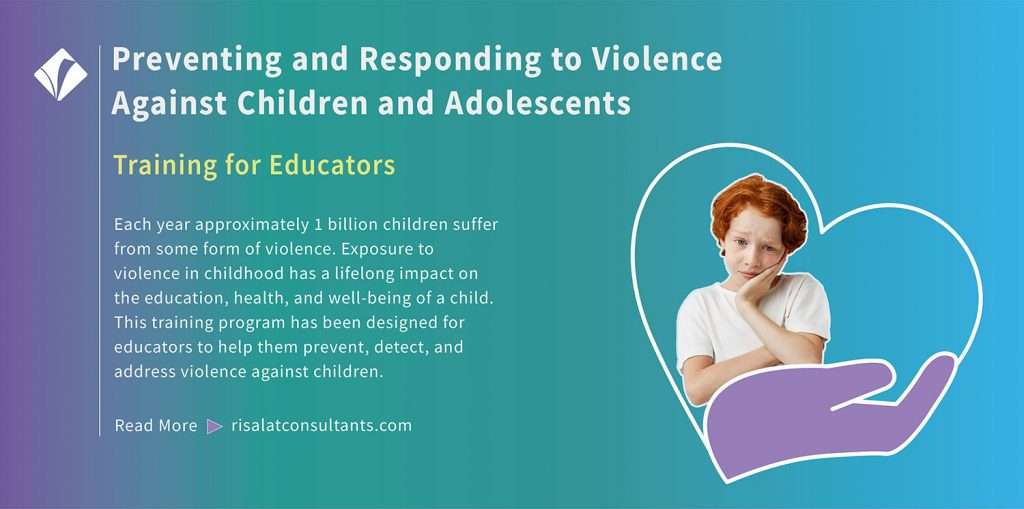
Violence against children is a worldwide concern. It affects nearly 1 billion children each year. Exposure to violence in childhood has a lifelong impact on the education, health, and well-being of a child. It can lead to cognitive, emotional, and social problems that result in poor performance. Preventing and addressing violence promotes peaceful and inclusive societies thereby contributing to sustainable development. Schools play a crucial role in channeling violence prevention efforts. Thus, it is essential that educational institutions strengthen their capacity in creating a violence-free environment.
This training programme has been designed for educators to help them prevent, detect, and address violence against children (VAC). Throughout the course of this programme, you shall broaden your knowledge regarding child abuse and neglect and develop the necessary skills to act upon it. Moreover, you will learn what an effective school-based intervention looks like and understand how to support the creation of a safe environment.
Target Audience
Training for Educators on Preventing and Responding to Violence against Children and Adolescents is the best suit for the personnel of educational establishments including:
- Teachers and Educators
- Head Teachers
- School Principals
- Educational Specialists
Programme Objectives
Upon the successful completion of Preventing and Addressing Violence Against Children Training, its participants shall be able to:
- Comprehend and analyze the characteristics of VAC
- Analyze legal, social, and cognitive implications of VAC
- Understand how to respond to violence against children inside and outside of the educational establishment
- Understand the role of educators in addressing the VAC
- Deal with challenges associated with reporting VAC cases
- Work with families and community to prevent VAC
- Design and Implement school-based activities for preventing the VAC
Programme Contents
- Statistics of Violence Against Children
- Defining Violence Against Children
- Child Rights; UN Convention on the Rights of the Child
- Legal obligations of the State
- The role of educators in addressing VAC
- Professional Responsibilities and Personal Commitments
- Physical Abuse
- Neglect
- Emotional Maltreatment
- Sexual Abuse
- General of Indicators of Abuse and Neglect
- Working with families and children
- Developing and Implementing School-based programmes for children and adolescents
- Creating School-based programmes for families
- Schools, Community, and VAC
- Individual Action
- Safe Spaces
- Monitoring the VAC
Full day-by-day contents
First Day – Understanding Violence Against Children
- Statistics of Violence Against Children
- Defining Violence Against Children
- Child Rights; UN Convention on the Rights of the Child
- Legal obligations of the State
- The role of educators in addressing VAC
- Professional Responsibilities and Personal Commitments
- Community Efforts to combat VAC
Second Day – Recognizing and Reporting Child Abuse and Neglect
- Physical Abuse
- Neglect
- Emotional Maltreatment
- Sexual Abuse
- General of Indicators of Abuse and Neglect
- Working with families and children
- Child Abuse inside a school
- Reporting VAC
- Challenges with Reporting VAC
Third Day – Proactive action to prevent Violence against children
- Developing and Implementing School-based programmes for children and adolescents
- Creating School-based programmes for families
- Schools, Community, and VAC
- Individual Action
- Safe Spaces
- Monitoring the VAC
Programme Methodology
Training Programme on Preventing and Addressing Violence Against Children in Stockholm, Sweden represents a well-blended mix of theoretical and practical activities. Contemporary adult learning techniques will be applied while delivering the sessions. Open presentation will be supported by group discussions and situational analysis. In addition, the presenter shall utilize video examples and case studies. Active Participation of delegates will be promoted to support engaging learning process.
Course Deliverables
Participants will enjoy a full-service experience that covers everything needed before, during, and after the programme:
Before the Programme
- Participant Pre-Assessment to ensure effective preparation
- Complimentary Visa Support & Advisory (E-visa applications are fully processed by our team)
During the Programme
- Airport Pickup & Welcome Assistance
- Accommodation with Breakfast for the full duration
- Welcome Dinner for networking and connecting with fellow Participants & the Risalat Team
- Risalat Training Kit, including: bag, water bottle, coffee mug, t-shirt, cap, passport cover, pens, notebook, magnet, keychain
- Lunch Provided Daily during training days
- Comprehensive Course Manual & Training Materials
- Project-Based Templates, Tools, and Worksheets
- Mini Pad / Tablet for convenient access to digital resources
- Digital Case Studies, Reading Packs & Reference Materials
- Access to Sample Datasets & Practical Exercises
- Field Visit (where applicable)
- Complimentary Refreshments & Full Training Venue Facilities
- Access to Online Learning Resources
- Entertaining City Tour
- Certificate of Completion
- Risalat Programme Participation Recognition Award
After the Programme
- Post-Training Support & Follow-Up Guidance
- Programme Report
£3,450 per participant · invoice and bank transfer · groups of 5 or more receive a discount
Five or more from one organisation: ask for the group rate on the invoice request.
Ten or more: an in-house version for your institution may cost less per person. Ask for an in-house quote.
Registration closes in 5 days (23 Oct 2026)