Programme Introduction
Dialogue, peace, and mediation are key three pillars that support conflict de-escalation and resolution. They lay the groundwork for forging understanding and collaboration among conflict parties. Dialogue is a means of conflict resolution and the basis of human reconciliation efforts while peace is what creates an environment for growth and stability. The two are complemented by mediation – a framework for facilitating negotiation.
This dialogue, peace, and mediation training is the exclusive product of Risalat. The programme is specifically developed to help delegates acquire knowledge and hone necessary skills to better promote sustainable peace, manage conflicts, and facilitate reconciliation.
Target Audience
Dialogue, peace, and mediation training programmes can benefit a wide range of professionals and more particularly those who are involved in conflict resolution and peacemaking initiatives. Specific roles may include but not be limited to:
- Government officials
- Diplomats
- Conflict mediators
- Conflict arbitrators
- Humanitarian staff and members of aid organizations
- Community leaders
- Members of civil society groups
- Policymakers
- Strategic planners
- Law enforcement and security personnel
Tick what your team needs to be able to do.
Programme Objectives
This training programme aims to build core skills and knowledge for effective dialogue and peace mediation practice. Upon the successful completion, its delegates are expected to be able to:
- Perform conflict analysis, identify its root causes, and select appropriate approach to resolution.
- Employ effective dialogue and mediation practices to address conflicts, forging understanding on different perspectives of the parties.
- Create respectful and sensitive atmosphere for conflict dialogues with the aim to promote balanced and productive discussions.
- Contribute to peacebuilding efforts by facilitating, building, and maintaining partnerships.
Programme Contents
- Understanding the concept of dialogue and its role in conflict resolution
- Defining and comprehending peacebuilding
- Resolving disputes through mediation
- Conflicts and crises – understanding the specificities
- Defining and classifying conflicts
- Conflict dynamics and sources
- Stakeholders, their interests, and power dynamics
- Case studies on historical and contemporary conflicts
- Communication skills for constructive dialogue
- Building empathy and understanding
- Emotional responses during dialogue
- Leading productive discussions
- Key principles of mediation
- Mediation Process, techniques, and strategies
- Resistance management
- Inclusive dialogue
- Conflict escalation – how to address it?
- Power imbalance management
- Understanding peacebuilding frameworks
- Key components of peacebuilding frameworks: reconciliation, reconstruction, and development
- Planning and executing peacebuilding projects
- Tools for assessing the impact of peacebuilding initiatives
- Feedback mechanisms and continuous improvement
- Addressing cultural and social biases
- Techniques for early conflict detection and intervention
- Building early warning systems and communication channels
- Strategies for engaging stakeholders and preventing escalation
- Ethical Principles in Dialogue and Mediation
- Maintaining professionalism in conflict resolution
Full day-by-day contents
First Day
- Understanding the concept of dialogue and its role in conflict resolution
- Defining and comprehending peacebuilding
- Resolving disputes through mediation
- Conflicts and crises – understanding the specificities
- Defining and classifying conflicts
- Conflict dynamics and sources
- How to perform effective conflict analysis
Second Day
- Stakeholders, their interests, and power dynamics
- Case studies on historical and contemporary conflicts
- Communication skills for constructive dialogue
- Building empathy and understanding
- Emotional responses during dialogue
- Leading productive discussions
- Encouraging participation and engagement
Third Day
- Key principles of mediation
- Mediation Process, techniques, and strategies
- Resistance management
- Inclusive dialogue
- Conflict escalation – how to address it?
- Power imbalance management
- Drafting and formalizing agreements
Fourth Day
- Understanding peacebuilding frameworks
- Key components of peacebuilding frameworks: reconciliation, reconstruction, and development
- Planning and executing peacebuilding projects
- Tools for assessing the impact of peacebuilding initiatives
- Feedback mechanisms and continuous improvement
Fifth Day
- Addressing cultural and social biases
- Techniques for early conflict detection and intervention
- Building early warning systems and communication channels
- Strategies for engaging stakeholders and preventing escalation
- Ethical Principles in Dialogue and Mediation
- Maintaining professionalism in conflict resolution
- Managing ethical dilemmas and conflicts of interest
- Building Networks and Collaboration
Programme Methodology
This training has been designed as an active multi-day skills building exercise. It enshrines systematic approaches to developing capacities of delegates in dialogue, peace and mediation. Group work coupled with case studies, role plays, simulations, panel discussions, and video demonstrations intends to build real-life
Host Country Profile
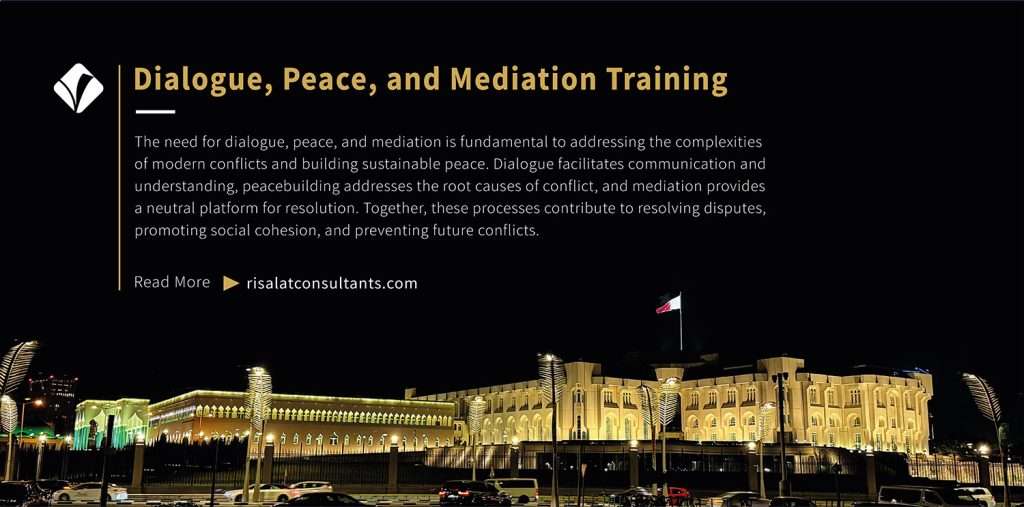
Qatar has emerged as a significant player in international diplomacy, particularly in the fields of dialogue, peace, and mediation. Leveraging its strategic geographic location and diplomatic relationships, the state has positioned itself as a neutral mediator in various regional and global conflicts.
Qatar’s foreign policy is characterized by its willingness to engage with diverse parties, including those often isolated by the international community. This approach has allowed Qatar to facilitate peace talks and negotiations, most notably in the conflicts involving the Taliban in Afghanistan, where it hosted critical rounds of peace negotiations that eventually led to the U.S.-Taliban agreement in 2020. In addition, the state has most recently been brokering ceasefire throughout ongoing Hamas-Israel war actively contributing to peace negotiations as a mediator alongside providing financial aid to Gaza.
Qatar’s role in mediation extends beyond high-profile conflicts, encompassing efforts to foster dialogue between rival factions in the Middle East, Africa, and beyond. The country has utilized its wealth and influence to support diplomatic initiatives, such as providing a venue for peace talks and offering financial aid to support post-conflict recovery efforts.
Course Deliverables
Participants will enjoy a full-service experience that covers everything needed before, during, and after the programme:
Before the Programme
- Participant Pre-Assessment to ensure effective preparation
- Complimentary Visa Support & Advisory (E-visa applications are fully processed by our team)
During the Programme
- Airport Pickup & Welcome Assistance
- Accommodation with Breakfast for the full duration
- Welcome Dinner for networking and connecting with fellow Participants & the Risalat Team
- Risalat Training Kit, including: bag, water bottle, coffee mug, t-shirt, cap, passport cover, pens, notebook, magnet, keychain
- Lunch Provided Daily during training days
- Comprehensive Course Manual & Training Materials
- Project-Based Templates, Tools, and Worksheets
- Mini Pad / Tablet for convenient access to digital resources
- Digital Case Studies, Reading Packs & Reference Materials
- Access to Sample Datasets & Practical Exercises
- Field Visit (where applicable)
- Complimentary Refreshments & Full Training Venue Facilities
- Access to Online Learning Resources
- Entertaining City Tour
- Certificate of Completion
- Risalat Programme Participation Recognition Award
After the Programme
- Post-Training Support & Follow-Up Guidance
- Programme Report
£4,560 per participant · invoice and bank transfer · groups of 5 or more receive a discount
Five or more from one organisation: ask for the group rate on the invoice request.
Ten or more: an in-house version for your institution may cost less per person. Ask for an in-house quote.
Registration closes in 5 days (23 Oct 2026)