关键信息
- 日期
- 2027年3月15–19日(5天)
- 地点
- Hawthorn Suites by Wyndham Abu Dhabi, Abu Dhabi, United Arab Emirates
- 每位学员费用
- £2,860(英镑)
- 付款
- 通过发票和银行转账付款
- 报名截止
- 2027年1月24日
- 形式
- 5-day short course: a practical capacity-building programme for government, NGO and project teams in Abu Dhabi
- 证书
- 结业证书
- 内训选项
- 按您的日期,为您的团队专场举办
本页内容15个部分
培训项目概述
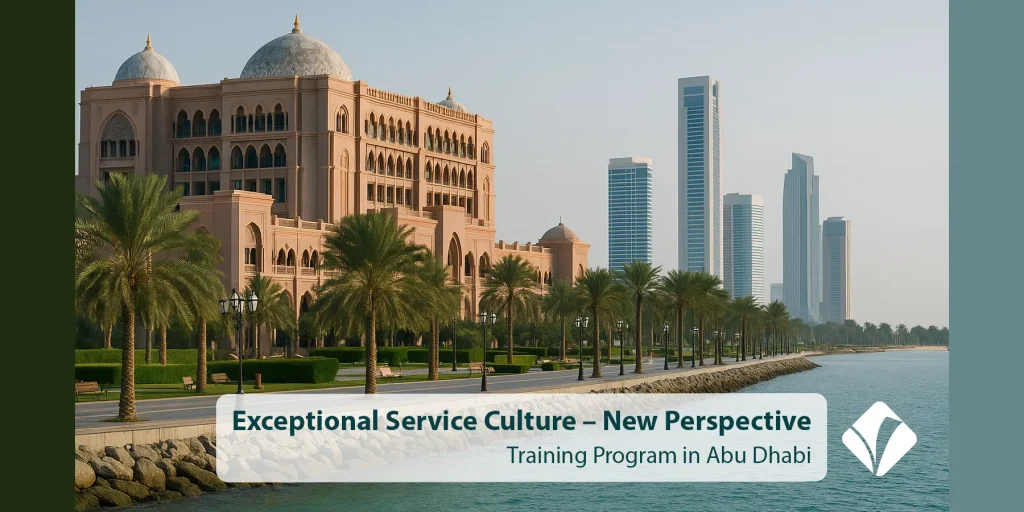
Exceptional Service Culture Training in Abu Dhabi gives government agencies, donor-financed project units, public service providers and private-sector teams a practical way to strengthen service standards, staff behaviour and customer journey improvement. The five-day learning journey concentrates on tasks that professionals can demonstrate at work, rather than a collection of unrelated management topics.
Abu Dhabi’s Department of Government Enablement has extended the TAMM platform to integrate government services and improve user journeys. Its published 2025–2027 strategy offers an official example of institutions treating user experience as a shared responsibility.
Abu Dhabi Customs reported that satisfaction with its TAMM-delivered services reached 97.1 per cent in 2025. The figure concerns that authority’s users and cannot be generalised to all services, but it demonstrates why service measurement matters.
The OECD 2026 trust survey distinguishes satisfaction with administrative services from trust in institutions. This training therefore addresses front-office conduct, back-office decisions, complaint resolution and leadership accountability together.
In a mixed professional group, participants compare the procedures they use, the documents that demonstrate compliance and the decisions for which they are accountable. Every technical case is assessed for practicality, evidence quality and risks that could arise during implementation. The programme is a skills course, not a promise of institutional accreditation or an externally arranged visit.
The Programme Strengthens Institutional Capability
- 客户旅程分析
- Service culture assessment
- Customer-centric leadership
- Accessible service channels
- Service-level agreement design
- Frontline behaviour standards
- Active listening and empathy
- Communicating under pressure
- Complaint capture and escalation
- Root-cause analysis of service failures
- Staff coaching and reinforcement
- Cross-department handoff management
- Service cost and effort measurement
- Customer satisfaction interpretation
- Feedback-to-action routines
- Retention and reputation management
The output of the week is an institution-specific working package, combining documented decisions, review checklists, a short executive brief and a realistic adoption plan. Participants are encouraged to bring non-sensitive examples from their own work while all teaching datasets and scenarios can be completed with fictional material.
The Growing Importance of Exceptional Service Culture
Technical proficiency in customer-centred service management is increasingly connected with institutional accountability. Teams need to know not just how a tool or procedure operates but when it is appropriate, who authorises it, what evidence is retained and how problems are escalated. Reliable practice improves the quality of decisions while reducing avoidable rework.
Abu Dhabi’s Department of Government Enablement has extended the TAMM platform to integrate government services and improve user journeys. Its published 2025–2027 strategy offers an official example of institutions treating user experience as a shared responsibility.
各机构日益需要具备以下能力的专业人员:
- Planning customer journey mapping for a defined operational purpose
- Planning service culture assessment for a defined operational purpose
- Planning customer-centric leadership for a defined operational purpose
- Planning accessible service channels for a defined operational purpose
- Planning service-level agreement design for a defined operational purpose
- Planning frontline behaviour standards for a defined operational purpose
- Planning active listening and empathy for a defined operational purpose
- Planning communicating under pressure for a defined operational purpose
- Planning complaint capture and escalation for a defined operational purpose
- Planning root-cause analysis of service failures for a defined operational purpose
- Planning staff coaching and reinforcement for a defined operational purpose
- Planning cross-department handoff management for a defined operational purpose
Strong customer-centred service management systems help organisations:
- Make customer-centric leadership a documented routine instead of an informal assumption
- Make accessible service channels a documented routine instead of an informal assumption
- Make service-level agreement design a documented routine instead of an informal assumption
- Make frontline behaviour standards a documented routine instead of an informal assumption
- Make active listening and empathy a documented routine instead of an informal assumption
- Make communicating under pressure a documented routine instead of an informal assumption
- Make complaint capture and escalation a documented routine instead of an informal assumption
- Make root-cause analysis of service failures a documented routine instead of an informal assumption
- Make staff coaching and reinforcement a documented routine instead of an informal assumption
An effective institutional approach links senior management ownership with staff capability, written procedures and proportionate monitoring. This programme uses Abu Dhabi as a professional learning venue while inviting participants to compare methods across agencies and countries.
1. What is the purpose of customer journey mapping?
A journey perspective exposes cross-department barriers that individual transaction metrics can miss.
2. How should an organisation act on repeated complaints?
Complaints provide evidence for process changes, not merely a volume to close.
3. Which figure did Abu Dhabi Customs publish for 2025 TAMM customer satisfaction?
Abu Dhabi Customs reported 97.1 per cent for its services via TAMM, not for all Abu Dhabi agencies.
Who Should Attend This Exceptional Service Culture Training?
本培训项目适合:
- Customer service managers
- Public service centre leaders
- Government service delivery officers
- Corporate account managers
- Customer contact centre supervisors
- Frontline service representatives
- Customer experience analysts
- HR learning and development officers
- Quality assurance specialists
- Digital service product owners
- Tourism and hospitality managers
- Municipal service managers
- Utility customer relations officers
- Operations and compliance managers
The course is most useful to people who have a real operational responsibility or are preparing to supervise one. Mixed groups enable a technical specialist to test recommendations with finance, compliance, programme and management colleagues before applying them to an institution.
勾选您的团队需要具备的能力。
Exceptional Service Culture Training Objectives
Upon successful completion of this Exceptional Service Culture Training, participants will be able to:
- Explain customer journey mapping and its practical boundaries
- Diagnose gaps in service culture assessment using appropriate evidence
- Apply customer-centric leadership to a realistic work case
- Choose suitable approaches for accessible service channels
- Prepare defensible records for service-level agreement design
- Evaluate operational risks associated with frontline behaviour standards
- Design checks for active listening and empathy
- Coordinate staff responsible for communicating under pressure
- Interpret data and feedback relating to complaint capture and escalation
- Communicate decisions about root-cause analysis of service failures to leadership
- Develop a phased institutional plan for staff coaching and reinforcement
Each objective is practised through an assessment, demonstration, structured case or group decision. The emphasis is on repeatable methods that can be embedded in existing workflows and adapted to the participant’s legal, organisational and financing constraints.
培训项目内容与结构
- Define exceptional service as observable staff behaviour
- Differentiate transactions, journeys and ongoing relationships
- Map customer expectations against delivered service
- Identify moments of truth and points of friction
- Assess internal culture with a staff questionnaire
- Define the link between values and operating standards
- Examine accessible and inclusive service approaches
- Write service promises and realistic response commitments
- Define first-contact resolution and clear case ownership
- Map handoffs between front office and operations
- Use scripts flexibly without losing empathy or accuracy
- Set standards for telephone, email and face-to-face contact
- Plan service capacity across demand peaks and channels
- Calculate avoidable effort and the cost of rework
- Listen actively and restate the customer problem
- Distinguish complaints, requests, suggestions and incidents
- Apply calm de-escalation to demanding interactions
- Recognise vulnerability and accessibility assistance needs
- Design triage rules and escalation to specialist teams
- Record cases with evidence and proportional privacy
- Analyse repeat contacts and systemic failure patterns
- Assess proficiency in technical and interpersonal skills
- Practise coaching conversations based on observed behaviour
- Plan peer review and safe practice role plays
- Align incentives with outcomes rather than ticket volume
- Develop visible team standards and service reminders
- Coordinate customer experience with IT and finance teams
- Review a digital journey and its assisted alternative
- Build a concise balanced service performance scorecard
- Segment feedback to find excluded customer groups
- Review complaints alongside customer satisfaction measures
- Identify recurrent failure causes and corrective actions
- Budget staff time and operational effort for improvement
- Prioritise changes by impact, feasibility and risk
- Prepare a realistic manager coaching and reinforcement plan
完整的每日课程内容
The five-day sequence moves from understanding the problem and evidence base through operational design and assurance to an actionable institutional plan. The themes are:
- Day one: service culture and the customer perspective
- Day two: designing standards and consistent service delivery
- Day three: complaint recovery and difficult conversations
- Day four: staff capability coaching and service improvement
- Day five: measurement service leadership and improvement planning
完整的每日课程内容
First Day | Service culture and the customer perspective
- Define exceptional service as observable staff behaviour
- Differentiate transactions, journeys and ongoing relationships
- Map customer expectations against delivered service
- Identify moments of truth and points of friction
- Assess internal culture with a staff questionnaire
- Define the link between values and operating standards
- Examine accessible and inclusive service approaches
- Interpret customer effort and satisfaction measures
- Set a baseline for the service improvement project
Workshop: Baseline assessment
Map a fictional licensing applicant’s journey and identify five moments where the organisation creates unnecessary effort. The group records evidence used, unresolved assumptions, responsible officers and decisions requiring verification. Participants then compare approaches with colleagues, revise their work and identify a practical step for their own institution.
Second Day | Designing standards and consistent service delivery
- Write service promises and realistic response commitments
- Define first-contact resolution and clear case ownership
- Map handoffs between front office and operations
- Use scripts flexibly without losing empathy or accuracy
- Set standards for telephone, email and face-to-face contact
- Plan service capacity across demand peaks and channels
- Calculate avoidable effort and the cost of rework
- Use simple checklists for quality observations
- Build a service charter for a selected process
Workshop: Design choices
Draft a service charter with realistic service levels, assigned case ownership and an accessible assisted channel. The group records evidence used, unresolved assumptions, responsible officers and decisions requiring verification. Participants then compare approaches with colleagues, revise their work and identify a practical step for their own institution.
Third Day | Complaint recovery and difficult conversations
- Listen actively and restate the customer problem
- Distinguish complaints, requests, suggestions and incidents
- Apply calm de-escalation to demanding interactions
- Recognise vulnerability and accessibility assistance needs
- Design triage rules and escalation to specialist teams
- Record cases with evidence and proportional privacy
- Analyse repeat contacts and systemic failure patterns
- Draft a consistent explanation and remedy response
- Close the feedback loop with the service user
Case Study: Risk and decisions
Role-play an escalated complaint, document root causes and craft a respectful, lawful resolution. The group records evidence used, unresolved assumptions, responsible officers and decisions requiring verification. Participants then compare approaches with colleagues, revise their work and identify a practical step for their own institution.
Fourth Day | Staff capability coaching and service improvement
- Assess proficiency in technical and interpersonal skills
- Practise coaching conversations based on observed behaviour
- Plan peer review and safe practice role plays
- Align incentives with outcomes rather than ticket volume
- Develop visible team standards and service reminders
- Coordinate customer experience with IT and finance teams
- Review a digital journey and its assisted alternative
- Create an action team to investigate service failure
- Select appropriate quality and effort indicators
Workshop: Operations and assurance
Observe a simulated service team and design coaching, feedback and cross-functional corrective actions. The group records evidence used, unresolved assumptions, responsible officers and decisions requiring verification. Participants then compare approaches with colleagues, revise their work and identify a practical step for their own institution.
Fifth Day | Measurement service leadership and improvement planning
- Build a concise balanced service performance scorecard
- Segment feedback to find excluded customer groups
- Review complaints alongside customer satisfaction measures
- Identify recurrent failure causes and corrective actions
- Budget staff time and operational effort for improvement
- Prioritise changes by impact, feasibility and risk
- Prepare a realistic manager coaching and reinforcement plan
- Explain progress to leadership and the public appropriately
- Agree 30, 60 and 90-day service culture milestones
Capstone Exercise: Institutional action plan
Build a service quality dashboard and present a funded improvement plan with measurable user outcomes. The group records evidence used, unresolved assumptions, responsible officers and decisions requiring verification. Participants then compare approaches with colleagues, revise their work and identify a practical step for their own institution.
Exceptional Service Culture Training Methodology
Facilitators introduce concepts through short explanations and then ask participants to work through realistic decisions related to service standards, staff behaviour and customer journey improvement. The format uses controlled datasets, fictional records and carefully selected public references; participants are never required to share confidential customer information, protected case files or unpublished institutional records.
本培训项目融合了:
- Instructor-led explanations of terminology and current guidance
- Daily applied workshops using topic-specific exercises
- Structured comparison of official policies and standards
- Small-group analysis of competing operational options
- Individual review of an institutional readiness baseline
- Short presentations of decisions and their evidence
- Peer scrutiny of assumptions and implementation risks
- Simulation of procedures and escalation decisions
- 模板开发与需求核对
- Daily reflective notes on changes to working practice
- 促成者对参与者编写文件的反馈
- Final presentation of a feasible institutional action plan
Before arrival, a short pre-assessment identifies job roles, expected outputs and practical barriers. The trainer uses it to adjust examples while retaining the published technical content. Exercises favour local adaptation over copying another country’s arrangements.
The final peer review tests feasibility, ownership, evidence needs and a realistic timetable for introducing the proposed changes.
预期成果
Upon completion of this Exceptional Service Culture Training, participants will be able to:
- Produce a usable review or working document for customer journey mapping
- Produce a usable review or working document for service culture assessment
- Produce a usable review or working document for customer-centric leadership
- Produce a usable review or working document for accessible service channels
- Produce a usable review or working document for service-level agreement design
- Produce a usable review or working document for frontline behaviour standards
- Produce a usable review or working document for active listening and empathy
- Produce a usable review or working document for communicating under pressure
- Produce a usable review or working document for complaint capture and escalation
Participants should be able to explain why a selected method is appropriate, what information is still missing and who must authorise its implementation. Their final products are designed for managerial discussion and further adaptation, not as substitutes for professional certification, legal advice or regulatory approval.
每位学员£2,860 · 通过发票和银行转账付款 · 5人及以上团体报名可享优惠
同一机构五人及以上:请在申请发票时索取团体价。
Ten or more: an in-house version for your institution may cost less per person. Ask for an in-house quote.
注册截止于 63天后 (2027年1月24日)
Institutional Application of Exceptional Service Culture Training
本培训项目帮助机构加强:
- Governance and staff ownership of customer journey mapping
- Governance and staff ownership of service culture assessment
- Governance and staff ownership of customer-centric leadership
- Governance and staff ownership of accessible service channels
- Governance and staff ownership of service-level agreement design
- Governance and staff ownership of frontline behaviour standards
- Governance and staff ownership of active listening and empathy
- Governance and staff ownership of communicating under pressure
- Governance and staff ownership of complaint capture and escalation
- Governance and staff ownership of root-cause analysis of service failures
- Governance and staff ownership of staff coaching and reinforcement
- Governance and staff ownership of cross-department handoff management
学员将带着实用工具回到工作岗位,以提升:
- A practical checklist or decision record for accessible service channels
- A practical checklist or decision record for service-level agreement design
- A practical checklist or decision record for frontline behaviour standards
- A practical checklist or decision record for active listening and empathy
- A practical checklist or decision record for communicating under pressure
- A practical checklist or decision record for complaint capture and escalation
- A practical checklist or decision record for root-cause analysis of service failures
- A practical checklist or decision record for staff coaching and reinforcement
- A practical checklist or decision record for cross-department handoff management
Institutional adaptation begins with a named management sponsor and a narrow process where improvement can be observed. Participants identify baseline records, reporting responsibilities, resources and review dates, then recommend whether to pilot, revise or defer each intervention. A capacity assessment may help the organisation identify readiness gaps.
区域相关性与应用
中东
The Abu Dhabi government service model and Bahrain’s public service feedback initiatives offer grounded regional examples of integrated digital and frontline service management.
Asia and the Pacific
Large public and private organisations across Asia can apply customer journey mapping to licensing, banking, utilities and hospitality, testing the usability of both self-service and assisted channels.
Africa and Europe
Municipalities, utilities and development agencies can adapt the techniques to resource-limited environments, focusing on transparency, accessibility, complaint handling and measurable service improvements.
The cases are intended as comparative learning, not universal legal advice. Each team must verify the applicable national rules, sector requirements and institutional capacity before adopting a template. For pre-course prioritisation, participants may use Risalat’s Training Needs Assessment.
东道国概况:阿联酋
Abu Dhabi is the capital of the United Arab Emirates and a regional centre for public administration, business and international professional events. The programme concentrates on service processes applicable to many institutional settings.
The Department of Government Enablement’s work on TAMM and customer experience offers a documented learning context. Published satisfaction measurements should be read as individual agency results, not as guarantees for other organisations.
Delegates must check visa and transit requirements for their passport and residence status. Site observation or visits to government entities are not promised without specific host agreement.
Exceptional Service Culture Training Deliverables
Risalat structures this programme around preparation, practical participation and follow-up. Topic-specific templates are designed for adaptation to the participant’s institutional context. Travel, accommodation and participation arrangements remain subject to the confirmed booking conditions issued by Risalat.
培训开始前
- 学员课前评估
- Exceptional Service Culture Readiness Assessment
- Exceptional Service Culture Resource Pack
- 课前阅读资料
- 免费签证支持与咨询
培训期间
- 机场接机与欢迎协助
- Accommodation with breakfast: 6 nights, check-in Sunday 14 March 2027, check-out Saturday 20 March 2027 (one night before and one night after the programme)
- 欢迎交流晚宴
- Risalat培训礼包(背包、水瓶、马克杯、T恤、帽子、护照套、笔、笔记本、冰箱贴及钥匙扣)
- Comprehensive Exceptional Service Culture Training Manual
- Practical diagnostic checklist for customer journey mapping
- Process mapping and baseline analysis worksheet
- Risk and controls assessment matrix
- Performance indicator and evidence register
- Case study decision log and peer review form
- Institutional 30, 60 and 90-day action plan template
- 实践研讨与模拟演练
- 小组讨论与同伴学习
- 每日午餐与茶歇
- 全面使用培训场地设施
- 装有数字学习资料的迷你平板电脑
- 实地考察(如适用)
- 城市休闲观光
培训结束后
- 结业证书
- Risalat培训项目参与表彰奖
- 培训后参考资料
- Completed Exceptional Service Culture case and decision toolkit
- Institutional implementation roadmap
- Selected monitoring and quality review templates
- 培训后支持与跟进指导
- 培训项目报告
Organisations seeking dedicated group delivery, tailored case exercises or additional implementation support can request a tailored in-house proposal.
Common Challenges in Exceptional Service Culture, And How This Training Helps
当多个问题需要关注时,组织应如何设定优先级?
Day one uses customer journey mapping to identify what is known, what is assumed and which operational outcome matters most. The exercise assigns a review owner and produces a practical record of what should change.
How can an organisation find reliable evidence for a difficult decision?
Days one and two develop a documented baseline for customer-centric leadership and test whether information is complete and fit for purpose. The exercise assigns a review owner and produces a practical record of what should change.
How can an organisation translate general standards into procedures staff can use?
Day two turns accessible service channels into a practical checklist, record and decision sequence. The exercise assigns a review owner and produces a practical record of what should change.
组织如何在不隐瞒的情况下管理风险和失误?
Days three and four create clear review gates for frontline behaviour standards and assign accountability for correcting failures. The exercise assigns a review owner and produces a practical record of what should change.
How can an organisation coordinate different units without losing ownership?
The day-four exercises map roles, handoffs and escalation around communicating under pressure. The exercise assigns a review owner and produces a practical record of what should change.
How can an organisation measure improvement when resources and time are limited?
Day five chooses a small set of indicators linked to complaint capture and escalation and a realistic review cycle. The exercise assigns a review owner and produces a practical record of what should change.
How can an organisation make training useful after participants return to work?
The final capstone turns staff coaching and reinforcement into a 90-day sequence with named owners, management decisions and observable outputs. The exercise assigns a review owner and produces a practical record of what should change.
常见问题
Who should attend Exceptional Service Culture Training in Abu Dhabi?
The course is intended for responsible professionals such as customer service managers, public service centre leaders, government service delivery officers, and cross-functional colleagues whose decisions affect service standards, staff behaviour and customer journey improvement.
Is this a practical course or mainly lectures?
It combines technical explanations with five applied cases, review templates, group decisions and a final action plan linked to customer-centred service management.
What should participants prepare before attending?
Complete the pre-assessment, identify one relevant process or institutional challenge, and bring only public or appropriately anonymised records. Confidential files are not required.
这些方法可以用于政府和捐赠方资助的项目吗?
Yes, the cases can be adapted to public agencies, implementation units and regulated organisations, provided users check applicable national law, donor requirements and organisational controls.
Is a particular institution or technical visit confirmed?
No external institution or visit is represented as confirmed. Any field or technical exposure component depends on prior host acceptance and appropriate safeguarding arrangements.
Who Will Deliver This Programme
Each date is delivered by a team assigned from Risalat's expert network for this subject. For this programme we assign:
How we choose them: Experience in the region of the participants or comparable settings; Command of the financier rules that apply (World Bank, ADB, AfDB, EU, UN) where relevant; Delivery in English; other languages on request for in-house groups; No conflict of interest with participants' institutions.
Training courses in Abu DhabiCustomer Service & Hospitality training courses
为何选择在阿布扎比举办本培训项目
阿布扎比是一座宁静的首都,拥有实力雄厚的公共部门机构,适合举办政府绩效和能源领域的培训项目。
The Exceptional Service Culture Training in Abu Dhabi programme in March 2027 brings together officials and professionals from across the Middle East region and beyond. Sessions combine short inputs, case studies and group work on participants' own files, and the city's institutions can be added as a study visit on request.
交通: 扎耶德国际机场(AUH)。
使用免费的签证查询工具确认您是否需要签证,完成报名后即可申请邀请函。
阿布扎比的其他培训项目
- 经济合作与发展组织(OECD) OECD
- 联合国开发计划署(UNDP) 联合国开发计划署
For teams and institutions
Bring your team
Teams that learn together apply more at work. Tell us how many people and how you would like to take part: we reply with a group quote within two working days.
阿拉伯联合酋长国更多培训课程 · 中东所有培训项目 · 完整培训日历
在路线图中规划此项目:为什么重要、为什么要批准它、要计划的日期以及它所构建的职业生涯。