Programme Introduction
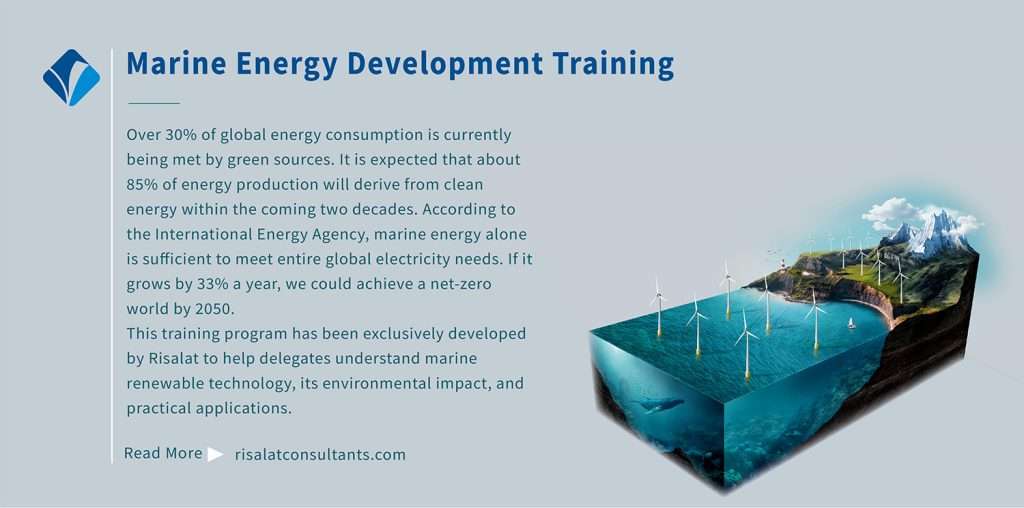
The Marine Energy Development Training equips government officials, renewable energy professionals, project managers, investors, and development practitioners with practical knowledge and tools to plan, assess, finance, and implement marine energy projects, including offshore wind, tidal, wave, and ocean thermal systems.
As countries accelerate energy transitions and climate commitments, marine energy is emerging as a strategic pillar for coastal and island economies. However, many initiatives face challenges related to feasibility assessment, environmental safeguards, regulatory frameworks, project bankability, and operational readiness.
This programme responds to these realities by combining technical foundations with applied project development approaches. Participants learn how to evaluate marine energy resources, structure viable projects, manage environmental and social risks, and align investments with national energy and climate strategies.
The curriculum reflects internationally recognized renewable energy and project development practices, including approaches promoted by organizations such as International Energy Agency and World Bank to support sustainable energy planning and delivery.
Watch how marine energy is transforming energy systems through innovative project development and sustainable investment strategies.
Target Audience –Marine Energy Development
This Marine Energy Development programme supports participants in moving from resource assessment to bankable project preparation.
- Government energy planners and policy makers
- Renewable energy developers and engineers
- Project managers in energy and climate programmes
- Investors and private-sector energy firms
- Researchers and academic practitioners
- Development partner and donor programme staff
- Environmental and regulatory specialists
- Coastal and island energy authorities
Tick what your team needs to be able to do.
Programme Objectives
By the end of this Marine Energy Development Training, participants will be able to:
- Understand core marine energy technologies and applications
- Assess resource potential and project feasibility
- Design marine energy project concepts aligned with national priorities
- Apply environmental and social safeguards in project planning
- Develop bankable project frameworks and investment cases
- Navigate policy, regulatory, and permitting requirements
- Structure financing options and risk mitigation strategies
- Plan implementation pathways from concept to operations
- Integrate marine energy into broader climate and energy systems
- Strengthen collaboration between government, developers, and financiers
Programme Contents – Marine Energy Development
- Overview of offshore wind, tidal, wave, and ocean thermal systems
- Global market trends and technology pathways
- Role of marine energy in energy transition strategies
- Case studies from operational projects
- Site selection and marine resource mapping
- Technical feasibility and early-stage project screening
- Grid integration considerations
- Environmental baseline assessments
- Marine spatial planning and permitting processes
- Environmental and social impact management
- Regulatory frameworks and institutional coordination
- Stakeholder engagement strategies
- Project costing and financial modeling fundamentals
- Public–private partnership structures
- Blended finance and de-risking mechanisms
- Investor requirements and bankability criteria
- Construction planning and supply chain considerations
- Operations and maintenance strategies
- Risk management across the project lifecycle
- Group work on participant project concepts
- Peer review and expert feedback
- Institutional action planning
Full day-by-day contents
First Day – Introduction to Marine Energy & Global Trends
- Overview of offshore wind, tidal, wave, and ocean thermal systems
- Global market trends and technology pathways
- Role of marine energy in energy transition strategies
- Case studies from operational projects
Second Day – Resource Assessment & Feasibility Analysis
- Site selection and marine resource mapping
- Technical feasibility and early-stage project screening
- Grid integration considerations
- Environmental baseline assessments
Third Day – Project Development, Policy & Regulation
- Marine spatial planning and permitting processes
- Environmental and social impact management
- Regulatory frameworks and institutional coordination
- Stakeholder engagement strategies
Fourth Day – Financing, Risk & Investment Readiness
- Project costing and financial modeling fundamentals
- Public–private partnership structures
- Blended finance and de-risking mechanisms
- Investor requirements and bankability criteria
Fifth Day – Implementation, Operations & Applied Lab
- Construction planning and supply chain considerations
- Operations and maintenance strategies
- Risk management across the project lifecycle
- Group work on participant project concepts
- Peer review and expert feedback
- Institutional action planning
Training Methodology of Marine Energy Development
This training uses an applied, practitioner-oriented approach combining:
- Interactive technical sessions
- Real-world marine energy case studies
- Group exercises and project simulations
- Feasibility and financing workshops
- Policy and regulatory clinics
- Peer learning and expert guidance
Host Country Profile
South Korea is a regional leader in marine and renewable energy development, driven by its extensive coastline, growing energy demand, and strong commitment to low-carbon growth. With active investments in offshore wind, tidal energy, and smart grid integration, the country offers a practical learning environment for marine energy planning and project implementation. Hosting the programme in Seoul provides participants access to advanced infrastructure, research ecosystems, and policy-driven clean energy initiatives, supporting applied learning in feasibility assessment, project development, and climate-aligned energy strategies. This Marine Energy Development programme strengthens project readiness across feasibility, regulation, and investment preparation.
For official national perspectives on renewable energy planning and deployment in South Korea, visit the Korea Energy Agency, the government agency responsible for promoting renewable energy and energy efficiency across the country.
Institutional Application
Participants leave with structured tools and action plans that can be directly applied within ministries, utilities, development agencies, and private firms, supporting stronger project preparation, regulatory alignment, and investment readiness for marine energy portfolios.
Expected Outcomes
The Marine Energy Development Training equips participants with the practical knowledge, strategic insight, and project development tools required to advance sustainable marine energy initiatives from early feasibility to implementation and investment readiness.
- Strengthen understanding of marine energy technologies
- Develop practical project development skills
- Improve feasibility assessment and risk management capacity
- Build investor-ready project frameworks
- Enhance coordination across policy, technical, and financial teams
- Support evidence-based energy planning and decision making
£5,160 per participant · invoice and bank transfer · groups of 5 or more receive a discount
Five or more from one organisation: ask for the group rate on the invoice request.
Ten or more: an in-house version for your institution may cost less per person. Ask for an in-house quote.
Registration closes in 43 days (30 Nov 2026)
Course Deliverables
Before the Programme
- Pre-training needs assessment
- Programme briefing materials
- Marine energy self-assessment templates
- Logistics and travel guidance
During the Programme
- Welcome networking session
- Accommodation with breakfast
- Comprehensive course manual and technical references
- Feasibility and project development templates
- Applied group exercises and simulations
- Daily lunch and refreshments
- Certificate of Completion
- Programme participation recognition
After the Programme
- Post-training reference materials
- Updated project development tools
- Guidance on advancing marine energy initiatives
- Practical recommendations for policy, finance, and implementation
- Continued engagement through future energy and climate programmes
Participants may also be interested in our Renewable Energy National Development Workshop to explore broader energy planning and policy frameworks.