Key facts
- Dates
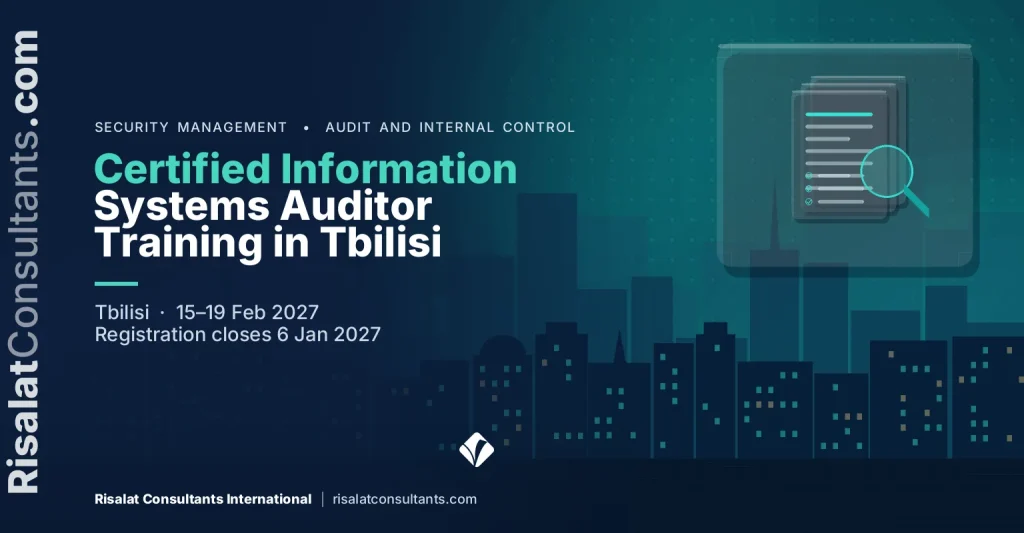
- 15–19 Feb 2027 (5 days)
- Where
- Regus Tbilisi - Vazha Pshavela, Tbilisi, Georgia
- Fee per participant
- £2,930 (GBP)
- Payment
- By invoice and bank transfer
- Registration closes
- 6 Jan 2027
- Certificate
- Certificate of completion
- In-house option
- Run it for your team, on your dates
On this page 16 sections
Programme Overview
This programme gives participants practical knowledge and tools in fraud, audit and internal control, with a focus on what works in public institutions and donor-financed projects.
Delivered by Risalat Consultants International in Tbilisi, Georgia, it combines expert-led sessions, real cases and group work, so that participants can apply what they learn in their own institution.
The Programme Strengthens Institutional Capability
- IS Audit Standards, Guidelines, and Codes of Ethics
- Types of Audits, Assessments, and Reviews
- Risk-Based Audit Planning
- Types of Controls and Considerations
- Audit Project Management
- Audit Testing and Sampling Methodology
- Audit Evidence Collection Techniques
- Audit Data Analytics
- Fraud risk assessment and fraud risk registers
- Design and testing of internal controls
- The Three Lines model and the role of oversight
- Audit planning, evidence and documentation
It is designed for professionals and Executives in Information System Sector, experts in information & Operational Risk management, IT infrastructure security specialists and others who want practical, current skills in fraud, audit and internal control.
The Growing Importance of Certified Information Systems Auditor
Public bodies and donor-financed projects are expected to show that funds are used for their intended purpose. Auditors, oversight bodies and financiers increasingly look beyond the financial statements to the controls, records and behaviours behind them.
Fraud and control weaknesses rarely come from one failure. They grow where roles are unclear, records are incomplete and warning signs are not followed up. Teams that understand how fraud happens, and how controls stop it, protect both their institution and the people it serves.
Organisations increasingly require professionals capable of:
- Identify and rate fraud and control risks in their own processes
- Design controls that are proportionate and testable
- Gather and document reliable audit evidence
- Recognise red flags early and escalate them correctly
- Turn findings into practical, agreed actions
Strong fraud, audit and internal control systems help organisations:
- Reduce losses and ineligible expenditure
- Pass external audits with fewer findings
- Strengthen trust with financiers and citizens
- Respond to allegations in a fair and documented way
This Certified Information Systems Auditor programme brings these elements together in a practical format, so that participants understand not only what good practice looks like but also how to introduce it in their own setting, with the people and resources they have.
Who Should Attend This Certified Information Systems Auditor Training?
This programme is designed for:
- Professionals and Executives in Information System Sector
- Experts in information & Operational Risk management
- IT infrastructure security specialists
- Internal Control & Information Systems Audit Professionals
- Internal auditors and audit managers
- Finance managers and accountants
- Compliance and risk officers
- Procurement officers and managers
- Project and programme managers
- Project implementation unit (PIU) staff
- Audit committee and board members
- Inspectors and oversight body staff
The programme suits experienced professionals as well as those moving into new responsibilities. Groups that mix institutions and countries are encouraged, because participants learn a great deal from each other’s experience.
Tick what your team needs to be able to do.
Certified Information Systems Auditor Training Objectives
Upon successful completion of this Certified Information Systems Auditor Training, participants will be able to:
- The Goals and the Objectives of Information Systems Internal Audit
- Role of IT Audit in internal control system
- Effective techniques for IT Audit Planning
- Ways for gathering Audit Related Information and Evidence
- Methods to evaluate IT internal control system
- Information Risk Management and Audit of Information Security
- Explain how and why fraud happens, using recognised fraud risk models
- Carry out a fraud and control risk assessment for a real process
- Map controls to risks using the Three Lines model
- Plan an audit or review and choose suitable tests
Each objective is practised during the programme through exercises, cases or group work, so that participants leave able to do it, not only to describe it.
Programme Contents and Structure
- IS Audit Standards, Guidelines, and Codes of Ethics
- Audit Testing and Sampling Methodology
- Laws, Regulations, and Industry Standards
- Privacy Programme and Principles
- Quality Assurance and Quality Management of IT
- System Readiness and Implementation Testing
- IT Asset Management
- Types of Audits, Assessments, and Reviews
- Audit Evidence Collection Techniques
- Organizational Structure, IT Governance, and IT Strategy
- Data Governance and Classification
- Project Governance and Management
- Implementation Configuration and Release Management
- Job Scheduling and Production Process Automation
- Risk-Based Audit Planning
- Audit Data Analytics
- IT Policies, Standards, Procedures and Practices
- IT Resource Management
- Business Case and Feasibility Analysis
- System Migration, Infrastructure Deployment, and Data Conversion
- System Interfaces
- Types of Controls and Considerations
- Reporting and Communication Techniques
- Enterprise Architecture and Considerations
- IT Vendor Management
- System Development Methodologies
- Post-implementation Review
- Shadow IT and End-User Computing
- Audit Project Management
- Quality Assurance and Improvement of Audit Process
- Enterprise Risk Management
- IT Performance Monitoring and Reporting
- Control Identification and Design
- IT Components
- Systems Availability and Capacity Management
Full day-by-day contents
The programme runs over 5 days. Each day combines expert input, practical work and a closing workshop or case study:
- First Day: How fraud happens and why it matters
- Second Day: Fraud risk assessment
- Third Day: Controls and the Three Lines model
- Fourth Day: Detection, audit and investigation
- Fifth Day: Reporting, follow-up and action planning
Full day-by-day contents
First Day | How fraud happens and why it matters
- IS Audit Standards, Guidelines, and Codes of Ethics
- Audit Testing and Sampling Methodology
- Laws, Regulations, and Industry Standards
- Privacy Programme and Principles
- Quality Assurance and Quality Management of IT
- System Readiness and Implementation Testing
- IT Asset Management
- Problem and Incident Management
Workshop: How fraud happens and why it matters: Applying It to Your Institution
Working in small groups, participants apply the day's methods to examples from their own institutions and agree practical next steps.
Second Day | Fraud risk assessment
- Types of Audits, Assessments, and Reviews
- Audit Evidence Collection Techniques
- Organizational Structure, IT Governance, and IT Strategy
- Data Governance and Classification
- Project Governance and Management
- Implementation Configuration and Release Management
- Job Scheduling and Production Process Automation
- IT Change, Configuration, and Patch Management
Workshop: Fraud risk assessment: Applying It to Your Institution
Working in small groups, participants apply the day's methods to examples from their own institutions and agree practical next steps.
Third Day | Controls and the Three Lines model
- Risk-Based Audit Planning
- Audit Data Analytics
- IT Policies, Standards, Procedures and Practices
- IT Resource Management
- Business Case and Feasibility Analysis
- System Migration, Infrastructure Deployment, and Data Conversion
- System Interfaces
- Operational Log Management
Case Study: Controls and the Three Lines model in Practice
Participants analyse a realistic case, compare the choices made with good practice and draw lessons they can use in their own setting.
Fourth Day | Detection, audit and investigation
- Types of Controls and Considerations
- Reporting and Communication Techniques
- Enterprise Architecture and Considerations
- IT Vendor Management
- System Development Methodologies
- Post-implementation Review
- Shadow IT and End-User Computing
- IT Service Level Management
Workshop: Detection, audit and investigation: Applying It to Your Institution
Working in small groups, participants apply the day's methods to examples from their own institutions and agree practical next steps.
Fifth Day | Reporting, follow-up and action planning
- Audit Project Management
- Quality Assurance and Improvement of Audit Process
- Enterprise Risk Management
- IT Performance Monitoring and Reporting
- Control Identification and Design
- IT Components
- Systems Availability and Capacity Management
- Database Management
Capstone Exercise: Certified Information Systems Auditor Action Plan for Your Institution
Participants bring the week together in an action plan for their own institution, with priorities, owners and first steps, and present it for feedback from peers and facilitators.
- Transaction
- Record
- Control
- Evidence
- Opinion
Certified Information Systems Auditor Training Methodology
The CISA (Certified Information Systems Auditor) designation is a globally recognized certification for IS audit control, assurance and security professionals. Being CISA-certified showcases your audit experience, skills and knowledge, and demonstrates you are capable to assess vulnerabilities, report on compliance and institute controls within the enterprise. The CISA has gained world-class recognition making it a certification that IT-inclined accountants would definitely consider. Certified Information Systems Auditor Training in Tbilisi, Georgia has been designed in a manner to provide all the necessary theoretical basis and practical skills used in IT Audit. The syllabus has been crafted based on the CISA certification programme, hence it provides all the essential information and knowledge for the participants’ to proceed with the certification. Certified Information Systems Auditor Training in Tbilisi, Georgia will be conducted along workshop principles with formal lectures, case studies and interactive worked examples. Relevant patterns will be provided to illustrate the application of each tool in an operations environment. The sample questions from Previous CISA exams will be explained and demonstrated. The demo-exam will take place after the completion of theoretical studies. Each learning point will be reinforced with practical exercises.
The programme combines:
- Expert-led sessions on current practice
- Regional and international case studies
- Group work and practical exercises
- Simulations and role plays where relevant
- Discussion of participants' own challenges
- Peer learning across institutions and countries
- Practical tools and templates to take back to work
- Daily reflection and action planning
Before the programme, a short pre-assessment helps the facilitators understand each participant’s role and priorities, so that examples and exercises can be adjusted to the group. Each day ends with a short reflection in which participants note what they will apply at work.
Certification and Exam Preparation
Where the programme prepares participants for a professional certificate or examination, the sessions follow the published body of knowledge and exam format of the awarding body. Participants practise with exam-style questions, review weak areas with the facilitators and leave with a personal study plan for the weeks before the exam.
- Overview of the certification, its requirements and exam format
- Structured review of the body of knowledge
- Exam-style practice questions with explanations
- Time management and exam technique
- Personal study plan and recommended reading
£2,930 per participant · invoice and bank transfer · groups of 5 or more receive a discount
Five or more from one organisation: ask for the group rate on the invoice request.
Ten or more: an in-house version for your institution may cost less per person. Ask for an in-house quote.
Registration closes in 59 days (6 Jan 2027)
Expected Outcomes
Upon completion of this Certified Information Systems Auditor Training, participants will be able to:
- Assess fraud and control risks in their own processes
- Design and test proportionate controls
- Recognise red flags and escalate them correctly
- Document reliable evidence
- Report findings that lead to agreed action
- Lead practical improvements in their institution
Participants leave with a personal action plan and practical tools they can use in their institution from the first week back. Institutions that send several participants can use the programme to agree shared methods and templates across teams, which makes improvements easier to sustain.
Institutional Application of Certified Information Systems Auditor Training
This programme supports organisations in strengthening:
- Fraud and corruption risk management
- Internal control frameworks
- Audit and oversight arrangements
- Follow-up of audit findings
- Integrity and reporting channels
Participants return with practical tools to improve:
- Risk registers and control maps
- Audit planning and testing
- Evidence and documentation
- Reporting to management and boards
- Prevention of ineligible expenditure
The programme is built so that learning moves from the classroom into the institution. Participants work on their own processes and documents where possible, and leave with an action plan that their managers can review and support.
Regional Relevance & Application
Europe
European institutions apply fraud, audit and internal control within detailed regulatory frameworks and reform agendas. Participants from Europe can compare their practice with colleagues from other regions and test how established methods work under different conditions.
Africa
Across Africa, ministries, agencies and project teams working in fraud, audit and internal control increasingly operate alongside donor-financed programmes that expect clear systems and evidence. The programme helps participants adapt good practice to the institutions and resources they work with.
Middle East
In the Middle East, national development strategies and diversification plans place growing demands on fraud, audit and internal control. Participants explore how to build the capability these plans need inside public bodies and companies.
Asia
Institutions across Asia combine rapid growth with ambitious modernisation programmes. Participants from Asia can share their experience of scaling systems quickly and learn from approaches used elsewhere.
Pacific
Small island and Pacific states face particular constraints of size, distance and capacity. The programme highlights practical, proportionate approaches to fraud, audit and internal control that suit smaller institutions.
Holding the programme in Tbilisi, Georgia brings participants together away from their daily pressures, so they can compare how fraud, audit and internal control is handled in different settings. The same programme can also be delivered in-house for one institution, in its own country or online, with cases taken from its current work.
Host Country Profile – Georgia
Programmes, Workshops, Exposures, Training Courses in Tbilisi, Georgia by Risalat Consultants International
Studying away from their own country gives participants time to focus, a fresh view of their own institution and the chance to build a network with colleagues from other countries.
The programme takes place at Regus Tbilisi – Vazha Pshavela.
Certified Information Systems Auditor Training Deliverables
Participants receive support before, during and after the programme, so that preparation, learning and follow-up form one continuous experience.
Before the Programme
- Participant Pre-Assessment
- Certified Information Systems Auditor Readiness Assessment
- Certified Information Systems Auditor Resource Pack
- Preparatory Reading Materials
- Complimentary Visa Support & Advisory
During the Programme
- Airport Pickup & Welcome Assistance
- Accommodation with Breakfast
- Welcome Networking Dinner
- Risalat Training Kit (Bag, Bottle, Mug, T-Shirt, Cap, Passport Cover, Pens, Notebook, Magnet & Keychain)
- Comprehensive Certified Information Systems Auditor Training Manual
- Fraud Risk Register Template
- Control Mapping Matrix
- Audit Evidence Checklist
- Findings and Follow-up Tracker
- Practical Workshops & Simulations
- Group Discussions & Peer Learning
- Daily Lunch and Refreshments
- Full Access to Training Venue Facilities
- Mini Pad / Tablet with Digital Learning Materials
- Field Visit (where applicable)
- Entertaining City Tour
After the Programme
- Certificate of Completion
- Risalat Programme Participation Recognition Award
- Post-Training Reference Materials
- Fraud Risk Self-Assessment Guide
- Control Testing Checklist
- Post-Training Support & Follow-Up Guidance
- Programme Report
Institutions can also request a tailored in-house version of this programme, delivered at their premises or online. Request a proposal.
Common Challenges in Certified Information Systems Auditor, And How This Training Helps
How can institutions identify and rate fraud and control risks in their own processes?
The programme addresses this directly on the first day (How fraud happens and why it matters), where participants practise the methods involved and adapt them to their own institution, then build it into their action plan.
How can institutions design controls that are proportionate and testable?
The programme addresses this directly on the second day (Fraud risk assessment), where participants practise the methods involved and adapt them to their own institution, then build it into their action plan.
How can institutions gather and document reliable audit evidence?
The programme addresses this directly on the third day (Controls and the Three Lines model), where participants practise the methods involved and adapt them to their own institution, then build it into their action plan.
How can institutions recognise red flags early and escalate them correctly?
The programme addresses this directly on the fourth day (Detection, audit and investigation), where participants practise the methods involved and adapt them to their own institution, then build it into their action plan.
How can institutions turn findings into practical, agreed actions?
The programme addresses this directly on the fifth day (Reporting, follow-up and action planning), where participants practise the methods involved and adapt them to their own institution, then build it into their action plan.
Frequently Asked Questions
When and where does the Certified Information Systems Auditor programme take place?
It runs from 21 Dec 2026 to 25 Dec 2026, in Tbilisi, Georgia (Regus Tbilisi – Vazha Pshavela). The registration deadline is shown at the top of this page.
Who should attend?
The programme is designed for professionals and Executives in Information System Sector, experts in information & Operational Risk management, IT infrastructure security specialists, internal Control & Information Systems Audit Professionals, and others who want practical skills in fraud, audit and internal control.
Will I receive a certificate?
Yes. Participants who complete the programme receive a Certificate of Completion from Risalat Consultants International.
Can this programme be delivered for our institution only?
Yes. We can deliver a tailored in-house version at your premises, in another city or online, built around your own cases. Use the proposal request on this page.
Do I need prior experience in fraud, audit and internal control?
No specialist background is required beyond experience in a related role. A short pre-assessment helps the facilitators adapt the sessions to the group.
Training courses in TbilisiSecurity Management training courses
Why Tbilisi for this programme
Tbilisi is known for public service halls and anti-corruption reforms, and has easy visas for many countries.
The Certified Information Systems Auditor Training in Tbilisi programme in February 2027 brings together officials and professionals from across the Caucasus region and beyond. Sessions combine short inputs, case studies and group work on participants' own files, and the city's institutions can be added as a study visit on request.
Getting there: Tbilisi International (TBS).
Check whether you need a visa with the free Visa Checker, and ask for an invitation letter once you are registered.
The same topic in other cities
Other programmes in Tbilisi
- Renewable Energy Planning and Mini-Grids Training for Central Asian Officials in Tbilisi
- Anti-Corruption, Integrity and Asset Declarations in Tbilisi
- PPP and Infrastructure Project Finance Training for Central Asian Officials in Tbilisi
- Water Resources Management and WASH Service Delivery in Tbilisi
- Digital Government and Citizen e-Services Training for Central Asian Officials in Tbilisi
More training courses in Georgia · All programmes in Asia · Full training calendar