Key facts
- Dates
- 8–12 Mar 2027 (5 days)
- Where
- Comfort Hotel Vesterbro, Copenhagen, Denmark
- Fee per participant
- £4,250 (GBP)
- Payment
- By invoice and bank transfer
- Registration closes
- 17 Jan 2027
- Certificate
- Certificate of completion
- In-house option
- Run it for your team, on your dates
On this page 16 sections
Programme Overview
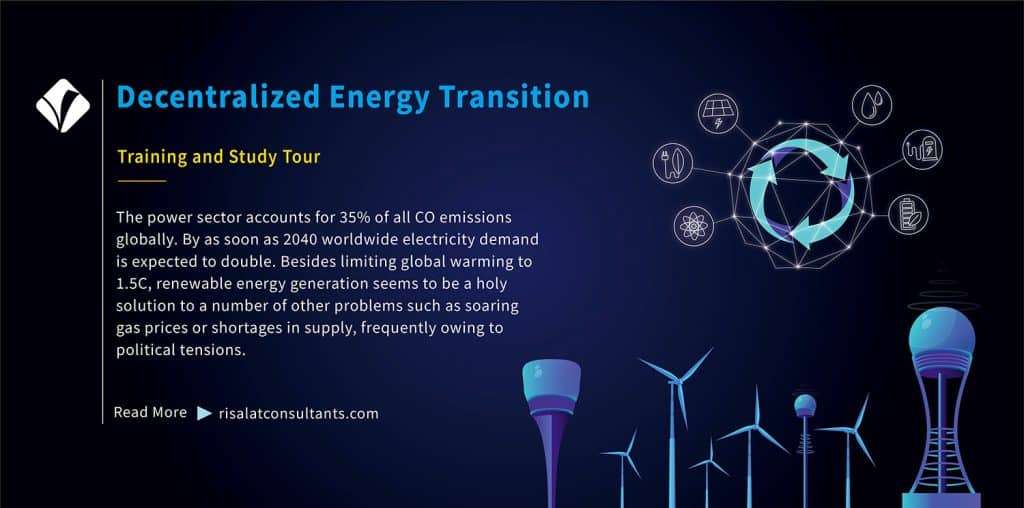
Energy systems are moving away from a small number of large power stations towards many smaller sources located close to where energy is used: rooftop and ground-mounted solar, community wind, local combined heat and power, heat pumps, batteries and mini-grids. Decentralisation improves resilience, can lower costs for remote users and gives communities and municipalities a direct role in the transition.
Denmark shows how far this can go. According to the IEA’s 2023 review, wind supplied 54% of Danish electricity in 2022, the highest share among IEA members, and wind, bioenergy and solar together supplied about 80% of the power mix. District heating covers about 70% of residential space heating, and the Danish Energy Agency reports that two out of three Danish houses are heated this way.
In developing countries, decentralised solutions are central to energy access. Mission 300, led by the World Bank Group and the African Development Bank, aims to connect 300 million people in Africa to electricity by 2030, with distributed renewable energy expected to reach rural and remote communities. ESMAP has estimated that around half a billion people could be served cost-effectively by mini-grids.
This Decentralised Energy Transition Training and Study Tour in Copenhagen brings together the technical, regulatory, financial and community aspects of decentralised energy over five days, ending with a full day of technical visits and a capstone roadmap.
The Programme Strengthens Institutional Capability
- Decentralised energy planning and least-cost electrification
- Mini-grid and standalone solar programme design
- Integration of variable renewables into distribution networks
- Storage, flexibility and demand response
- District heating and heat pump planning
- Regulation of mini-grids, tariffs and grid arrival
- Net metering and self-consumption rules
- Energy communities and cooperative ownership
- Financial modelling for decentralised projects
- Results-based financing and blended finance
- Community engagement and benefit sharing
- Environmental and social management of small energy projects
- Monitoring connections, reliability and productive use
- Coordination between ministries, regulators and utilities
Every topic leads to a practical output that participants can take back to their institution.
The Growing Importance of Decentralised Energy Transition
Financing for decentralised energy has grown sharply. In Nigeria, the World Bank approved a 750 million dollar IDA credit in December 2023 for the DARES programme, which aims to bring new or improved electricity to more than 17.5 million people through mini-grids and standalone solar, and to replace more than 280,000 petrol and diesel generators. Similar programmes across Africa and Asia need staff who can design, regulate and supervise them.
In Europe, the revised Renewable Energy Directive, in force since November 2023, raises the EU’s binding renewable target to at least 42.5% by 2030 and requires faster permitting. Earlier EU rules introduced renewable energy communities and citizen energy communities, giving local groups a legal basis to own and share energy.
Organisations increasingly require professionals capable of:
- Comparing grid, mini-grid and standalone options on cost and service
- Preparing electrification plans with geospatial data
- Specifying hybrid solar and storage systems
- Designing tariffs that balance affordability and cost recovery
- Drafting mini-grid regulations, including rules for grid arrival
- Assessing heat planning and district heating options
- Building financial models for decentralised projects
- Structuring results-based grants and blended finance
- Engaging communities and building local ownership
- Managing environmental and social risks of small projects
- Monitoring service quality and productive use
Strong decentralised energy systems help organisations:
- Reach remote users faster than grid extension alone
- Reduce dependence on diesel and imported fuel
- Improve supply resilience and reliability
- Attract private investment into access programmes
- Support small businesses and productive use
- Give communities a stake in local projects
- Meet national climate and access commitments
- Use public funds more efficiently
The challenge for most institutions is less about technology than about planning, regulation, finance and coordination. These are the areas the programme focuses on.
Source: IEA Denmark 2023 Energy Policy Review (2022 data, via Danish Ministry of Climate, Energy and Utilities); Danish Energy Agency preliminary statistics for 2023 (via State of Green).
1. What share of Denmark's electricity came from wind in 2022, according to the IEA?
The IEA's 2023 review of Denmark reports that wind provided 54% of electricity in 2022, the highest share among IEA members.
2. How many people does Mission 300 aim to connect to electricity in Africa by 2030?
The World Bank states that Mission 300 aims to connect 300 million people by 2030, 250 million through the World Bank Group and 50 million through the AfDB Group.
3. How is ownership of the Middelgrunden wind farm near Copenhagen divided?
The cooperative and the Copenhagen municipal utility each own 10 of the 20 turbines.
Who Should Attend This Decentralised Energy Training?
This programme is designed for:
- Officials from ministries of energy, power and rural development
- Rural electrification agency staff
- Energy regulators and tariff analysts
- Utility planners and distribution engineers
- Project implementation unit staff on energy access projects
- Municipal and regional energy planners
- Urban planners working on heat and transport
- Mini-grid developers and operators
- Energy consultants and advisers
- Development bank and fund staff
- Transport and e-mobility officials
- Climate change and environment officers
- NGO and cooperative leaders working on community energy
- Business leaders investing in distributed energy
Teams combining policy, regulatory and technical staff benefit most, since the workshops are designed for joint decisions.
Tick what your team needs to be able to do.
Decentralised Energy Training Objectives
Upon successful completion of this Decentralised Energy Training, participants will be able to:
- Explain how decentralised and centralised systems differ and interact
- Choose between grid, mini-grid and standalone options for a given area
- Describe the main technologies, including solar, storage, small CHP and heat pumps
- Assess flexibility needs when variable renewables grow
- Compare regulatory models for mini-grids and self-consumption
- Explain how energy communities and cooperatives are structured
- Build a simple financial model for a decentralised project
- Design a results-based financing instrument
- Plan community engagement and benefit sharing
- Set indicators for access, reliability and productive use
- Prepare a roadmap for a decentralised energy initiative
Objectives are reviewed in the daily workshops and the capstone roadmap.
Programme Contents and Structure
- Centralised and decentralised energy systems: generation, networks and demand
- Distributed energy resources: rooftop solar, wind, small CHP, storage and heat
- Mini-grids, standalone solar and grid extension as complementary access options
- Electricity, heat and transport as one coupled system
- Denmark’s path from central power stations to wind, bioenergy and district heating
- Universal access goals: Mission 300 and the role of distributed renewables
- Planning tools: least-cost electrification and geospatial analysis
- Integrating variable renewables into distribution networks
- Flexibility: demand response, storage, interconnection and sector coupling
- Battery storage for mini-grids and distribution grids
- Smart meters, digital monitoring and remote operations
- District heating and large heat pumps as flexibility resources
- Role of transmission system operators: the Energinet model
- Grid codes and connection rules for distributed generation
- Regulatory models for mini-grids: licensing, tariffs and arrival of the main grid
- Net metering, feed-in arrangements and self-consumption rules
- EU renewable energy communities and citizen energy communities
- The revised EU Renewable Energy Directive (2023/2413) and faster permitting
- Danish experience with cooperative ownership: Middelgrunden and Samsø
- Municipal heat planning under Denmark’s Heat Supply Act
- Quality standards and consumer protection for solar products
- Economics of decentralised projects: capital cost, tariffs and willingness to pay
- Financial modelling basics for mini-grids and community schemes
- Results-based financing and performance grants
- Public-private models: Nigeria’s DARES programme as a case
- Blended finance and the role of development banks
- Risk management: demand risk, currency risk and grid arrival
- Community engagement, consent and benefit sharing
- Briefing on Denmark’s energy policy and institutions
- Technical visit to a decentralised renewable energy or district heating site
- Discussion on smart grid operation and grid reliability with practitioners
- Observing heat pump, storage or sector coupling solutions where available
- How Danish municipalities and utilities plan and finance local energy
- Transferable lessons for developing country contexts
- Capstone preparation in country teams
Full day-by-day contents
The programme runs over five days, moving from concepts to delivery and ending with Danish site visits.
- Day 1: systems, access goals and planning
- Day 2: grids, flexibility, storage and heat
- Day 3: policy, regulation and energy communities
- Day 4: finance and delivery programmes
- Day 5: study tour and capstone roadmap
Full day-by-day contents
First Day | Decentralised Energy Systems and Transition Drivers
- Centralised and decentralised energy systems: generation, networks and demand
- Distributed energy resources: rooftop solar, wind, small CHP, storage and heat
- Mini-grids, standalone solar and grid extension as complementary access options
- Electricity, heat and transport as one coupled system
- Denmark’s path from central power stations to wind, bioenergy and district heating
- Universal access goals: Mission 300 and the role of distributed renewables
- Planning tools: least-cost electrification and geospatial analysis
- Typical barriers reported by financiers and governments
Workshop: Mapping the Decentralised Opportunity
Teams take their own country or region and map where grid extension, mini-grids, standalone solar and local heat solutions make most sense. Using public data on access and demand, they identify two priority areas, the institutions involved and the main barriers, and present a one-page opportunity map that is refined through the week.
Second Day | Grids, Flexibility, Storage and Heat Pumps
- Integrating variable renewables into distribution networks
- Flexibility: demand response, storage, interconnection and sector coupling
- Battery storage for mini-grids and distribution grids
- Smart meters, digital monitoring and remote operations
- District heating and large heat pumps as flexibility resources
- Role of transmission system operators: the Energinet model
- Grid codes and connection rules for distributed generation
- Electric vehicles and charging as a new grid load
- Operation and maintenance planning for small systems
Workshop: Sizing a Hybrid Mini-Grid
Using an illustrative village load profile, groups size a solar, battery and backup mini-grid, test the effect of productive use loads such as milling and cold storage, and estimate the share of demand met by solar. They discuss when the system should be covering: later connection to the main grid and what data operators must collect.
Third Day | Policy, Regulation and Energy Communities
- Regulatory models for mini-grids: licensing, tariffs and arrival of the main grid
- Net metering, feed-in arrangements and self-consumption rules
- EU renewable energy communities and citizen energy communities
- The revised EU Renewable Energy Directive (2023/2413) and faster permitting
- Danish experience with cooperative ownership: Middelgrunden and Samsø
- Municipal heat planning under Denmark’s Heat Supply Act
- Quality standards and consumer protection for solar products
- Gender and inclusion in access programmes
Case Study: Community Ownership in Denmark
Participants compare two Danish models: the Middelgrunden offshore wind farm, split between a cooperative of more than 8,000 members and the city utility, and Samsø, where local ownership financed wind turbines and biomass district heating. Groups identify which conditions made each model work and which could be adapted to their own regulatory and financing context.
Fourth Day | Finance, Business Models and Delivery Programmes
- Economics of decentralised projects: capital cost, tariffs and willingness to pay
- Financial modelling basics for mini-grids and community schemes
- Results-based financing and performance grants
- Public-private models: Nigeria’s DARES programme as a case
- Blended finance and the role of development banks
- Risk management: demand risk, currency risk and grid arrival
- Community engagement, consent and benefit sharing
- Environmental and social aspects of distributed energy
- Monitoring results: connections, reliability and productive use
Case Study: Nigeria DARES and Results-Based Finance
Using World Bank public information on the Distributed Access through Renewable Energy Scale-up programme, groups examine how an IDA credit is combined with private capital and partner financing to deploy mini-grids and standalone solar. They outline a results-based grant design for their own country, including eligibility, verification and safeguards for female-headed households and small businesses.
Fifth Day | Danish Study Tour and Capstone Planning
- Briefing on Denmark’s energy policy and institutions
- Technical visit to a decentralised renewable energy or district heating site
- Discussion on smart grid operation and grid reliability with practitioners
- Observing heat pump, storage or sector coupling solutions where available
- How Danish municipalities and utilities plan and finance local energy
- Transferable lessons for developing country contexts
- Capstone preparation in country teams
- Presentation, feedback and action planning
Capstone Exercise: Decentralised Energy Roadmap
Each team prepares a roadmap for one priority area identified on the First Day: the technical option, the regulatory changes required, the business and financing model, community engagement and monitoring indicators, with a timeline for the first 18 months. The panel tests feasibility against what participants observed during the visits.
Decentralised Energy Training Methodology
The programme combines short expert inputs with practical modelling, case analysis and exposure to Danish practice.
The programme combines:
- Short technical presentations
- Opportunity mapping for participants’ own countries
- Mini-grid sizing exercises
- Simple financial modelling in spreadsheets
- Case studies of financed programmes such as DARES
- Analysis of Danish cooperative and municipal models
- Regulatory drafting exercises
- Group discussions and peer exchange
- A full day of technical visits
- Structured visit debriefs
- A capstone roadmap presented to a panel
The facilitator adapts examples to the regions represented, so that participants from Africa, Asia and the Middle East see cases close to their own context.
- Inputs
- Activities
- Outputs
- Outcomes
- Impact
Technical Visits and Site Programme
The Fifth Day is a full-day study tour of Denmark’s decentralised energy system. Visits are confirmed with host organisations before the programme and are chosen from sites such as community or municipal wind installations, district heating plants with heat pumps or thermal storage, and utilities or research facilities working on smart grid operation.
Each visit includes a briefing, guiding questions and a debrief that feeds into the capstone roadmap. Where hosts are available, a practitioner session on grid optimisation and reliability is included.
Expected Outcomes
Upon completion of this Decentralised Energy Training, participants will be able to:
- Advise their institution on the right mix of grid and off-grid options
- Contribute to mini-grid and self-consumption regulations
- Review financial models and tariff proposals
- Design or improve results-based financing schemes
- Plan community engagement for local energy projects
- Apply Danish lessons on heat planning and cooperative ownership
- Track access, reliability and productive use indicators
- Lead a practical decentralised energy roadmap
Participants also join a network of peers working on similar programmes.
£4,250 per participant · invoice and bank transfer · groups of 5 or more receive a discount
Five or more from one organisation: ask for the group rate on the invoice request.
Ten or more: an in-house version for your institution may cost less per person. Ask for an in-house quote.
Registration closes in 70 days (17 Jan 2027)
Institutional Application of Decentralised Energy Training
This programme supports organisations in strengthening:
- National electrification planning
- Mini-grid regulatory frameworks
- Tariff setting and subsidy design
- Distribution grid planning for distributed generation
- Heat planning and district energy
- Programme design for access projects
- Private sector engagement
- Community and cooperative energy models
- Environmental and social management
- Results monitoring and verification
- Coordination between ministries, regulators and utilities
Participants return with practical tools to improve:
- Opportunity mapping
- Mini-grid sizing
- Financial modelling
- Results-based grant design
- Regulatory checklists
- Community engagement planning
- Monitoring indicators
- Roadmap preparation
Institutions can use Risalat’s free institutional capacity assessment to identify priorities before nominating staff, and explore related programme categories for follow-up training.
Regional Relevance & Application
Africa
Mission 300 targets 300 million new connections by 2030, with the World Bank Group aiming for 250 million and the African Development Bank Group for 50 million. Programmes such as DARES in Nigeria and Ethiopia’s access programme, which has supported mini-grids alongside grid connections, depend on strong planning and regulation.
Asia
ESMAP’s mini-grid market outlook found that Africa and Asia would need around 210,000 mini-grids to connect 500 million people, against about 19,000 installed at the time. Island and mountain regions in South and Southeast Asia rely on decentralised options to reach remaining households.
Europe
EU rules on energy communities and the revised Renewable Energy Directive are driving local ownership, self-consumption and faster permitting across member states, with Denmark among the long-standing examples.
Middle East
Rooftop solar, distributed generation and district cooling are growing in the region, raising the same questions about grid codes, tariffs and network planning covered in the programme.
Workshops are adapted to the regions participants come from.
Host Country Profile – Denmark
Denmark offers a working example of a decentralised energy system at national scale. Its electricity transmission and gas networks are owned and operated by Energinet, an independent public enterprise owned by the Ministry of Climate, Energy and Utilities, whose mandate includes integrating renewable power. The Danish Energy Agency provides policy and statistics, and municipalities prepare heat plans under the Heat Supply Act.
Copenhagen is a good base for this topic. Just outside the harbour, the Middelgrunden offshore wind farm, commissioned in 2000, has 20 turbines with a total capacity of 40 MW, half owned by a cooperative with more than 8,000 members and half by the municipal utility. Samsø, recognised as a renewable energy island, reports 100% local ownership of its renewable investments, 21 wind turbines and four biomass district heating plants. The Danish Energy Agency reports that wind and solar supplied 63.1% of electricity in 2023, and the Climate Act sets a 70% emissions reduction target for 2030 compared with 1990.
Denmark is in the Schengen Area. Participants who need a visa apply for a short-stay Schengen visa through the Danish mission or its appointed visa centre and should apply early. Copenhagen Airport has direct flights from major hubs in Europe, the Middle East and Asia, and the city’s metro and trains link the airport, the venue and visit sites.
Decentralised Energy Training Deliverables
Participants receive structured support before, during and after the programme.
Before the Programme
- Participant Pre-Assessment
- Decentralised Energy Readiness Assessment
- Decentralised Energy Resource Pack
- Preparatory Reading Materials
- Complimentary Visa Support & Advisory
During the Programme
- Airport Pickup & Welcome Assistance
- Accommodation with Breakfast
- Welcome Networking Dinner
- Risalat Training Kit (Bag, Bottle, Mug, T-Shirt, Cap, Passport Cover, Pens, Notebook, Magnet & Keychain)
- Comprehensive Decentralised Energy Transition Training Manual
- Electrification Opportunity Mapping Template
- Mini-Grid Sizing Worksheet
- Decentralised Project Financial Model
- Results-Based Financing Design Checklist
- Mini-Grid Regulation Checklist
- Practical Workshops & Simulations
- Group Discussions & Peer Learning
- Daily Lunch and Refreshments
- Full Access to Training Venue Facilities
- Mini Pad / Tablet with Digital Learning Materials
- Field Visit (where applicable)
- Entertaining City Tour
After the Programme
- Certificate of Completion
- Risalat Programme Participation Recognition Award
- Post-Training Reference Materials
- Decentralised Energy Roadmap for Your Institution
- Study Tour Lessons Summary
- Post-Training Support & Follow-Up Guidance
- Programme Report
Ministries, regulators, utilities and PIUs can host a tailored in-house version built around their own programmes. To discuss options, please request a tailored proposal.
Common Challenges in Decentralised Energy Transition, And How This Training Helps
How do we decide where mini-grids are better than grid extension?
The First Day covers least-cost planning and opportunity mapping, giving teams a method to compare options area by area.
How can mini-grids stay viable when the main grid arrives?
The Third Day reviews regulatory approaches to grid arrival, including compensation and conversion to grid-connected operation.
How do we set tariffs that users can afford and operators can live with?
The Fourth Day financial modelling session links tariffs, subsidies and willingness to pay in a simple model.
How can we attract private capital into access programmes?
The DARES case study on the Fourth Day shows how public credit, results-based grants and partner financing are combined.
How do we integrate more variable renewables without losing reliability?
The Second Day covers storage, flexibility, heat pumps and sector coupling, drawing on Danish grid operation.
How can communities become owners rather than just customers?
The Third Day case study on Middelgrunden and Samsø examines cooperative and local ownership models and what it takes to adapt them.
How do we turn a study tour into lasting change?
The Fifth Day capstone links visit observations to a roadmap with clear actions, owners and indicators for the next 18 months.
Frequently Asked Questions
What does decentralised energy cover in this programme?
Mini-grids, standalone solar, rooftop solar, community wind, small CHP, district heating, heat pumps and storage, together with the regulation, finance and community engagement needed to deliver them.
Is the programme relevant to energy access in developing countries?
Yes. Case material includes Mission 300 and Nigeria's DARES programme, and workshops focus on planning, regulating and financing mini-grids and standalone solar.
What happens on the study tour day?
The Fifth Day is a full day of technical visits to decentralised energy and district heating sites in Denmark, confirmed with host organisations, followed by the capstone roadmap.
Do participants need an engineering background?
No. Technical topics are explained for policy, regulatory and finance staff, while engineers benefit from the sizing and grid integration exercises.
Can the programme be delivered in-house?
Yes. Risalat can tailor it for a ministry, regulator, utility or PIU, using its own programmes as case material.
Training courses in CopenhagenEnergy and Water training courses
Why Copenhagen for this programme
Copenhagen, Denmark, was chosen for this programme because it is easy to reach for the participants we expect and has suitable venues for practical, interactive training.
The Decentralised Energy Transition Training and Study Tour in Copenhagen programme in March 2027 brings together officials and professionals. Sessions combine short inputs, case studies and group work on participants' own files, and the city's institutions can be added as a study visit on request.
Check whether you need a visa with the free Visa Checker, and ask for an invitation letter once you are registered.
The same topic in other cities
- Participatory Irrigation Modernization and Canal Infrastructure in Bali (Bali)
- Agricultural Extension Modernisation & Climate-Smart Practices in Chiang Mai (Chiang Mai)
Other programmes in Copenhagen
- CFO Strategy & Leadership Programme & Exposure
- Environmental & Social Safeguards (World Bank ESF, IFC Performance Standards & ADB SPS) Training
- World Bank Environmental and Social Framework (ESF) Training
- Environmental and Social Safeguards Training and Tour in Copenhagen
Related: Climate finance and energy programmes · free Climate Finance Proposal Readiness · all programmes
More training courses in Denmark · All programmes in Europe · Full training calendar