Programme Overview
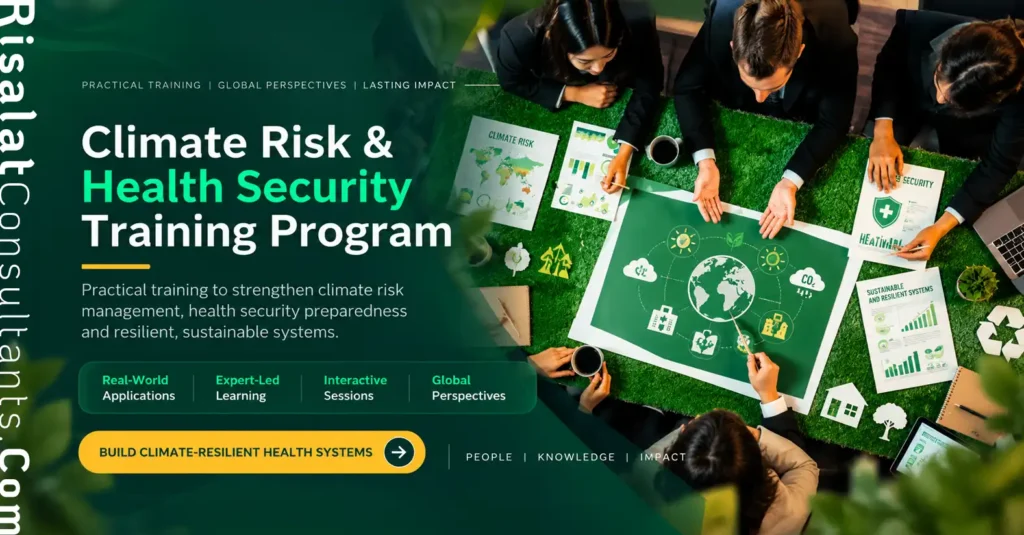
Climate Risk & Health Security Capacity Building Training focuses on strengthening the ability of governments, health institutions, and development partners to anticipate, assess, and respond to the growing intersection between climate change and public health risks.
Climate change is increasingly recognized as a major threat to health systems, impacting disease patterns, infrastructure resilience, and emergency response capacity. Global frameworks such as the World Health Organization’s operational approach to climate-resilient health systems emphasize the need for institutions to anticipate, prevent, and manage climate-related health risks through integrated systems and capacity development.
However, many institutions face challenges in integrating climate risk into health planning, conducting vulnerability assessments, strengthening early warning systems, and aligning public health strategies with climate adaptation and disaster risk frameworks.
This programme addresses these challenges by combining climate science, public health risk assessment, emergency preparedness, and governance frameworks into a practical, implementation-oriented learning experience, integrating structured approaches such as emergency management and disaster preparedness.
Participants will gain hands-on tools to design climate-resilient health systems, strengthen health security, and integrate climate risk into policy, planning, and institutional decision-making.
Target Audience
This programme is designed for professionals involved in health systems, climate policy, and risk management, including:
- Government and public health officials
- Ministries of Health and Environment representatives
- Disaster risk management authorities
- Development partners and donor-funded project staff
- Health system planners and administrators
- Climate and environmental specialists
- NGOs and humanitarian organizations
- Policy makers and advisors
Tick what your team needs to be able to do.
Programme Objectives
Upon completion, participants will be able to:
- Assess climate-related health risks and vulnerabilities
- Integrate climate risk into public health planning and systems
- Strengthen health security and emergency preparedness
- Design climate-resilient health strategies and programmes
- Apply early warning systems and climate-informed decision-making
- Align health systems with national adaptation and resilience strategies
- Improve coordination across health, environment, and disaster sectors
- Develop actionable climate-health risk management plans
Climate Risk and Health Security Training Structure and Content
First Day | Climate Change & Health Risk Foundations
- Climate science and public health linkages
- Climate-sensitive diseases and environmental risks
- Global frameworks on climate and health
- Health vulnerability and exposure mapping
Exercise: Climate-health risk mapping
Second Day | Health Risk Assessment & Early Warning Systems
- Climate and health vulnerability assessments (V&A)
- Epidemiological trends and climate impacts
- Early warning systems for health risks
- Data, surveillance, and predictive analytics
Digital health surveillance systems must also address cybersecurity risks to ensure data integrity and system reliability.
Case Study: Climate-driven disease outbreak
Third Day | Health Security & Emergency Preparedness
- Health security frameworks and resilience systems
- Disaster risk management in health systems
- Emergency preparedness and response planning
- Continuity of health services during climate shocks
Effective health security systems require structured crisis response aligned with strategic crisis management and risk reduction approaches.
Modern health risk management increasingly integrates GIS and remote sensing tools for hazard mapping and early warning systems.
Simulation: Emergency response scenario
Fourth Day | Climate Adaptation & Policy Integration
- National Adaptation Plans (NAPs) and health integration
- Climate-resilient health infrastructure and systems
- Policy design, governance, and institutional frameworks
- Financing climate-health interventions
These approaches are closely aligned with broader strategic healthcare planning frameworks used to strengthen national health systems.
Workshop: Climate-health policy framework design
Fifth Day | Implementation & Institutional Strengthening
- Integrating climate risk into health systems
- Cross-sector coordination (health–environment–DRR)
- Monitoring and evaluation of climate-health programmes
- Institutional capacity building and system strengthening
Training Methodology – Applied Health Security Approach
This programme uses an applied, policy-oriented learning methodology combining expert-led sessions, real-world case studies, simulations, and scenario-based exercises. Participants engage in practical climate-health risk assessments, emergency response simulations, and policy design workshops to ensure direct application within national health systems, donor-funded programmes, and institutional frameworks.
Key learning methods include:
- Climate-health case studies and global practices
- Scenario-based simulations and emergency exercises
- Interactive workshops and group discussions
- Practical tools, templates, and risk assessment frameworks
- Peer learning and cross-sector experience sharing
£3,880 per participant · invoice and bank transfer · groups of 5 or more receive a discount
Five or more from one organisation: ask for the group rate on the invoice request.
Ten or more: an in-house version for your institution may cost less per person. Ask for an in-house quote.
Registration closes in 74 days (31 Dec 2026)
Expected Outcomes of Climate Risk and Health Security Training
Participants will strengthen their ability to build climate-resilient and secure health systems.
They will be able to:
- Improve preparedness for climate-related health risks
- Strengthen emergency response and health security systems
- Integrate climate risk into public health strategies
- Enhance early warning and monitoring systems
- Develop institutional frameworks for climate-health resilience
- Support national and regional climate adaptation efforts
Institutional Application
This programme supports organizations in strengthening health system resilience, improving emergency preparedness, and integrating climate risk into policy and planning frameworks.
Participants will return with practical tools to enhance institutional capacity, strengthen cross-sector coordination, and support sustainable and resilient health systems.
These capabilities complement wider emergency management and disaster preparedness systems required for resilient institutions.
Climate Risk and Health Security Training in the Philippines
The Philippines provides a highly relevant environment for climate risk and health security training, given its exposure to extreme weather events, public health challenges, and ongoing investments in disaster risk management and climate resilience.
As one of the most climate-vulnerable countries globally, the Philippines has prioritized strengthening health system resilience, emergency preparedness, and climate adaptation strategies across national and local levels.
The Philippines actively collaborates with regional and global development partners to strengthen climate resilience and health security systems. Initiatives supported by the Asian Development Bank focus on climate adaptation, disaster risk management, and resilient infrastructure, while global frameworks guided by the World Health Organization support the integration of climate risk into public health systems and policies.
Hosting this programme in Manila provides participants with practical exposure to real-world climate-health challenges, disaster preparedness systems, and integrated resilience strategies in a dynamic and high-risk environment.
Course Deliverables
Participants will enjoy a full-service experience that covers everything needed before, during, and after the programme:
Before the Programme
- Participant Pre-Assessment
- Complimentary Visa Support & Advisory
- Airport Pickup & Welcome Assistance
- Accommodation with Breakfast
- Welcome Networking Dinner
During the Programme
- Risalat Training Kit (bag, bottle, mug, t-shirt, cap, etc.)
- Lunch provided daily
- Comprehensive course manual and training materials
- Practical tools, templates, and frameworks
- Mini Pad / Tablet for digital resources
- Case studies, datasets, and reference materials
- Field visit (where applicable)
- Full training venue facilities and refreshments
- Access to online learning resources
- City tour
After the Programme
- Certificate of Completion
- Risalat Recognition Award
- Post-training support and follow-up guidance
- Programme report
Organizations seeking to strengthen climate risk management, health security systems, and institutional resilience are encouraged to engage with Risalat Consultants International for tailored programme delivery and advisory support.