Key facts
- Dates
- 1–5 Feb 2027 (5 days)
- Where
- TBD, Kaula Lumpur, Malaysia
- Fee per participant
- £3,850 (GBP)
- Payment
- By invoice and bank transfer
- Registration closes
- 23 Dec 2026
- Certificate
- Certificate of completion
- In-house option
- Run it for your team, on your dates
Programme Overview
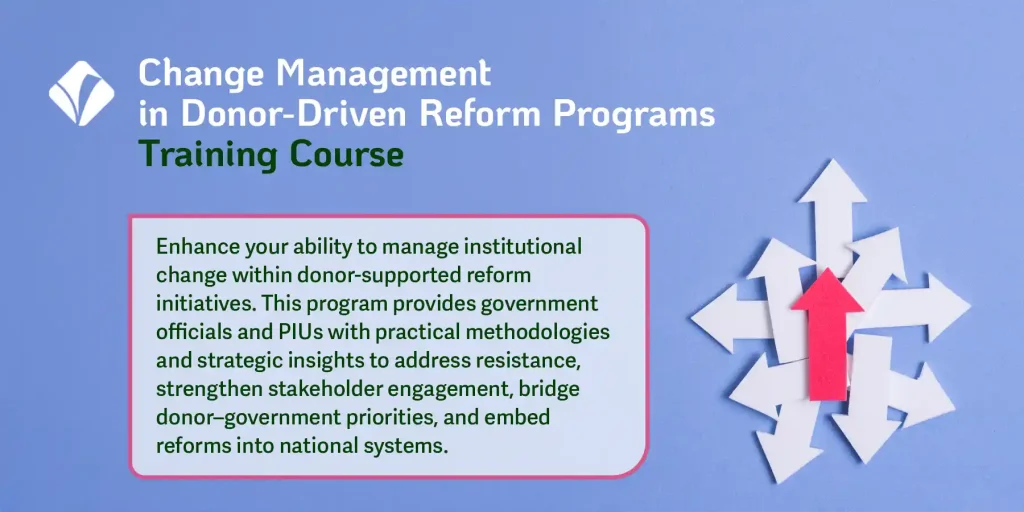
Change Management for Donor-Funded Reform Programmes is essential for ensuring that government institutions successfully adopt, implement, and sustain the reforms supported by international development partners. Across sectors such as public financial management, governance, procurement modernization, digital transformation, and service delivery improvement, donor-funded reforms demand deep shifts in processes, culture, accountability systems, and organizational behavior. However, even the strongest technical designs or well-structured reform strategies can fail if the people and institutions responsible for implementation are not fully prepared and supported through the change.
This comprehensive programme empowers government officials, PIU teams, and development partners with the frameworks, tools, and leadership approaches required to guide complex institutional change. Grounded in global best practices such as the World Bank’s Governance & Public Sector Reform Guidelines, participants will learn how to diagnose change readiness, manage resistance, coordinate stakeholders with differing priorities, and bridge gaps between donor expectations and national realities. Through practical exercises, real reform case studies, and hands-on planning sessions, the programme helps teams build the confidence, capacity, and strategic thinking needed to steer reforms effectively, maintain momentum, and ensure long-term sustainability beyond the life of the donor project.
Target Audience
This Change Management for Donor-Funded Reforms Training Course is designed for:
- Project Implementation Unit (PIU) managers and team leaders
- Senior government officials implementing donor-funded reforms
- HR, training, and institutional development managers
- Public sector reform advisors and consultants
- Monitoring, evaluation, and learning (MEL) specialists
- Donor project coordinators and capacity-building focal points
Tick what your team needs to be able to do.
Course Objectives
By the end of this programme on Change Management for Donor-Funded Reform Programmes, participants will be able to:
- Understand the dynamics and complexity of change in donor-funded reform environments.
- Apply structured change management models (Kotter, ADKAR, Lewin, Prosci) to real reform cases.
- Develop a Change Management Plan aligned with donor project frameworks (WB, ADB, UNDP, EU).
- Build effective communication and stakeholder engagement strategies.
- Manage institutional resistance and sustain reform momentum beyond project timelines.
- Integrate change processes with capacity building, M&E, and performance frameworks.
- Use behavioral insights and adaptive management to adjust reform approaches dynamically.
Programme Contents
- Nature and scope of public sector reforms
- Why change fails: institutional inertia, political economy, and misaligned incentives
- Donor vs. government drivers of change
- Key change management frameworks (Kotter, ADKAR, Lewin, Bridges Transition Model)
- Mapping the reform ecosystem: donors, ministries, oversight bodies, civil society
- Building a theory of change for institutional reform
- Aligning change management with project logical framework and results chain
- Identifying champions, resistors, and influencers
- Crafting the change narrative and defining key milestones
- Integration with donor monitoring and reporting mechanisms
- Stakeholder analysis and mapping tools
- Internal and external communication planning
- Managing expectations between donors and implementing agencies
- Effective feedback loops and participatory reform mechanisms
- Cultural, social, and organizational barriers to reform
- Leading through uncertainty: adaptive leadership in reforms
- Motivating teams and building reform coalitions
- Conflict management and negotiation skills for reform leaders
- Incentive frameworks to sustain behavior change
- Integrating HR and performance management with reform goals
- Embedding new practices into government systems and policies
- Monitoring and evaluating change effectiveness
- Creating institutional learning systems
- Knowledge management and transition planning at project closure
- Case studies:
- WB PFM Reforms in Ghana
- ADB Procurement Modernization in Laos
Full day-by-day contents
Day 1 – Understanding Change in Donor-Driven Contexts
- Nature and scope of public sector reforms
- Why change fails: institutional inertia, political economy, and misaligned incentives
- Donor vs. government drivers of change
- Key change management frameworks (Kotter, ADKAR, Lewin, Bridges Transition Model)
- Mapping the reform ecosystem: donors, ministries, oversight bodies, civil society
Day 2 – Designing a Change Management Strategy
- Building a theory of change for institutional reform
- Aligning change management with project logical framework and results chain
- Identifying champions, resistors, and influencers
- Crafting the change narrative and defining key milestones
- Integration with donor monitoring and reporting mechanisms
Day 3 – Stakeholder Engagement and Communication
- Stakeholder analysis and mapping tools
- Internal and external communication planning
- Managing expectations between donors and implementing agencies
- Effective feedback loops and participatory reform mechanisms
- Cultural, social, and organizational barriers to reform
Day 4 – Leadership, Motivation & Managing Resistance
- Leading through uncertainty: adaptive leadership in reforms
- Motivating teams and building reform coalitions
- Conflict management and negotiation skills for reform leaders
- Incentive frameworks to sustain behavior change
- Integrating HR and performance management with reform goals
Day 5 – Institutionalizing Change and Sustaining Results
- Embedding new practices into government systems and policies
- Monitoring and evaluating change effectiveness
- Creating institutional learning systems
- Knowledge management and transition planning at project closure
- Case studies:
- WB PFM Reforms in Ghana
- ADB Procurement Modernization in Laos
- UNDP Digital Governance Reforms in Rwanda
Programme Methodology
- Interactive lectures & guided discussions
- Case studies of World Bank, ADB, UNDP, DFID reforms
- Group exercises using actual reform scenarios
- Simulation & role-play on resistance management
- Hands-on workshops to develop change roadmaps
- Action plan development for participant’s home institutions
Expected Outcome
Key Outcomes of the Change Management for Donor-Funded Reforms Training in Kuala Lumpur
- Participants develop a practical, donor-aligned Change Management Plan
- Improved leadership and communication during reform rollouts
- Reduced resistance and smoother adoption of donor-introduced reforms
- Strengthened institutional readiness for sustainability and transition
- Enhanced alignment between donor priorities and government ownership
Host Country Profile
Malaysia stands out as an exceptional host for this programme due to its impressive track record in public sector modernization, digital governance, and institutional reform. With nationally recognized initiatives in e-government, procurement transparency, and civil service transformation, Malaysia offers a living laboratory where participants can observe reform success in practice. Its strong partnerships with the World Bank, UNDP, Islamic Development Bank, and regional development institutions make it a regional hub for capacity building and policy innovation. Combined with Kuala Lumpur’s world-class infrastructure, accessibility, and professional environment, Malaysia provides the ideal setting for government teams to explore effective change management strategies and strengthen their ability to drive donor-funded reforms sustainably.
Course Deliverables
Participants will enjoy a full-service experience that covers everything needed before, during, and after the programme:
Before the Programme
- Participant Pre-Assessment to ensure effective preparation
- Complimentary Visa Support & Advisory (E-visa applications are fully processed by our team)
During the Programme
- Airport Pickup & Welcome Assistance
- Accommodation with Breakfast for the full duration
- Welcome Dinner for networking and connecting with fellow Participants & the Risalat Team
- Risalat Training Kit, including: bag, water bottle, coffee mug, t-shirt, cap, passport cover, pens, notebook, magnet, keychain
- Lunch Provided Daily during training days
- Comprehensive Course Manual & Training Materials
- Project-Based Templates, Tools, and Worksheets
- Mini Pad / Tablet for convenient access to digital resources
- Digital Case Studies, Reading Packs & Reference Materials
- Access to Sample Datasets & Practical Exercises
- Field Visit (where applicable)
- Complimentary Refreshments & Full Training Venue Facilities
- Access to Online Learning Resources
- Entertaining City Tour
- Certificate of Completion
- Risalat Programme Participation Recognition Award
After the Programme
- Post-Training Support & Follow-Up Guidance
- Programme Report
£3,850 per participant · invoice and bank transfer · groups of 5 or more receive a discount
Five or more from one organisation: ask for the group rate on the invoice request.
Ten or more: an in-house version for your institution may cost less per person. Ask for an in-house quote.
Registration closes in 59 days (23 Dec 2026)