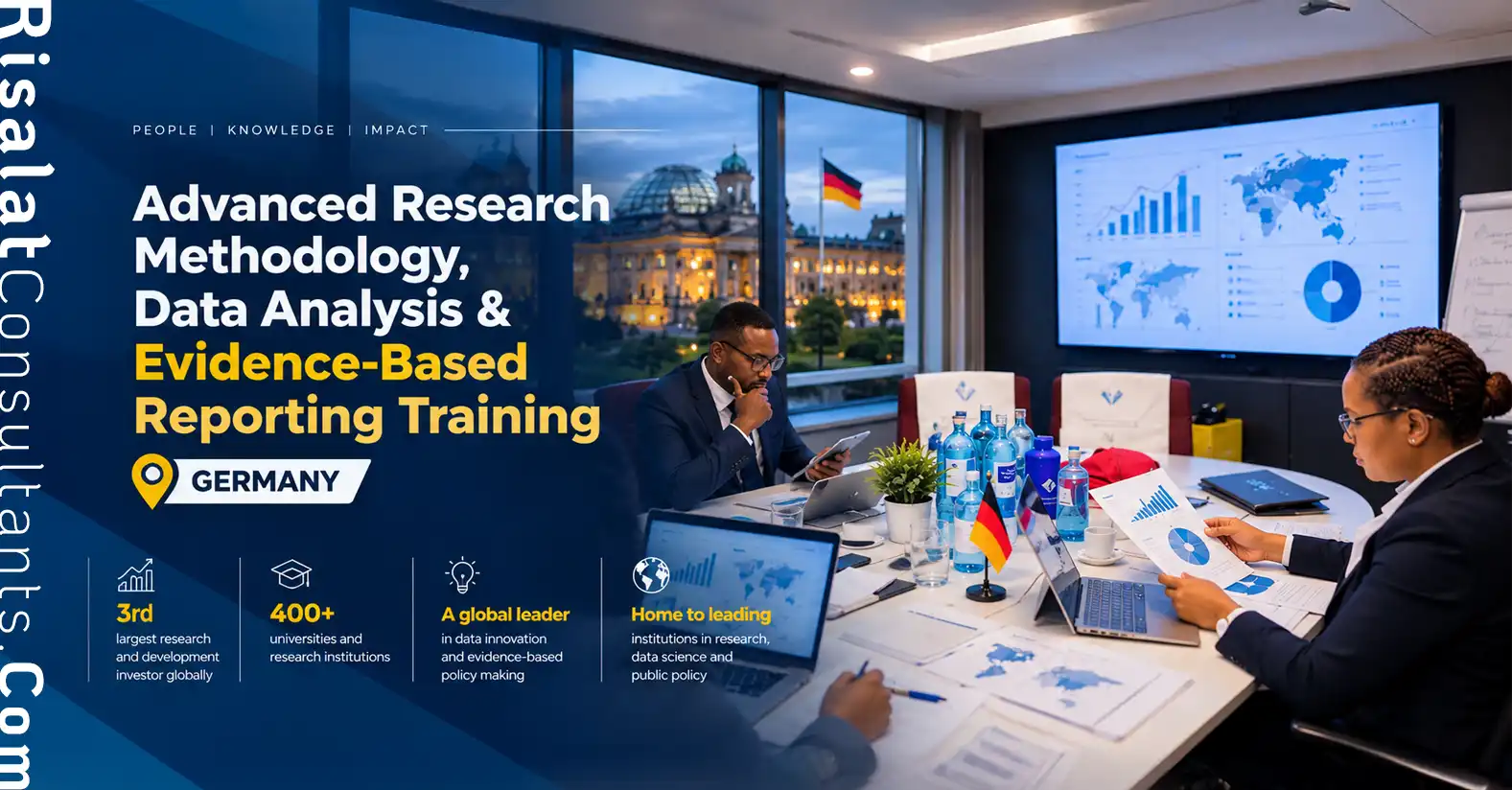
Advanced Research Methodology, Data Analysis & Evidence-Based Reporting Training

Program Date

14 Sep 18 Sep 2026

Program Location

Frankfurt, Germany

Program Venue

TBD

Registration & Payment Deadline

30 Jun 2026

Research Methods Data Analysis Training Overview

This Research Methods Data Analysis Training focuses on strengthening the ability of professionals to design research, analyze data, and translate findings into actionable insights for decision-making. In today’s data-driven environment, organizations require more than technical research skills, they need the capability to connect data with strategy, policy, and performance outcomes.

This program equips participants with practical tools and internationally aligned methodologies to design robust research frameworks, collect and analyze data, and develop reports that directly support organizational decision-making. The training emphasizes real-world application, ensuring participants move beyond theory into practical implementation within institutional, government, and development contexts.

This Research Methods Data Analysis Training complements our broader work in survey research services Risalat and supports organizations in strengthening data-driven planning, evaluation, and reporting systems.

Participants will explore both qualitative and quantitative research methods, analytical techniques, and reporting approaches that enhance organizational effectiveness. The program also focuses on transforming research outputs into clear, decision-oriented insights that inform policy, strategy, and performance management systems.

Through applied case studies, simulations, and real-world exercises, participants will develop the ability to conduct research that not only generates knowledge but also drives measurable impact.


Target Audience

This program is designed for professionals involved in research, analysis, and decision-making, including:

  • Monitoring & Evaluation (M&E) professionals
  • Policy analysts and researchers
  • Government and public sector officials
  • Data analysts and statisticians
  • Development and donor-funded project staff
  • Consultants and advisors
  • Program and project managers
  • Professionals involved in reporting, planning, and evaluation

This program is particularly relevant for professionals involved in funded research and donor programs, complementing expertise in grant management and compliance training.


Objectives of Research Methods Data Analysis Training

Upon completion, participants will be able to:

  • Design effective research frameworks aligned with organizational goals
  • Apply qualitative and quantitative research methodologies
  • Collect, manage, and analyze data using appropriate approaches
  • Interpret data to generate actionable insights
  • Strengthen evidence-based decision-making processes
  • Develop policy-relevant and decision-oriented reports
  • Improve data visualization and communication of findings
  • Integrate research into monitoring, evaluation, and performance systems
  • Enhance organizational learning and knowledge management
  • Develop practical research and reporting plans

Research methods training advertisement outlining course objectives, data analysis techniques, report writing, and practical applications.


Research Methods Data Analysis Training Structure

First Day | Research Design & Methodological Foundations

  • Introduction to applied research and decision-making
  • Types of research: qualitative, quantitative, mixed methods
  • Defining research questions and objectives
  • Research design and framework development
  • Ethical considerations in research

Applied Exercise: Designing research frameworks

Second Day | Data Collection & Research Tools

  • Data collection methods and techniques
  • Surveys, interviews, focus groups, and field data collection
  • Sampling strategies and data quality assurance
  • Digital tools for data collection
  • Data management and organization

Workshop: Developing data collection tools

Third Day | Data Analysis & Analytical Thinking

  • From data to insights: analytical thinking frameworks
  • Data cleaning and preparation
  • Descriptive and basic inferential analysis
  • Qualitative analysis and thematic interpretation
  • Introduction to modern analytical tools and platforms (including Excel, SPSS, Power BI, Tableau, and AI-assisted analytics tools)
  • Common pitfalls in data analysis and interpretation

This approach builds on practical experience delivered in our research methodology training in Hanoi portfolio, where participants applied real-world data analysis and reporting techniques.

Case Study: Data analysis and interpretation

Fourth Day | Reporting for Impact & Decision-Making

  • Transforming analysis into actionable insights
  • Writing for decision-makers, policymakers, and donors
  • Structuring analytical reports and policy briefs
  • Data visualization and storytelling techniques
  • Communicating findings effectively to stakeholders
  • Linking research findings to strategy and policy

Simulation: Decision-making using research findings

Fifth Day | Integration & Institutional Application

  • Integrating research into organizational systems
  • Linking research with monitoring and evaluation frameworks
  • Developing institutional research and reporting strategies
  • Strengthening evidence-based planning and performance management
  • Developing practical research and reporting action plans
Capstone Exercise: Applied research and reporting project

Training Methodology for Research Methods Data Analysis

This program uses an applied learning approach combining expert-led sessions, real-world case studies, scenario-based exercises, and interactive workshops. Participants engage in practical research design, data analysis, and reporting exercises to ensure direct application within their professional environments.

Participants leave with practical tools, templates, and frameworks that can be immediately applied to improve research quality, reporting effectiveness, and decision-making processes.


Outcomes of Research Methods Data Analysis Training

Participants will gain practical skills in research methodology, enabling them to design, analyze, and apply research for evidence-based decision-making.

They will be able to:
  • Design and implement applied research studies
  • Analyze and interpret data effectively
  • Develop decision-oriented reports and policy briefs
  • Strengthen data-driven decision-making processes
  • Improve communication and visualization of findings
  • Support monitoring, evaluation, and performance systems
  • Enhance institutional effectiveness through data insights
Participants return equipped to improve analytical capacity, reporting quality, and organizational performance.
Similar applied learning approaches are implemented in our research methodology training in Malaysia, ensuring consistency across international training environments.

Institutional Application

This program supports organizations in strengthening evidence-based planning, improving policy development, and enhancing institutional performance.

Participants will return with practical tools to integrate research and data analysis into decision-making processes, ensuring that research outputs directly contribute to strategic and operational outcomes.


Host Country Profile

Germany is one of the world’s leading hubs for research, innovation, and data-driven industries, making it an ideal location for a Research Methodology Training. The country is known for its strong integration between research, industry, and policy, supported by globally recognized institutions such as the Max Planck Society, Fraunhofer Society, and Helmholtz Association.

Germany’s advanced approach to applied research, data analytics, and evidence-based decision-making provides participants with exposure to real-world practices used in government, academia, and the private sector. The country’s emphasis on precision, analytical rigor, and innovation creates a highly relevant environment for professionals seeking to strengthen research and data capabilities.

Hosting this program in Germany allows participants to gain insights into how research is effectively translated into policy, strategy, and industrial applications, reinforcing practical learning and global best practices.


Course Deliverables

Participants will enjoy a full-service experience that covers everything needed before, during, and after the program:

Before the Program
  • Participant Pre-Assessment to ensure effective preparation
  • Complimentary Visa Support & Advisory (E-visa applications are fully processed by our team)
  • Airport Pickup & Welcome Assistance
  • Accommodation with Breakfast for the full duration
  • Welcome Dinner for networking and connecting with fellow Participants & the Risalat Team

During the Program

  • Risalat Training Kit, including: bag, water bottle, coffee mug, t-shirt, cap, passport cover, pens, notebook, magnet, keychain
  • Lunch Provided Daily during training days
  • Comprehensive Course Manual & Training Materials
  • Project-Based Templates, Tools, and Worksheets
  • Mini Pad / Tablet for convenient access to digital resources
  • Digital Case Studies, Reading Packs & Reference Materials
  • Access to Sample Datasets & Practical Exercises
  • Field Visit (where applicable)
  • Complimentary Refreshments & Full Training Venue Facilities
  • Access to Online Learning Resources
  • Entertaining City Tour

After the Program

  • Certificate of Completion
  • Risalat Program Participation Recognition Award
  • Post-Training Support & Follow-Up Guidance
  • Program Report

Program Fee
GBP 4930

Fee Covers

  • Visa Assistance (complimentary)

  • Participant Assessment

  • Airport Pickup

  • Accommodation

  • Wi-Fi

  • Welcome Dinner

  • Breakfast

  • Workshop Kit

  • Program Materials

  • Program Experts

  • Practical Activities

  • Lunch

  • Refreshments

  • Interactive workshop

  • City Map & Direction

  • Risalat T-shirt (complimentary)

  • Field Visit

  • Program Certificate

  • Entertaining Tour

  • Program Report