Rural Feeder Road Engineering and Low-Volume Sealed Pavement Design in Cape Town
Rural feeder road engineering is central to expanding agricultural logistics, market access, and basic social services across sub-Saharan Africa.
Your choices are remembered on this device. Designed to WCAG 2.2 AA · keyboard: Tab to move, Esc to close. Read our accessibility statement.
Press / to search from any page · Esc to close
Stay ahead of the competition, learn from the most successful actors in the industry. From Construction Quality Control and Effective supervision skills to Construction Procedures, Implementation, and Strategic Management.
Construction & Engineering training courses from Risalat Consultants International: 100 open dates in Brisbane, Dubai, Singapore and Casablanca, for governments, international organisations, project teams and companies. Choose a date below, or ask us to run any course in-house.
Rural feeder road engineering is central to expanding agricultural logistics, market access, and basic social services across sub-Saharan Africa.
Rural feeder road networks form the backbone of agricultural supply chains and socio-economic integration across East Africa.
Airfield infrastructure in small island developing states faces severe operational and environmental pressures, requiring stringent adherence to international civil aviation norms.
Municipal district heating infrastructure in cold-climate regions requires urgent technical modernisation to ensure operational resilience and reduce energy losses.
Delta cities confront severe flood vulnerabilities driven by high astronomical tides, land subsidence, and intensified upstream fluvial discharge.
Public works contracts require rigorous oversight to safeguard workforce welfare, protect local communities and prevent costly operational delays.
Coastal transport infrastructure in small island developing states faces acute vulnerability to sea-level rise, intense storm surges, and cyclonic weather patterns.
Practical construction supervision training in Male with applied cases, structured exercises and an institutional action plan.
This intensive five-day programme delivers operational engineering and regulatory skills required to implement cyclone-resilient housing recovery in island environments.
This intensive four-day professional course in Dakar addresses the engineering, design, and operational supervision of medium-voltage (MV) and low-voltage (LV) distribution networks and associated…
Pumped storage hydropower serves as a vital component in modern power networks, providing large-scale energy balancing and system resilience.
A five-day programme in Dubai on administering donor-financed works contracts: variations, securities, interim payments, late-payment interest, NeST e-contract records and closing audit findings.
Achieving and sustaining quality in construction industry in the long run is a complex issue.
A five-day Tokyo programme on construction quality control: ISO 9001:2026 quality systems, concrete and steel testing, corrosion, welding, statistical QC and site audits, with…
Semi-arid regions face acute hydrological variability, where protracted dry spells alternate with brief, intense run-off events.
Post-disaster infrastructure recovery in fragile environments requires technical precision, rapid execution, and robust community engagement.
Renovation and refurbishment of existing buildings have become growingly popular.
Ageing high-head hydropower assets require systematic electro-mechanical refurbishment to restore operational reliability, extend asset service life, and maximise generation efficiency.
This five-day professional training programme delivers specialised technical competencies for designing, upgrading, and preserving highway infrastructure in mountainous and high-rainfall tropical environments.
District Health Infrastructure Commissioning and Clinical Works provides health sector practitioners with the operational competencies required to oversee the completion, validation, and formal handover…
This intensive five-day programme delivers essential engineering methodologies for the rapid rehabilitation and protection of vital transit routes subject to severe degradation and geohazards.…
This intensive four-day professional course in Baku equips civil engineers, technical supervisors, and education project managers with the core capabilities required to plan, design,…
A five-day Abu Dhabi programme on construction management: FIDIC 2017 contracts and 2022 reprints, procurement, risk, cost control, CPM scheduling and audit, ending with…
Road networks play a critical role in economic development and regional connectivity, facilitating trade, mobility, and access to employment opportunities while supporting industrial growth,…
Rural feeder roads provide the critical link between isolated farming communities and regional economic hubs across West Africa.
Road traffic collisions present an urgent challenge for national highway networks, requiring rigorous engineering interventions to prevent fatalities and severe injuries.
This five-day professional training programme provides specialized instruction in climate-resilient maritime civil engineering and port layout design.
Rural feeder road networks across Pacific island nations face severe operational challenges due to high-intensity rainfall, steep catchments, and vulnerable subgrades.
Semi-arid landscapes face accelerating land degradation, sand encroachment, and severe soil erosion, which threaten rural livelihoods and water security across vulnerable river basins.
Hospital infrastructure rehabilitation demands specialised engineering oversight to maintain clinical operations whilst upgrading deteriorated physical assets.
Coastal transport corridors across the Pacific region face severe structural vulnerability due to marine exposure, intense tropical rainfall, and terrain instability.
This programme gives officials and project teams the practical methods of healthcare facility climate-resilient design and civil works, built around real cases from public…
Municipal water authorities face growing challenges in delivering reliable, potable water through ageing transmission networks.
Healthcare systems across the Pacific region face severe exposure to climate change, extreme meteorological events, and geological shocks.
This five-day professional training programme provides an intensive technical review of port infrastructure engineering, marine terminal civil works, and dredging project supervision.
School Infrastructure Seismic Retrofitting and Disaster Resilience is an intensive four-day professional training programme delivered by Risalat Consultants International in Almaty, Kazakhstan.
Bridge Asset Monitoring, Culvert Hydrology and Scour Protection in Brisbane delivers practical engineering competencies for maintaining critical road infrastructure under extreme tropical weather conditions.…
This five-day professional training programme provides specialized technical instruction on port infrastructure rehabilitation and interisland terminal modernising works.
Rapid urbanisation and intensifying precipitation events present critical engineering challenges for municipal authorities across East Africa.
Protracted emergencies severely disrupt physical school environments and instructional delivery, leaving education authorities with the urgent task of restoring core infrastructure while sustaining academic…
Community-driven resilience planning has become essential for maintaining basic service delivery and safeguarding community assets in fragile and conflict-affected contexts.
Mountain road infrastructure faces sustained threats from extreme weather, seismic activity, and slope instability, disrupting vital connectivity for isolated rural communities.
Marine transport hubs require robust civil engineering frameworks to accommodate modern container vessels and regional cargo demands.
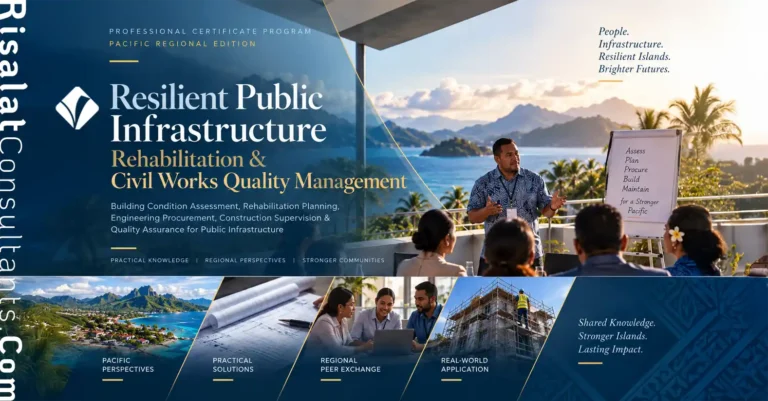
This Public Infrastructure Rehabilitation Training provides a practical framework for building condition assessment, rehabilitation planning, climate-resilient design, engineering procurement, construction supervision and QA/QC.
Public sector agencies and project implementation units face stringent accountability demands when executing complex public works and operational programmes.
Educational facilities in the Pacific region face severe and recurrent threats from tropical cyclones, earthquakes, and sea-level hazards.
Healthcare infrastructure in sub-zero regions faces acute operational stresses that undermine infection prevention and control.
This five-day professional programme addresses the critical operational demands of medium-voltage and low-voltage distribution grid expansion.
Rapid urban growth and intensifying climate variability place immense pressure on municipal drainage networks and catchment infrastructure.
Dam Safety Surveillance and Hydromechanical Asset Management is an intensive five-day programme delivered in Vienna, designed to strengthen the technical oversight of large storage…
Community-driven development approaches place direct control over planning decisions and investment resources in the hands of local communities.
Sub-surface dams and sand storage dams offer resilient, low-maintenance infrastructure for water-scarce drylands and seasonal river basins.
Road authorities across developing economies face critical challenges in reducing road traffic fatalities along regional transport corridors.
Secondary Road Rehabilitation and Climate-Proof Pavement Design is an intensive five-day programme delivered in Tbilisi, Georgia.
Rapid urban expansion across developing municipalities creates extensive impervious surfaces, compounding urban runoff and overwhelming legacy drainage networks.
Hospital infrastructure projects require rigorous engineering governance to guarantee patient safety, hygiene integrity, and structural resilience.
Mountain road networks in rugged terrains face severe vulnerability to rainfall-triggered landslides, surface erosion, and toe slope destabilisation.
Cross-border road transport corridors serve as vital economic lifelines across West Africa, connecting landlocked regions and production centres to international maritime gateways.
Rapid urban growth in West Africa places severe pressure on public health and municipal infrastructure, particularly in informal settlements and peri-urban zones.
Cross-border power transmission infrastructure requires rigorous engineering approaches to ensure system reliability, operational resilience, and cross-jurisdictional compatibility.
Hydropower infrastructure remains central to sustainable energy transitions and water security across developing economies.
Public agencies and project execution units operate under strict governance mandates requiring robust occupational health, safety and environmental controls.
Lowland and coastal transport corridors present critical engineering risks that demand rigorous geotechnical and hydraulic expertise.
Public education authorities across Central Asia face substantial engineering challenges in bringing ageing school infrastructure into alignment with modern safety requirements.
Rapid urban growth across Pacific Island nations has intensified the demand for low-cost residential housing that can withstand severe tropical cyclones and earthquakes.
Primary healthcare infrastructure requires robust engineering oversight to guarantee structural integrity, occupant safety, and functional clinical performance.
Rural piped water supply schemes play a critical role in providing safe, reliable potable water to underserved communities, particularly across complex island topographies.
Coastal settlements face increasing threats from intense tropical cyclones, storm surges, and riverine flooding.
Crisis-Zone Public Works Asset Verification and Field Safety Protocols is an intensive four-day professional training programme delivered in Dakar, Senegal.
Post-conflict urban recovery requires a delicate balance between urgent physical stabilisation and long-term historic conservation.
Island municipal authorities face acute engineering constraints when managing stormwater run-off across flat, porous, and low-elevation coastal zones.
Climate change continues to escalate the frequency and severity of extreme rainfall events across Southeast Asia, placing rural transport networks under unprecedented hydrological stress.…
Mountain highway networks in Central Asia and the South Caucasus face severe geotechnical hazards that disrupt essential transit corridors and community access.
Civil works procurement in small island developing states presents unique operational realities that require specialized regulatory applications.
Municipal engineers and conservation professionals face complex engineering challenges when restoring blast-damaged historic residential fabric.
This four-day professional course addresses the critical interface between rural infrastructure development and smallholder market integration.
Mountainous highway corridors face continuous operational and structural threats from geotechnical hazards, rockfalls, and rainfall-induced slope failures.
This programme gives officials and project teams the practical methods of climate-resilient low-cost housing design and rural reconstruction, built around real cases from public…
Health facility engineering and biomedical asset management are fundamental to clinical safety, operational continuity, and sustainable public expenditure.
Community-driven development programmes place infrastructure planning, execution, and routine management into the hands of local institutions.
Rapid urbanisation and intensifying wet seasons present severe structural challenges to low-lying metropolitan areas across Central and West Africa.
Rural feeder road networks form the backbone of local economies, enabling market access and social mobility across secondary and rural regions.
This four-day intensive programme equips technical professionals with practical skills to procure, contract, and supervise rural health infrastructure works.
Public hospital engineering teams face continuous operational challenges in mitigating pathogen transmission whilst delivering acute clinical services.
As low-lying island states transition towards clean energy, land scarcity severely constrains conventional ground-mounted solar deployment.
Educational infrastructure across hazard-prone regions faces severe risks from high-magnitude earthquakes and extreme wind loads.
School infrastructure plays a fundamental role in safeguarding student safety, fostering learning equity, and supporting educational continuity.
Climate-Resilient Subgrade Engineering and Geohazard Mitigation provides advanced technical methodologies for civil works design engineers and geotechnical specialists operating in harsh continental environments.
High-altitude transport routes face severe environmental pressures, including freeze-thaw cycles, seismic activity, rapid snowmelt, and intense slope instability.
This intensive four-day professional training course equips technical specialists and public officials with essential methodologies for disaster-resilient housing reconstruction and vulnerability assessment.
Rebuilding hospital infrastructure in post-conflict and crisis-affected regions requires rigorous oversight to transform damaged buildings into fully functional clinical environments.
This programme gives officials and project teams the practical methods of runway civil works supervision and airfield pavement quality control, built around real cases…
Coastal regions across South and Southeast Asia face severe exposure to tropical cyclones, monsoon storm surges, and long-term coastal erosion.
Expanding electricity distribution into remote localities demands rigorous civil and electrical engineering discipline.
Rural road networks across Sub-Saharan Africa face severe operational challenges due to intensified precipitation regimes and hydrological extremes.
Ageing water infrastructure and shifting precipitation patterns present severe operational risks to multi-purpose storage assets worldwide.
Rapid peri-urban expansion presents significant engineering challenges for municipal authorities managing informal settlements and unserviced urban fringes.
Healthcare infrastructure across the Pacific requires systematic modernisation to keep pace with evolving clinical demands and environmental regulations.
Hydropower development demands rigorous technical oversight, strict quality control, and systematic risk management across every stage of civil works execution.
Mountain highway corridors across Southeast Asia face severe geotechnical risks, including rainfall-triggered landslides, cut-slope failures, and chronic rockfall.
Try another month or city, or ask us to run this programme on dates that suit you.
Request your datesRisalat has 100 open Construction & Engineering courses in 43 cities (Brisbane, Dubai, Singapore, Casablanca, Dakar and Tbilisi and others), from 4 Jan 2027 to 15 Nov 2027. A typical course lasts 5 days. Fees start at £1,650 per participant.
Subjects covered most often: Infrastructure and urban development, Climate change and environment, Public procurement, Audit and internal control and Disaster risk management.
The courses are written for governments, public agencies, teams running donor-financed projects and companies. Sessions combine short inputs, case studies and group work on participants' own files.
Ranked by how often the subject has run in this field and by registrations.
Risalat also advises institutions on these subjects:
Free tools to prepare before a course:
There are 100 upcoming Construction & Engineering courses in Brisbane, Dubai, Singapore, Casablanca, Dakar and Tbilisi, starting between 4 Jan 2027 and 15 Nov 2027.
Fees for the upcoming courses range from £1,650 to £4,800 per participant. Each programme page shows its own fee. Payment is by invoice and bank transfer.
The next one is Rural Feeder Road Engineering and Low-Volume Sealed Pavement Design in Cape Town, 4-7 Jan 2027 in Cape Town (4 days). Registration closes on 5 Dec 2026.
Upcoming dates are in Brisbane, Dubai, Singapore, Casablanca, Dakar, Tbilisi, Almaty and Istanbul. Teams from any country can join, and the course can also be delivered in your own country or online.
Yes. Any Risalat programme can be delivered in-house for one institution, in your own country or online, on dates that suit your team and adapted to your own documents. Request a proposal.
It depends on your passport: the free Visa Check shows the visa type, processing time and documents for the host country. Registered participants can request an invitation letter: self-funded participants receive it after full payment, sponsored participants on receipt of an official nomination letter and a payment commitment. Embassies can check the letter online.
Yes. Participants receive a Risalat certificate with its own code and QR code, which anyone can check online at risalatconsultants.com/verify.
You qualify for the discount if you register as a group. See the discount plans and cancellation policy.
We tailor any programme to your institution, in-house, online or in a city of your choice, with content built around your projects. Payment is by invoice and bank transfer.
Essential cookies keep this site secure. With your permission we also use analytics and advertising cookies. Cookie policy
Google Analytics counts visits: in the EU, the UK and Switzerland only after you accept, elsewhere unless you reject it. You can change your choice at any time from “Cookie settings” at the bottom of every page.
The Risalat Brief: one short report a week on a real delivery problem in procurement, safeguards, M&E or public finance, its causes and what works. No adverts; unsubscribe any time.
By subscribing you agree to receive our newsletter. Privacy policyMost questions (dates, fees, visas, registration, invoices) are answered fastest in our website chat, which also keeps a record for your team. For anything else, email info@risalatconsultants.com.
Still urgent?
Please do not send documents or payment details by WhatsApp.